
Choosing the right ceiling fan is not simply a matter of picking a style you like and checking whether it fits your budget. The wrong fan can leave you with weak airflow, unnecessary noise, poor energy efficiency, or an installation that does not suit your ceiling.
The good news is that choosing the right ceiling fan becomes much easier when you follow a simple order: measure the room, check the ceiling height, choose the correct fan size, compare airflow, then consider the motor, mounting type, location rating, controls, lighting, and other features.
In this guide, you will learn exactly what to look for when buying a ceiling fan for a bedroom, living room, home office, kitchen, porch, patio, or large open-plan space. You will also learn how to avoid the common mistakes that cause people to buy a fan that looks great but performs poorly.
Quick Answer: How Do You Choose the Right Ceiling Fan?
To choose the right ceiling fan, start with these five questions:
- How large is the room?
- How high is the ceiling?
- How much airflow do you need?
- Where will the fan be installed?
- Which features matter most to you?
For a typical room, a fan around 29–36 inches may suit a space up to 75 square feet, while 50–54 inches is commonly suitable for rooms around 225–400 square feet. ENERGY STAR also recommends mounting a ceiling fan in the middle of the room, at least 7 feet above the floor and at least 18 inches from the walls; when ceiling height permits, positioning the fan 8–9 feet above the floor can improve airflow.
But room size is only the starting point. A 52-inch fan may work very differently in an 8-foot room than it does on a 12-foot ceiling, which is why the rest of this guide matters.
How Does a Ceiling Fan Actually Cool a Room?
A ceiling fan does not work like an air conditioner.
An air conditioner removes heat from indoor air and lowers the room temperature. A ceiling fan mainly moves air across your skin, helping sweat evaporate and making you feel cooler.
That distinction matters when deciding whether you need a fan.
You may feel noticeably more comfortable with a ceiling fan running in a warm room even though the actual room temperature has not dropped. This is one reason ceiling fans can complement air conditioning rather than replace it in every situation. Australian consumer group CHOICE explains the same basic principle: ceiling fans cool people by moving air over the body rather than directly cooling the room itself.
So when shopping, think about air movement and comfort, not just the temperature shown on your thermostat.
1. Measure Your Room Size Before Buying a Ceiling Fan
The first step is simple: measure the room.
For a rectangular room:
Length × Width = Room Area
For example, if your room is 12 feet long and 12 feet wide:
12 × 12 = 144 square feet
For readers who use metric measurements, convert the result into square metres as well.
A room that is 3.6 m × 3.6 m is approximately 13 m².
This measurement gives you a starting point for selecting the fan’s blade span.
What If the Room Is Not Rectangular?
For an L-shaped or unusually shaped room, divide the space into smaller rectangles, calculate each area separately, and then add them together.
For example:
- Section A = 10 × 12 ft = 120 sq ft
- Section B = 6 × 8 ft = 48 sq ft
- Total = 168 sq ft
Do not automatically choose one oversized fan simply because the total area is large. Room shape and airflow distribution also matter.
What About Open-Plan Rooms?
Open-plan spaces are more difficult because a single fan may not distribute air evenly across a long or irregular area.
CHOICE notes that long, rectangular open areas may benefit from multiple fans because multiple smaller air sources can provide more consistent airflow throughout the space.
2. Choose the Right Ceiling Fan Size for Your Room
Fan size is one of the most important buying decisions.
ENERGY STAR’s current sizing guidance suggests the following starting points:
| Room Size | Suggested Fan Size |
|---|---|
| Up to 75 sq ft | 29–36 inches |
| 76–144 sq ft | 36–42 inches |
| 144–225 sq ft | About 44 inches |
| 225–400 sq ft | 50–54 inches |
These are useful starting guidelines rather than absolute rules.
A room’s layout, ceiling height, fan design, airflow rating, and desired air movement can all affect the final choice.
What Size Ceiling Fan for a 10×10 Room?
A 10×10 room is 100 square feet.
A fan in the 36–42-inch range can be a sensible starting point, but check the manufacturer’s room-size recommendation and airflow rating before buying.
What Size Ceiling Fan for a 12×12 Room?
A 12×12 room is 144 square feet.
A 42-inch fan is within the common sizing range, while a 44-inch model can also make sense depending on the room and the manufacturer’s specifications.
What Size Ceiling Fan for a 15×20 Room?
A 15×20 room is 300 square feet.
A 50–54-inch fan is a reasonable starting point under ENERGY STAR’s general sizing guidance. For a room with a long layout, furniture that blocks airflow, or unusually high ceilings, the best solution may be a different configuration or even multiple fans.
Should a Large Room Have Two Ceiling Fans?
Sometimes, yes.
Two appropriately sized fans can be more effective in a long or divided room than one very large fan placed in the wrong location.
The key is airflow coverage, not simply choosing the biggest available fan.
3. Check Your Ceiling Height Before Choosing a Fan
A fan that is perfect for a standard ceiling may be a poor choice for a low or very high ceiling.
ENERGY STAR recommends that ceiling fans be installed at least 7 feet above the floor, with 8–9 feet being a useful target when the ceiling allows it.
Best Ceiling Fan for an 8-Foot Ceiling
For an 8-foot ceiling, a low-profile, flush-mount, or hugger-style fan may be the better choice.
You want the blades to remain at a safe and useful height while still producing airflow where people can feel it.
Always check the manufacturer’s installation dimensions because the total hanging height differs from model to model.
Best Ceiling Fan for a 9-Foot Ceiling
A 9-foot ceiling gives you more flexibility.
A standard-mount fan can often work well, while a small downrod may help position the fan at an effective height.
Best Ceiling Fan for a 10-Foot Ceiling
A standard mount with an appropriate downrod is often a good fit.
The goal is not to hang the fan as high as possible. The goal is to position the blades where they can move air effectively without creating a clearance problem.
What About Very High or Vaulted Ceilings?
High ceilings usually call for a longer downrod.
For vaulted or sloped ceilings, you may also need an angled-ceiling adapter designed for the fan.
Do not improvise the mounting hardware. Use components approved or specified by the fan manufacturer.
4. Choose the Right Mounting Type
Once you know your ceiling height, decide how the fan should be mounted.
Flush-Mount and Low-Profile Fans
These fans sit close to the ceiling and are commonly used where ceiling height is limited.
They can be a practical choice for bedrooms and smaller rooms with low ceilings.
Hugger Ceiling Fans
“Hugger” is commonly used for low-mounted fans. ENERGY STAR defines a hugger fan as one where the lowest point of the blades is 10 inches or less from the ceiling.
Do not assume a hugger fan is automatically best simply because it is low profile. Check the actual airflow and dimensions of the model you are considering.
Downrod-Mount Fans
A downrod creates additional space between the ceiling and the fan.
This is particularly useful for taller ceilings because it can place the fan closer to the 8–9-foot zone recommended for good airflow.
Angled or Sloped Ceiling Mount
A sloped ceiling may require special hardware.
Before buying, confirm that the fan can be installed on the angle of your ceiling and that the required mounting kit is compatible with that model.
5. How to Choose the Right Downrod Length
Downrod length is one of the easiest things to overlook.
A downrod that is too short can leave the fan too close to a tall ceiling. One that is too long can place the fan unnecessarily low.
The ideal length depends on your ceiling height, the fan’s dimensions, and the manufacturer’s mounting recommendations.
ENERGY STAR notes that standard mounts often include a short downrod, while extended mounts can be used to position the fan at an effective height on taller ceilings.
Before ordering an extension rod, check:
- Ceiling height
- Fan height
- Desired blade height
- Sloped-ceiling angle
- Manufacturer compatibility
Never assume that a random downrod will fit every ceiling fan.
6. Check Ceiling Fan Clearance and Placement
Fan placement matters almost as much as fan size.
ENERGY STAR recommends installing the fan in the middle of the room and at least 18 inches from the walls, while keeping the fan at least 7 feet above the floor.
Where Should a Ceiling Fan Be Placed?
For a typical rectangular room, the center of the occupied area is often the best starting point.
But “center of the room” does not always mean the exact geometric center.
For example, if a large part of the room is unused because of built-in cabinets or a dining table occupies one side, the most useful location may be centered over the main living area.
How Far Should a Ceiling Fan Be From a Wall?
A practical starting guideline is at least 18 inches from the wall.
Also consider cabinets, tall furniture, light fixtures, beams, and other obstructions.
Ceiling Fan Placement Over a Bed
A fan above the bed can provide direct personal airflow, which many people find comfortable for sleeping.
However, make sure the fan is installed safely and that its mounting position complies with the manufacturer’s instructions and local electrical requirements.
Ceiling Fan Placement Over a Dining Table
For a dining area, center the fan relative to the table or occupied zone rather than simply using the room’s architectural center.
Ceiling Fan Placement in an Open-Plan Room
For open-plan spaces, think about airflow coverage rather than symmetry.
A single fan may not adequately serve a living area, dining area, and kitchen if the space is especially long.
7. Understand CFM Before Buying
CFM stands for cubic feet per minute.
It describes the amount of air a fan moves at a particular speed.
A higher CFM can mean stronger airflow, but CFM should never be the only number you compare.
ENERGY STAR defines airflow in CFM and also measures fan efficiency in CFM per watt.
What Is a Good CFM for a Ceiling Fan?
There is no single CFM number that is best for every room.
A small bedroom and a large open living room have different airflow requirements.
Instead of asking:
“What is the highest CFM fan I can buy?”
ask:
“Which fan provides enough airflow for my room while matching my comfort and noise preferences?”
Is Higher CFM Always Better?
No.
A very high-airflow fan may feel uncomfortable in a small bedroom, especially if you prefer gentle airflow while sleeping.
A lower-output fan may also disappoint in a large living room.
The best result comes from matching fan size, CFM, room size, ceiling height, and how you use the space.
What Is CFM per Watt?
CFM/W means cubic feet per minute per watt.
It shows how much airflow a fan produces for the electricity it uses.
In general, a higher CFM/W value indicates better airflow efficiency.
ENERGY STAR defines ceiling fan efficiency using CFM per watt, making it a useful metric when comparing models.
How to Compare Two Ceiling Fans
Imagine two fans:
Fan A: 6,000 CFM at 70 watts
Fan B: 5,500 CFM at 50 watts
Fan A produces more airflow, but Fan B may provide better airflow efficiency.
That does not automatically make Fan B the better choice. You still need to consider room size, comfort, noise, design, price, controls, and installation.
8. AC vs DC Ceiling Fans: Which Should You Choose?
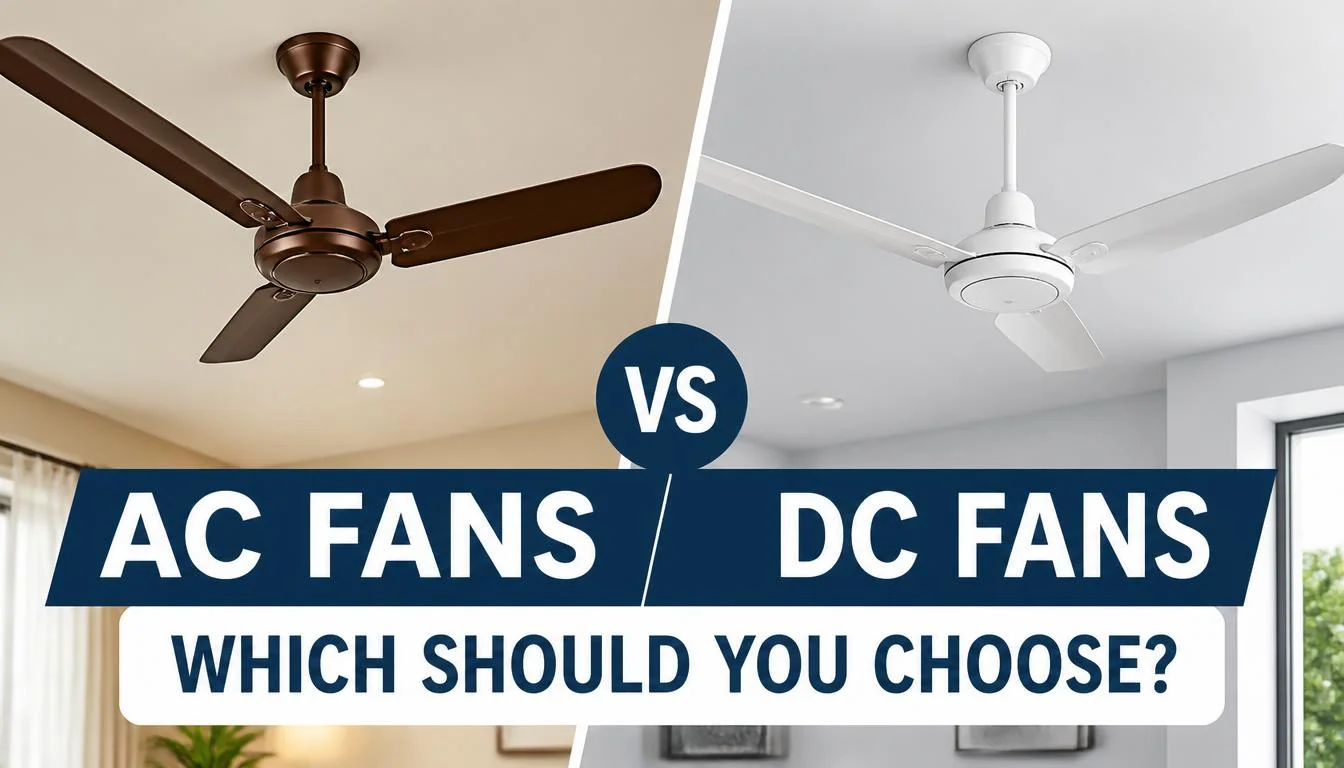
Motor type can affect the fan’s controls, efficiency, noise characteristics, and price.
AC Ceiling Fans
AC-motor fans are widely available and can be a cost-effective option.
They are often a good choice when your priorities are straightforward operation, familiar controls, and a lower purchase price.
DC Ceiling Fans
DC-motor fans are popular when buyers want precise speed control, quiet operation, and energy-conscious performance.
Many DC fans offer multiple speed settings and modern remote-control features.
However, don’t choose a fan solely because the box says “DC.”
Compare the actual airflow, wattage, noise, warranty, and available features.
9. Choose the Right Blade Design
A fan’s blade design affects its appearance and performance.
Does Blade Span Matter?
Yes.
Blade span is the diameter of the circular area covered by the blades.
Larger rooms generally require larger fan spans, but blade span must be matched to airflow and ceiling clearance.
What Is Ceiling Fan Blade Pitch?
Blade pitch is the angle at which the blades are positioned.
A larger pitch can contribute to greater airflow, but blade pitch alone does not tell you how well the fan will perform.
ENERGY STAR specifically notes that motor design, speed, blade length, blade material, number of blades, and blade design all contribute to airflow. It also warns that a higher pitch is not automatically better.
Is a 3-Blade or 5-Blade Ceiling Fan Better?
There is no universal winner.
A three-blade fan can offer strong airflow and a streamlined appearance. A five-blade fan may appeal to buyers who want a different look or a particular airflow characteristic.
Instead of counting blades, compare the fan’s actual performance specifications.
Does Blade Material Matter?
Yes, particularly in outdoor environments.
Moisture-resistant materials and appropriate finishes can help prevent problems such as warping, bubbling, or peeling. ENERGY STAR also notes that changing a fan’s blade style can affect performance.
10. Choose the Correct Ceiling Fan Rating for Indoor or Outdoor Use
One of the most important mistakes to avoid is installing an indoor-rated fan in an unsuitable outdoor location.
The broad categories you will commonly see are dry-rated, damp-rated, and wet-rated.
What Is a Dry-Rated Ceiling Fan?
Dry-rated fans are intended for locations that are not normally exposed to moisture.
They are commonly used in bedrooms, living rooms, offices, and other indoor spaces.
What Is a Damp-Rated Ceiling Fan?
Damp-rated fans are designed for humid or moisture-prone areas where direct exposure to water is limited.
A covered porch or screened patio is a common example. Hunter describes damp-rated fans as suitable for covered outdoor spaces that can be humid but are not directly exposed to water.
What Is a Wet-Rated Ceiling Fan?
Wet-rated fans are intended for locations with direct exposure to water or outdoor weather.
A wet-rated product is the appropriate category to consider when a location is exposed to rain, but always check the individual product’s certification and installation instructions.
Hunter’s current outdoor range distinguishes covered damp locations from uncovered wet locations.
Can You Use an Indoor Ceiling Fan on a Porch?
Do not assume that a porch is automatically safe for an indoor fan.
Even a covered porch can experience humidity and moisture. Choose a fan with the rating appropriate for the actual installation environment.
11. How to Choose a Quiet Ceiling Fan for a Bedroom
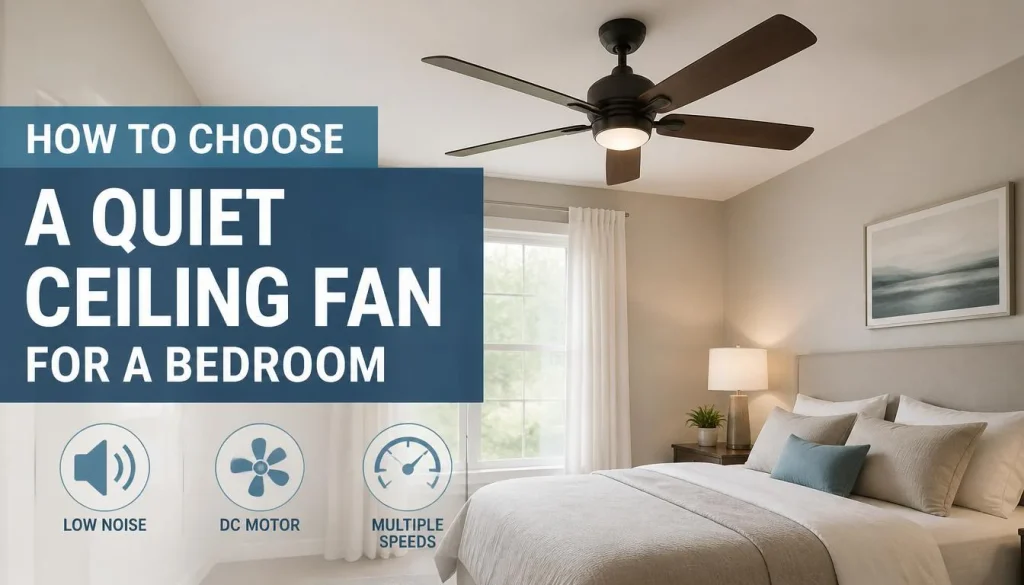
Noise becomes much more important in a bedroom than in a garage or busy living area.
A fan can create unwanted noise because of the motor, loose hardware, blade imbalance, mounting issues, or vibration.
What Causes a Ceiling Fan to Make Noise?
Common possibilities include:
- Loose screws or mounting hardware
- Unbalanced blades
- Motor noise
- Worn components
- Poor installation
- A ceiling structure that allows excessive vibration
ENERGY STAR notes that features such as precision bearings, heavy-duty windings, shock-absorbing components, and stronger housing can contribute to quieter, more stable operation.
How to Choose a Bedroom Fan
Look for a fan that offers:
- Multiple speed settings
- A low-speed option
- Balanced blades
- A motor designed for quiet operation
- A reliable mounting system
- A remote control if you want to adjust the fan without getting out of bed
12. How to Choose an Energy-Efficient Ceiling Fan
If your fan will run for hours every day, efficiency deserves serious attention.
ENERGY STAR says certified ceiling fans can be significantly more efficient than conventional models and uses airflow-per-watt performance as part of its efficiency criteria.
Look at CFM/W, Not Just Wattage
A low-wattage fan is not automatically the most efficient fan.
A better comparison is how much airflow the fan produces for the electricity it consumes.
For example, if one model delivers strong airflow at modest power consumption, it may provide better real-world efficiency than a fan that uses less electricity but moves considerably less air.
How Many Watts Does a Ceiling Fan Use?
There is no single wattage for all ceiling fans.
Power consumption depends on the motor, speed setting, fan size, controls, and other components.
ENERGY STAR product data includes low-speed, high-speed, and standby power information for certified fans, allowing buyers to compare actual consumption rather than relying on generic estimates.
How Much Does It Cost to Run a Ceiling Fan?
You can estimate the cost with this formula:
Cost = Power in kW × Hours Used × Electricity Rate
For example, a 60-watt fan uses 0.06 kW.
If it runs for 8 hours:
0.06 × 8 = 0.48 kWh per day
Multiply that by your local electricity price to estimate your daily operating cost.
Your actual cost depends on your electricity rate, the fan’s real power consumption, and the speed at which you operate it.
13. Should You Buy a Ceiling Fan With a Light?
A ceiling fan with a light can be a practical choice when you want one fixture to handle both airflow and room lighting.
Ceiling Fan With Light
This can work well in:
- Bedrooms
- Dining rooms
- Home offices
- Living rooms
- Smaller multipurpose rooms
Ceiling Fan Without Light
A fan without an integrated light may be better when the room already has excellent lighting or when you prefer separate control over the ceiling light.
Is an Integrated LED Light Worth It?
It can be useful because it reduces the need for a separate light fixture, but compare brightness, color temperature, dimming capability, replacement options, and warranty.
Do not buy a fan with a light simply because it seems like more features. Buy it because you actually need the lighting.
14. Choose the Right Ceiling Fan Controls
Modern ceiling fans can be controlled in several ways.
Remote Control
Great for bedrooms, living rooms, and rooms where the fan is mounted high.
Wall Control
Useful when you want a fixed, convenient control point.
Pull Chain
Simple and familiar, especially for basic fan installations.
Smart Ceiling Fan
Smart models may offer app control, schedules, voice assistants, and automation.
Before buying one, check whether it works with your preferred ecosystem and whether you can still control the fan manually if the internet or app is unavailable.
Alexa or Google Home Compatibility
Smart-home compatibility can be useful, but do not assume every “smart” fan works with every platform.
Check the exact compatibility listed by the manufacturer.
15. Do You Need a Reversible Ceiling Fan?
A reversible fan can be useful throughout the year.
ENERGY STAR notes that residential ceiling fans commonly include the ability to reverse motor and airflow direction, allowing year-round use.
Which Way Should a Ceiling Fan Turn in Summer?
In many standard installations, the goal is downward airflow that creates a cooling breeze at the occupied level.
The exact switch position or direction depends on the fan, so follow the manufacturer’s instructions.
Which Way Should a Ceiling Fan Turn in Winter?
In cooler weather, many reversible fans can be set to move air upward and help redistribute warm air that collects near the ceiling.
The fan should generally be used at a lower speed for this purpose.
Remember that the fan is redistributing air rather than creating heat.
16. Choose the Right Ceiling Fan for Each Room
The best ceiling fan is the one that matches the room’s size, ceiling, moisture level, noise needs, and how people use the space.
Best Ceiling Fan for a Bedroom
Prioritize:
- Quiet operation
- Gentle low-speed airflow
- Remote control
- Suitable size
- Reversible operation
- Optional dimmable light
Best Ceiling Fan for a Living Room
Look for:
- Strong airflow
- Proper blade span
- Multiple speed settings
- A design that fits the room
- Remote or wall control
Best Ceiling Fan for a Kitchen
Consider:
- Proper room size
- Easy-to-clean blades
- Adequate airflow
- Lighting if required
- A location that does not interfere with cabinets or fixtures
Best Ceiling Fan for a Dining Room
Choose the fan based on the table and occupied area rather than style alone.
Make sure the fan has enough clearance from pendant lights, walls, and furniture.
Best Ceiling Fan for a Home Office
A quiet motor and moderate airflow are usually more important than maximum power.
You want to stay comfortable without creating distracting noise.
Best Ceiling Fan for a Bathroom
Humidity changes the requirements.
Use only a fan specifically approved for the bathroom environment and follow all electrical installation requirements. Never assume a regular indoor fan is suitable simply because it is mounted away from the shower.
Best Ceiling Fan for a Covered Porch
A damp-rated outdoor fan is commonly the appropriate category for a covered porch that is protected from direct rain. Always confirm the exact rating of the model.
Best Ceiling Fan for an Open Patio
For areas exposed directly to rain or weather, look for a product specifically rated for wet locations or the exposure level stated by the manufacturer.
17. What to Check Before Buying a Ceiling Fan

Before clicking “Buy Now,” spend a few minutes checking the specifications.
Check the Warranty
Look separately at:
- Motor warranty
- Fan component warranty
- Light-kit warranty
- Electronics or control warranty
Warranty length can vary significantly between brands and components. ENERGY STAR product data, for example, records warranty information separately for components and light kits.
Check Replacement Parts
Ask whether replacement blades, remotes, receivers, light components, and mounting hardware are available.
A good fan is more useful when individual parts can be replaced instead of replacing the entire unit.
Check Motor Quality
Look beyond marketing terms.
Compare published airflow, power consumption, speed settings, warranty, and manufacturer support.
Check Installation Requirements
Make sure you understand:
- Fan-rated electrical box requirements
- Mounting hardware
- Downrod compatibility
- Sloped-ceiling requirements
- Wiring requirements
Do not assume an existing light-fixture box is automatically suitable for a ceiling fan.
When Should You Hire an Electrician?
Consider hiring a qualified electrician when:
- New wiring is required
- The existing electrical box is not fan-rated
- The ceiling structure needs reinforcement
- The installation involves unusual wiring
- The fan is being installed on a difficult or high ceiling
- Local electrical rules require professional installation
Always follow your local electrical code and the manufacturer’s installation instructions.
18. Common Ceiling Fan Buying Mistakes to Avoid
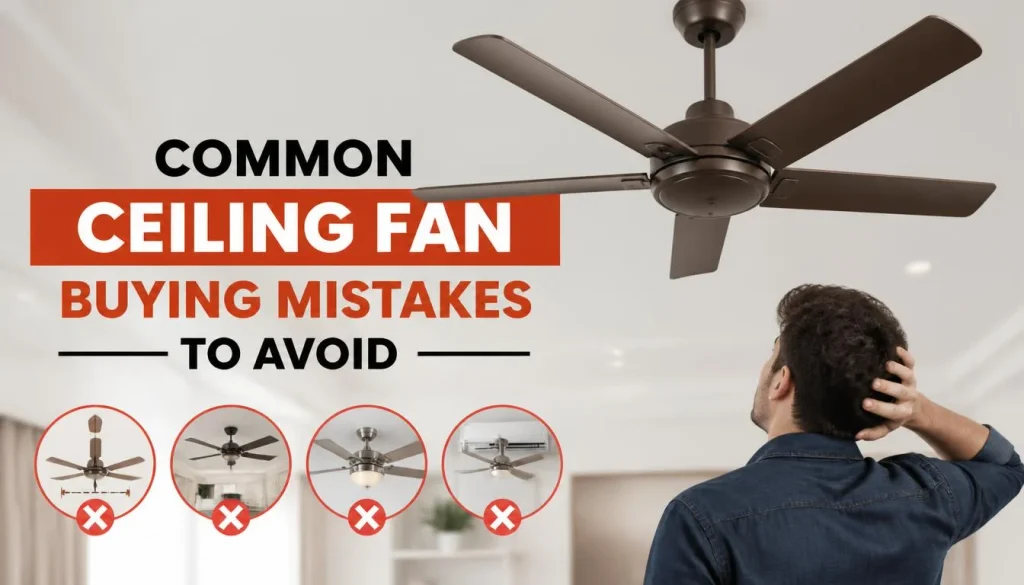
A lot of disappointing purchases come from a few simple mistakes.
Buying the Wrong Fan Size
A fan that is too small may struggle to provide useful airflow. An oversized fan can produce uncomfortable airflow in a small room and may look out of proportion.
Ignoring CFM
Two fans with the same blade span can have very different airflow performance.
Always compare the specifications.
Choosing a Fan Only for Its Appearance
A beautiful fan is still a bad purchase if it cannot move enough air for the room.
Style should come after performance and fit.
Ignoring Ceiling Height
A fan that works beautifully on a 9-foot ceiling may be a poor match for an 8-foot ceiling.
Choosing the Wrong Outdoor Rating
Do not install an indoor-only fan in a humid or outdoor location simply because the area is covered.
Choosing the Highest CFM Available
More airflow is not always better.
Your bedroom and your large living room do not need the same airflow experience.
Forgetting About Wall Clearance
Even a correctly sized fan can be poorly positioned.
Plan the location before installation.
Not Checking the Downrod
Tall ceilings often need an appropriate extension. Buying the fan first and thinking about the downrod later can create unnecessary hassle.
Ignoring Noise
A fan that sounds fine in a showroom may become annoying after running for hours in a bedroom.
Ceiling Fan Buying Checklist
Use this checklist before making your final decision:
☐ I measured the room length and width
☐ I calculated the room area
☐ I checked the ceiling height
☐ I selected an appropriate blade span
☐ I compared CFM
☐ I checked CFM/W or efficiency information
☐ I selected the correct mounting type
☐ I checked downrod requirements
☐ I planned the fan position and wall clearance
☐ I checked dry, damp, or wet location rating
☐ I considered noise level
☐ I compared AC and DC motor options
☐ I decided whether I need a light
☐ I selected the right control type
☐ I checked reverse-direction capability
☐ I reviewed the warranty
☐ I checked installation requirements
☐ I confirmed replacement-part availability
Frequently Asked Questions
How do I know what size ceiling fan I need?
Start with the room’s square footage, then compare the result with the manufacturer’s sizing guide. As a general ENERGY STAR starting point, rooms up to 75 sq ft may suit 29–36-inch fans, while 225–400 sq ft rooms commonly suit 50–54-inch fans.
Is a 52-inch ceiling fan good for a 12×12 room?
A 12×12 room is 144 square feet, so a 52-inch fan may be larger than the basic ENERGY STAR sizing recommendation for that room. However, the final decision should also consider the specific fan’s airflow, ceiling height, layout, and manufacturer’s recommendations.
What CFM should a ceiling fan have?
There is no single ideal CFM for every room. Choose airflow based on the room’s size and your preferred comfort level, then compare efficiency as well as maximum airflow.
Is a 3-blade or 5-blade ceiling fan better?
Neither is automatically better. Blade count is only one part of a fan’s design. Motor performance, blade pitch, blade length, material, and design also affect airflow.
Are DC ceiling fans better than AC fans?
DC fans can offer useful advantages such as multiple speed settings and efficient operation, but “better” depends on your priorities. Compare real specifications instead of choosing solely based on motor type.
What ceiling fan is best for an 8-foot ceiling?
A low-profile or hugger-style fan is often a practical choice for a low ceiling, but always check the complete installed height of the specific model.
Do I need a downrod for a 9-foot ceiling?
Not necessarily. A standard mount may work, depending on the fan’s design and the desired blade height. Check the manufacturer’s recommended mounting configuration.
What size ceiling fan is best for a large living room?
For a 225–400 square-foot room, ENERGY STAR’s general guidance points to 50–54 inches. Larger or unusually shaped spaces may require a different solution or multiple fans.
Can I install a ceiling fan on a sloped ceiling?
Many fans can be installed on sloped ceilings with the appropriate adapter or mounting system. Check the manufacturer’s specifications before purchasing.
Can I use an indoor ceiling fan on a porch?
Only when the fan is specifically rated for that environment. A covered porch often calls for a damp-rated model, while exposed locations may require a wet-rated fan.
Should a bedroom ceiling fan have a light?
It depends on the room. A fan with a light can save space and combine two functions, while a fan without a light may be better when the room already has a suitable lighting system.
Final Decision: How to Choose the Right Ceiling Fan
Choosing the right ceiling fan becomes much easier when you stop treating it as a simple style purchase.
Start with the room size. Then check the ceiling height and choose the appropriate blade span and mounting type. After that, compare airflow and efficiency instead of looking only at the fan’s appearance.
From there, consider the practical details that are easy to overlook: wall clearance, downrod length, noise, motor type, indoor or outdoor rating, lighting, controls, reverse operation, warranty, and installation requirements.
The best ceiling fan is not necessarily the largest, fastest, most expensive, or most stylish model.
It is the fan that fits your room, your ceiling, your airflow needs, and the way you actually use the space.
That is the approach that will help you buy once, stay comfortable, and avoid the most common ceiling fan mistakes.

“The right fan can make a bigger difference than you think.”
Hi, I’m Michael Turner, an author and home appliance researcher at BestFanSolve.com.
My interest in fans started with a simple question: How do you know which fan is actually right for your needs? With so many types, features, brands, and technical specifications available, choosing a fan can quickly become confusing. I created BestFanSolve.com to make that process easier.
Through this website, I share practical fan reviews, buying guides, comparisons, troubleshooting tips, maintenance advice, and solutions to common fan problems. I focus on turning complicated product information into clear, useful guidance that everyday readers can actually understand and use.
Whether you’re searching for a quiet bedroom fan, a powerful fan for a large room, an energy-efficient option, or simply trying to figure out why your current fan isn’t working properly, my goal is to help you find the information you need before making a decision.
I believe good recommendations should be based on research, real-world considerations, honest pros and cons, and the specific needs of the user—not simply marketing claims.
Through BestFanSolve.com, I’m committed to helping readers find the right fan, solve common fan problems, and make smarter purchasing decisions with confidence.
— Michael Turner
Author & Home Appliance Researcher
BestFanSolve.com