

Choosing the right ceiling fan size can make a noticeable difference in how comfortable your room feels. A fan that is too small may struggle to circulate air across the space, while an oversized fan can create more airflow than you actually need. Getting the size right also helps you plan the installation and choose a fan that fits your room properly.
So, what size ceiling fan do you need?
For most rooms, the best starting point is the room’s floor area. Small rooms generally need a ceiling fan with a blade span of around 29–36 inches, medium-sized rooms often suit 36–44-inch fans, and larger living spaces may need a 50–54-inch fan or something larger. Ceiling height, airflow performance, room layout, and blade clearance also matter.
This guide explains how to measure your room, use a ceiling fan size chart, compare common fan sizes, and choose the right model for your home. Whether you’re shopping in the USA, UK, Canada, or Australia, you’ll find measurements in both imperial and metric units.
Ceiling Fan Size Chart by Room Size
The easiest way to choose a ceiling fan is to calculate your room’s floor area and compare it with a recommended blade span.
The following chart uses the general sizing guidance published by ENERGY STAR’s ceiling fan guide. Treat these figures as starting points rather than fixed rules, because individual manufacturers may recommend different sizes for particular models.
| Room Area | Approximate Area in Square Metres | Suggested Blade Span |
|---|---|---|
| Up to 75 sq. ft. | Up to 7 m² | 29–36 inches (74–91 cm) |
| 76–144 sq. ft. | 7.1–13.4 m² | 36–42 inches (91–107 cm) |
| 145–225 sq. ft. | 13.5–20.9 m² | Around 44 inches (112 cm) |
| 226–400 sq. ft. | 21–37.2 m² | 50–54 inches (127–137 cm) |
| Over 400 sq. ft. | Over 37.2 m² | 56 inches (142 cm) or larger; consider multiple fans |
A square room is usually easier to size than a long, narrow room. In an open-plan living area, you may need more than one fan to distribute air evenly.
Also, don’t assume that two fans with the same blade span will perform identically. Motor design, blade shape, speed settings, and airflow ratings can affect how much air a fan actually moves.
What Is Ceiling Fan Blade Span?
Blade span is the diameter of the circular area covered by the fan blades as they rotate. It is measured from the tip of one blade to the tip of the opposite blade on a typical fan.
For example, a ceiling fan advertised as 52 inches has a blade span of approximately 52 inches, or 132 centimetres.
Blade span is not the same as the length of an individual blade. A fan with a longer-looking blade does not necessarily have the same overall diameter as another fan with a different design.
When comparing products, look for the manufacturer’s stated blade span rather than estimating the size from product photos.
How to Calculate the Right Ceiling Fan Size
You don’t need special equipment to measure your room. A tape measure and a calculator are enough to get started.
Step 1: Measure the Room
Measure the length and width of the room from wall to wall.
For a rectangular room, use this formula:
Room Area = Length × Width
If your room is 12 feet long and 12 feet wide:
12 × 12 = 144 square feet
For a room measured in metres, the process is exactly the same.
For example, a room measuring 3.6 metres × 3.6 metres has a floor area of 12.96 square metres.
Step 2: Compare the Area with the Size Chart
Once you have your room’s area, find the corresponding range in the chart above.
A 120-square-foot bedroom, for example, falls within the 76–144-square-foot range. A fan with a 36–42-inch blade span is a sensible starting point.
Before buying, check the recommended room size and airflow specifications of the particular fan you’re considering.
Step 3: Check the Ceiling Height
Room area alone doesn’t tell you how the fan should be mounted.
A room with an 8-foot ceiling may need a low-profile fan, while a room with a 12-foot ceiling may require a downrod to position the blades at a suitable height.
Measure the ceiling from the finished floor to the ceiling surface. Include any sloping sections or obstacles that could affect installation.
Step 4: Consider the Room Layout
A 300-square-foot square room and a 300-square-foot narrow room have the same floor area, but air may not circulate equally well in both.
In a long room, you may get better coverage with two appropriately positioned fans rather than one large fan in the centre.
For more detailed measuring instructions, Hunter Fan’s ceiling fan measurement guide explains how to calculate room area, measure blade span, and account for ceiling height.
What Size Ceiling Fan Do I Need for Common Room Dimensions?

Sometimes it’s easier to work with familiar room dimensions than to calculate the area yourself. Here are a few examples to help you narrow down your options.
| Room Dimensions | Floor Area | Suggested Starting Size |
|---|---|---|
| 8 × 10 ft | 80 sq. ft. | 36–42 inches |
| 10 × 10 ft | 100 sq. ft. | 36–42 inches |
| 10 × 12 ft | 120 sq. ft. | 36–42 inches |
| 12 × 12 ft | 144 sq. ft. | 36–42 inches |
| 12 × 14 ft | 168 sq. ft. | Around 44 inches |
| 15 × 15 ft | 225 sq. ft. | Around 44 inches |
| 15 × 20 ft | 300 sq. ft. | 50–54 inches |
| 20 × 20 ft | 400 sq. ft. | 50–54 inches |
These recommendations are starting points based on common sizing guidance. Ceiling height, room shape, furniture placement, and the manufacturer’s specifications can change the final choice.
What Size Ceiling Fan Do I Need for a 10 × 10 Room?
A 10 × 10-foot room has an area of 100 square feet.
A 36–42-inch ceiling fan is a reasonable starting point for this space. If you’re choosing a bedroom fan, pay attention to its low-speed performance as well as its maximum airflow.
A fan with several speed settings can make it easier to maintain comfortable airflow while sleeping.
What Size Ceiling Fan Do I Need for a 10 × 12 Room?
A 10 × 12-foot room has an area of 120 square feet.
A 36–42-inch fan is a sensible starting point. For a bedroom or home office, consider how the fan will operate at lower speeds, particularly if you prefer a gentle breeze.
Also, check the mounting height to make sure that the fan fits safely under your ceiling.
What Size Ceiling Fan Do I Need for a 12 × 12 Room?
A 12 × 12-foot room measures 144 square feet.
A 42-inch fan is a common option for this room size, although a nearby size may also be appropriate depending on the model and its airflow specifications.
Don’t choose a 52-inch fan simply because it is widely available. Compare the manufacturer’s room-size recommendation and make sure the fan can be installed with sufficient clearance.
What Size Ceiling Fan Do I Need for a 15 × 20 Room?
A 15 × 20-foot room has an area of 300 square feet.
A fan with a 50–54-inch blade span is a reasonable starting point. If the room is long or divided into separate seating areas, consider whether two fans would distribute air more evenly.
The goal is to create comfortable airflow throughout the occupied space, not simply to install the largest fan that fits.
What Size Ceiling Fan Do I Need for Each Room?
Different rooms have different needs. A bedroom may need quiet operation at low speed, while a large living room may require broader airflow coverage.
Ceiling Fan Size for a Bedroom
For a small bedroom, start by checking the room’s floor area against the sizing chart. A fan around 36–42 inches may suit many smaller bedrooms, while larger bedrooms often need a wider blade span.
Think about your sleeping habits, too.
If you prefer gentle airflow at night, look for a fan with several speed settings and a comfortable low-speed setting. A fan that moves plenty of air at maximum speed may not be the best option if you find strong airflow distracting while sleeping.
Ceiling Fan Size for a Living Room
Living rooms often have more furniture and a larger occupied area than bedrooms.
For a living room measuring 226–400 square feet, a 50–54-inch fan is a useful starting point. Larger or open-plan spaces may benefit from a fan with a 56-inch or greater blade span, or from multiple fans.
Before deciding, consider where people spend most of their time. A fan positioned over the main seating area may be more useful than one placed in the geometric centre of an irregular room.
Ceiling Fan Size for a Kitchen
The right size for a kitchen depends on its floor area and layout.
A compact kitchen may suit a smaller fan, while a large kitchen with a dining area may need more airflow coverage. Make sure the fan can be installed safely around cabinets, tall appliances, and lighting fixtures.
If the area is exposed to grease, steam, or significant moisture, follow the manufacturer’s guidance on suitable locations and maintenance.
Ceiling Fan Size for a Home Office
In a small office, a 29–36-inch fan may be suitable for rooms up to 75 square feet.
For a larger office, use the room-size chart as your starting point. Then consider whether the fan will create uncomfortable airflow around your desk, papers, monitors, or other equipment.
Adjustable speeds can be useful when you spend long periods working in the same position.
Ceiling Fan Size for a Garage
Garage spaces vary considerably, so measure the usable area rather than choosing a fan based on its appearance.
A small single-car garage may need a different size from a larger double-car garage or workshop. Consider ceiling height, lighting, storage racks, garage doors, and the location of any equipment.
Choose a fan suitable for the environment, especially if the space is dusty, humid, or exposed to outdoor air. Make sure the mounting arrangement is designed to support a ceiling fan safely.
Ceiling Fan Size for a Covered Patio
For a covered patio, begin with the floor area and expected airflow coverage.
A fan with a suitable outdoor rating is essential. A damp-rated model may be appropriate for certain protected, humid locations, while an area exposed to direct rain generally calls for a wet-rated fan.
Always check the exact product rating and installation instructions before buying. A covered outdoor space is not automatically suitable for an indoor-only fan.
42-Inch vs. 48-Inch vs. 52-Inch Ceiling Fan: Which Is Better?
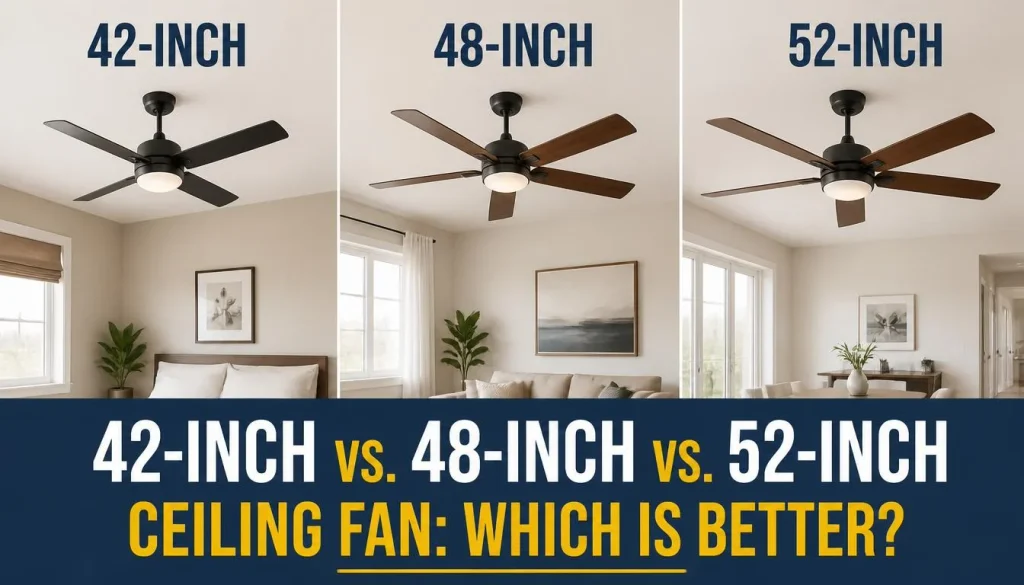
If you’re choosing between common ceiling fan sizes, the difference is not just visual. Blade span affects the size of the area covered by the rotating blades, while actual airflow also depends on the motor and blade design.
42-Inch Ceiling Fan
A 42-inch fan is a common option for smaller bedrooms, home offices, and similar spaces.
It can be a sensible choice when a larger fan would dominate a compact room or leave insufficient clearance around walls and furniture.
48-Inch Ceiling Fan
A 48-inch fan sits between the smaller and larger options.
It may suit a medium-sized room where a 42-inch fan seems undersized but a 52-inch model is not the best fit. Check the manufacturer’s room-size guidance and actual airflow rating before deciding.
52-Inch Ceiling Fan
A 52-inch fan is a popular choice for many bedrooms, living rooms, and medium-sized spaces.
However, popularity does not make it the right size for every room. A 52-inch model can be suitable in one space and inappropriate in another, depending on the room’s dimensions, ceiling height, and installation constraints.
Which size should you choose?
For a smaller room, compare 42- and 48-inch models first. For a medium-sized room, compare 48- and 52-inch options. Always use room measurements and product specifications to make the final decision.
How Much CFM Do You Need for a Ceiling Fan?
Room area helps you select a likely blade span, but it doesn’t tell you everything about airflow.
CFM stands for cubic feet per minute. It measures the volume of air a fan moves under specified operating conditions.
A fan with a larger blade span may move more air than a smaller fan, but blade design, motor performance, fan speed, and mounting height also affect the result.
What Is a Good CFM Rating for a Ceiling Fan?
There isn’t one CFM figure that works for every room.
A compact bedroom where you prefer gentle airflow has different requirements from a large living room where several people regularly gather.
Instead of choosing the fan with the highest advertised CFM, consider how much airflow you need at the speeds you expect to use most often.
Check the manufacturer’s published performance data and compare models under comparable conditions.
What Is CFM per Watt?
CFM per watt, written as CFM/W, measures airflow efficiency. It tells you how much air a fan moves for the electricity it consumes.
For example, one fan might produce greater maximum airflow, while another delivers better airflow efficiency at a particular operating speed.
Neither figure alone determines which fan is best for your home. Consider the combination of airflow, power consumption, speed settings, noise, room dimensions, and installation requirements.
You can find more information about airflow and efficiency in ENERGY STAR’s ceiling fan product criteria.
How Does Ceiling Height Affect Ceiling Fan Size?
A room’s ceiling height affects how the fan should be mounted and how much clearance is available.
The objective is to position the blades at a suitable height while allowing enough space between the fan, the floor, the ceiling, and surrounding objects.
Best Ceiling Fan for an 8-Foot Ceiling
An 8-foot ceiling leaves limited room for a hanging fixture.
A low-profile or flush-mount fan is often a practical option, provided the blades can be installed at a safe height and the model is designed for that mounting arrangement.
Check the complete installed height, including any integrated light fixture. A light kit can extend below the fan body and affect the available clearance.
Best Ceiling Fan for a 9-Foot Ceiling
A 9-foot ceiling generally offers more flexibility.
A standard-mount fan or a model with a short downrod may work well. The appropriate configuration depends on the fan’s body dimensions and the manufacturer’s installation recommendations.
Best Ceiling Fan for a 10-, 11-, or 12-Foot Ceiling
Taller ceilings often require a downrod to position the blades lower in the room.
For many installations, positioning the blades around 8–9 feet above the floor is a useful target when the ceiling allows it. The exact mounting height still depends on the fan model, the ceiling structure, and local safety requirements.
Ceiling Fan Downrod Length Chart
Use the following table as a starting point when planning an installation.
| Ceiling Height | Mounting Approach to Consider |
|---|---|
| 8 feet | Low-profile or flush mount, if the installed dimensions permit safe clearance |
| 9 feet | Standard mount or a short downrod, depending on fan dimensions |
| 10 feet | Standard mount with an appropriate downrod may be suitable |
| 11–12 feet | A longer downrod may be needed to achieve the desired blade height |
| 13 feet or higher | Calculate the required downrod using the fan’s actual dimensions and manufacturer guidance |
This is not a universal downrod-length specification. Two fans installed under the same ceiling can require different downrods because their motor housings and blade positions differ.
How to Calculate the Required Downrod Length
Start with the ceiling height and the desired height of the fan blades above the floor.
Then account for the vertical distance from the downrod connection point to the blade plane. Use the dimensions given in the fan’s product specifications or installation manual.
For example, suppose your ceiling is 10 feet high and you want the blades approximately 8.5 feet above the floor. If the vertical distance from the downrod connection to the blades is 9 inches, the calculated downrod length would be approximately 9 inches.
This is only an illustrative calculation. The actual measurement must use the exact dimensions of the fan being installed.
For angled or vaulted ceilings, make sure the fan and mounting hardware are compatible with the ceiling angle.
Ceiling Fan Clearance and Placement
Correct fan placement matters as much as choosing the right size.
A fan may fit within the room’s dimensions but still be unsuitable if the blades are too close to a wall, beam, light fixture, cabinet, or other obstruction.
How Far Should a Ceiling Fan Be from the Wall?
ENERGY STAR’s general installation guidance recommends placing a ceiling fan at least 18 inches from the walls.
However, some manufacturers recommend greater clearance. Always check the instructions for the exact model and account for nearby doors, cabinets, light fixtures, beams, and furniture.
If you have an unusually shaped room, consider the occupied area and the fan’s position rather than automatically placing it in the geometric centre.
How High Should Ceiling Fan Blades Be from the Floor?
ENERGY STAR recommends keeping the fan at least 7 feet above the floor and, where the ceiling permits, positioning it around 8–9 feet above the floor for effective airflow.
These general recommendations do not replace the product’s installation instructions or local rules.
If your ceiling is unusually low, choose a fan designed for that installation rather than improvising a mounting arrangement.
How Should You Position a Fan in a Long Room?
A long, narrow room can be harder to ventilate evenly than a square room.
One large fan near the middle may provide noticeable airflow in one section while leaving other areas less comfortable.
Depending on the layout, two appropriately sized fans positioned over separate occupied areas may provide more consistent coverage. Consider the electrical installation, blade clearance, mounting support, and combined airflow before choosing this arrangement.
Common Ceiling Fan Sizing Mistakes to Avoid

Choosing a ceiling fan based only on its appearance is an easy mistake to make. A little planning can help you avoid buying a model that doesn’t suit the room.
Choosing a Fan Without Measuring the Room
Guessing the room’s dimensions can lead to a fan that is too small or unnecessarily large.
Measure both the length and width before comparing models. If the room is irregular, divide it into separate rectangles and add the areas together.
Assuming a Bigger Fan Is Always Better
A larger fan is not automatically the best option.
You still need to account for airflow, room layout, mounting height, wall clearance, and the fan’s recommended room size.
Ignoring Airflow Specifications
Blade span alone does not determine how much air a fan moves.
Compare CFM ratings and efficiency information where available. Also consider the speed settings you are likely to use most often.
Forgetting About Ceiling Height
A fan that suits the room’s floor area may not fit properly under a low ceiling.
Before buying, check the full installed height and decide whether you need a flush mount, standard mount, downrod, or sloped-ceiling adapter.
Installing One Fan in a Large, Irregular Room Without Planning
Room shape matters. A long, open-plan space may benefit from multiple fans rather than one very large fan.
Think about the location of seating areas, dining tables, workspaces, and other places where people actually spend time.
Choosing the Wrong Fan for an Outdoor Area
Never assume that a fan intended for indoor use will be suitable for a porch or patio.
Check whether the product is dry-rated, damp-rated, or wet-rated, and follow the manufacturer’s instructions for that particular environment.
Ceiling Fan Sizing Tips for the USA, UK, Canada, and Australia
The basic sizing process is the same in all four countries: measure the room, calculate the floor area, compare the area with the manufacturer’s sizing chart, and check the installation requirements.
The main difference is how room dimensions are commonly expressed.
Inches and Square Feet vs. Centimetres and Square Metres
In the USA, room dimensions are commonly measured in feet and fan blade spans in inches.
Canada also uses square feet and inches frequently for home measurements and fan specifications, although metric measurements are used as well.
In the UK and Australia, you may encounter room dimensions in metres and fan diameters in centimetres or millimetres. Many fan product pages also display blade spans in inches.
For straightforward comparison:
- 1 square metre is approximately 10.76 square feet.
- 1 inch is 2.54 centimetres.
- A 42-inch fan has a blade span of approximately 107 centimetres.
- A 52-inch fan has a blade span of approximately 132 centimetres.
Using a chart that displays both imperial and metric measurements makes it easier to compare models regardless of where you live.
Check Local Installation Requirements
Ceiling fan installation requirements differ between countries and can also vary by location and installation type.
Before installation, check the product manual, mounting support, wiring requirements, and applicable electrical safety rules.
If you are in the UK, Electrical Safety First’s guidance on registered electricians is a useful resource for arranging electrical work safely.
Australian readers can also consult CHOICE’s ceiling fan buying guide, which discusses sizing, installation, running costs, and other purchasing considerations.
Frequently Asked Questions
What Size Ceiling Fan Do I Need for a 10 × 10 Room?
A 10 × 10-foot room has an area of 100 square feet. A 36–42-inch fan is a reasonable starting point, subject to the manufacturer’s recommendations and the ceiling height.
What Size Ceiling Fan Do I Need for a 12 × 12 Room?
A 12 × 12-foot room measures 144 square feet. A 42-inch fan is a common starting choice, although nearby sizes may also work depending on the fan’s specifications and room layout.
Is a 52-Inch Ceiling Fan Big Enough for a Living Room?
A 52-inch fan can be suitable for many medium-sized living rooms. For larger spaces, check whether a larger fan or multiple fans would distribute air more evenly.
Can a Ceiling Fan Be Too Big for a Room?
Yes. An oversized fan may be difficult to position with suitable wall clearance and can create stronger airflow than you prefer. Choose a model that fits the room’s dimensions and installation constraints.
How Many Ceiling Fans Do I Need for a 400-Square-Foot Room?
A 400-square-foot room is within the range for which a 50–54-inch fan is a common starting point. However, a long or irregular space may benefit from two fans. Consider the room layout and airflow coverage before deciding.
Does Ceiling Height Affect Ceiling Fan Size?
Yes. Ceiling height affects mounting options, downrod requirements, and blade clearance. A low-profile fan may be appropriate for a low ceiling, while a taller ceiling may require a downrod.
Should I Choose a 42-Inch or 52-Inch Ceiling Fan?
Choose based on the room’s area, layout, ceiling height, airflow requirements, and manufacturer guidance. A 42-inch fan is often a better starting point for a smaller room, while a 52-inch fan may suit a larger space.
Does a Larger Ceiling Fan Always Move More Air?
No. A larger blade span can help circulate air over a wider area, but actual performance also depends on motor design, blade shape, rotational speed, and other factors. Compare published airflow specifications rather than relying on blade span alone.
Is a Ceiling Fan Enough to Cool a Room?
A ceiling fan makes people feel cooler by moving air across the skin. Unlike an air conditioner, it does not directly lower the room’s air temperature. Use it to improve comfort, and consider air conditioning when actual temperature reduction is necessary.
Final Thoughts: Choose the Right Ceiling Fan for Your Room
Finding the right ceiling fan size starts with measuring your room, but the decision shouldn’t end with a number on a chart.
Check the floor area, compare suitable blade spans, and consider the ceiling height, mounting arrangement, airflow rating, and available clearance. For larger or unusually shaped rooms, think about how well the fan will circulate air across the spaces you use most often.
Before making your final choice, review the manufacturer’s sizing recommendations and installation instructions. A carefully selected fan will fit your room more appropriately and help you achieve the airflow and comfort you expect.

“The right fan can make a bigger difference than you think.”
Hi, I’m Michael Turner, an author and home appliance researcher at BestFanSolve.com.
My interest in fans started with a simple question: How do you know which fan is actually right for your needs? With so many types, features, brands, and technical specifications available, choosing a fan can quickly become confusing. I created BestFanSolve.com to make that process easier.
Through this website, I share practical fan reviews, buying guides, comparisons, troubleshooting tips, maintenance advice, and solutions to common fan problems. I focus on turning complicated product information into clear, useful guidance that everyday readers can actually understand and use.
Whether you’re searching for a quiet bedroom fan, a powerful fan for a large room, an energy-efficient option, or simply trying to figure out why your current fan isn’t working properly, my goal is to help you find the information you need before making a decision.
I believe good recommendations should be based on research, real-world considerations, honest pros and cons, and the specific needs of the user—not simply marketing claims.
Through BestFanSolve.com, I’m committed to helping readers find the right fan, solve common fan problems, and make smarter purchasing decisions with confidence.
— Michael Turner
Author & Home Appliance Researcher
BestFanSolve.com