

When shopping for a ceiling fan, you may notice specifications such as 3,000 CFM, 4,500 CFM, or even 6,000 CFM. But what do these numbers actually mean? And does a higher CFM rating always mean a better ceiling fan?
Understanding ceiling fan CFM helps you compare airflow, evaluate energy efficiency, and choose a fan that feels comfortable in your room. It is especially useful when two fans look similar but have different performance specifications.
In this guide, you will learn what CFM means, how airflow ratings are measured, how CFM compares with RPM and watts, and what to look for when choosing a ceiling fan. You will also discover why a fan with a high CFM rating may not always deliver the comfort you expect.
What Does CFM Mean on a Ceiling Fan?
CFM stands for Cubic Feet per Minute. It measures the volume of air a ceiling fan moves in one minute under specified testing conditions.
For example, a ceiling fan rated at 4,000 CFM has a reported airflow of 4,000 cubic feet per minute under the applicable measurement conditions.
CFM is one of the most useful specifications to check when comparing ceiling fans because it gives you an indication of how much air they circulate. However, it does not tell you everything about the fan’s performance.
How Does CFM Measure Ceiling Fan Airflow?
Imagine comparing two ceiling fans that are approximately the same size. One has a published airflow rating of 3,000 CFM, while the other is rated at 5,000 CFM.
Under comparable testing conditions, the second fan moves a greater volume of air per minute.
That does not automatically mean it will be the better choice for every home. The room’s dimensions, ceiling height, fan position, operating speed, and your preferred level of airflow all influence how comfortable the room feels.
A fan designed for a large living room may deliver more airflow than necessary for someone who prefers a gentle breeze while sleeping.
Why Does CFM Matter When Buying a Ceiling Fan?
CFM helps you evaluate a fan’s airflow instead of relying entirely on appearance, blade count, or advertised motor speed.
A fan with an appropriate airflow rating can help circulate air throughout the occupied area of a room. This moving air can make people feel cooler by increasing heat loss from the skin, although it does not directly lower the room’s air temperature.
Before buying a ceiling fan, consider its published CFM rating alongside its power consumption, blade span, speed settings, and installation requirements.
If you are comparing fans for different room sizes, our guide to how much CFM you need for a ceiling fan explains how to evaluate airflow in relation to your space.
What Does a Ceiling Fan CFM Rating Actually Tell You?

A CFM rating provides useful information, but understanding its limitations is just as important as knowing what the number means.
What Does a Higher CFM Rating Mean?
A higher CFM rating generally indicates that a ceiling fan moves a greater volume of air under the specified test conditions.
For example, if two fans have comparable specifications and are tested under the same conditions, a 5,000 CFM fan moves more total air per minute than a 3,500 CFM fan.
This can be useful in a spacious living room, a large family room, or another area where greater air circulation is desirable.
However, the fan with the highest rating is not necessarily the most suitable option. You should also consider how much electricity it uses and whether its airflow is comfortable at your preferred speed.
What CFM Does Not Tell You
CFM does not directly tell you:
- How fast the air will feel at a particular spot in the room.
- Whether the fan will distribute air evenly across the entire space.
- How much electricity the fan consumes.
- How noisy the fan will be.
- Whether the fan will be comfortable at its lowest speed.
These factors depend on other specifications and the installation environment.
For a more complete picture, compare CFM with power consumption, motor performance, blade design, and the fan’s available speed settings.
What Is the Difference Between Airflow and Air Speed?
Airflow and air speed are related, but they are not the same measurement.
Airflow describes the volume of air moving over a period of time. Air speed describes how quickly the air moves through a particular point or area.
A fan may move a large volume of air across a broad area, while another design may create a more noticeable breeze in a particular location.
This is one reason why the highest CFM rating does not always translate into the strongest sensation of moving air wherever you sit or stand.
How Is Ceiling Fan CFM Measured and Reported?
Ceiling fan airflow ratings are determined through testing rather than simply calculated from the fan’s diameter or motor speed.
The U.S. Department of Energy publishes requirements for measuring and reporting ceiling fan performance. You can review the official ceiling fan test procedure information for more details.
When comparing fans, it is important to understand which airflow figure the manufacturer is reporting.
Maximum-Speed CFM vs. Published Airflow Ratings
Some product specifications highlight airflow at the highest speed. Other labels, including the U.S. EnergyGuide label for certain ceiling fan types, can report a weighted-average airflow based on measurements at low and high speeds.
These figures are not necessarily interchangeable.
For example, a fan advertised with a maximum airflow of 5,500 CFM may display a different airflow number on its EnergyGuide label because the label can use a prescribed calculation based on airflow at different operating speeds.
The U.S. Department of Energy explains this distinction in its ceiling fan test procedure documentation.
When comparing two fans, check whether their CFM figures represent the same kind of rating. Comparing a maximum-speed figure with a weighted-average figure can lead to a misleading conclusion.
Where Can You Find a Fan’s CFM Rating?
You can usually find airflow information in the manufacturer’s:
- Product specification sheet.
- Official product webpage.
- Technical documentation or installation manual.
- EnergyGuide label, when applicable.
If the listing does not provide a clear airflow rating, look for documentation from the manufacturer rather than estimating performance from the fan’s appearance.
A reliable specification is much more useful than a general claim that a fan is powerful or designed for large rooms.
Ceiling Fan CFM Chart: How to Interpret Airflow Ratings
A CFM chart makes it easier to understand and compare different airflow figures.
The following table illustrates how several common CFM values compare. It is an airflow comparison, not an official room-size recommendation.
| Example CFM rating | What the number indicates |
|---|---|
| 2,000 CFM | 2,000 cubic feet of air moved per minute under the specified conditions |
| 3,000 CFM | More reported airflow than a 2,000 CFM rating under comparable conditions |
| 4,000 CFM | More reported airflow than a 3,000 CFM rating under comparable conditions |
| 5,000 CFM | Greater reported airflow than a 4,000 CFM rating under comparable conditions |
| 6,000 CFM | Greater reported airflow than a 5,000 CFM rating under comparable conditions |
Remember that these numbers alone cannot determine which fan is best for your room.
A higher rating may be useful when you need more airflow, but the fan must also be appropriately sized, safely installed, and comfortable to operate.
How Do You Convert CFM to Metric Units?
CFM is commonly used in North American ceiling fan specifications. Readers comparing products in the UK, Australia, Canada, or other markets may also encounter metric airflow measurements.
One CFM is approximately equal to 1.699 cubic metres per hour (m³/h).
To convert CFM into m³/h, multiply the CFM value by 1.699.
For example:
- 2,000 CFM ≈ 3,398 m³/h.
- 3,000 CFM ≈ 5,097 m³/h.
- 4,000 CFM ≈ 6,796 m³/h.
- 5,000 CFM ≈ 8,495 m³/h.
These conversions express the same airflow in different units. They do not indicate a change in the fan’s actual performance.
When shopping internationally, check whether the products you are comparing use the same airflow units and measurement methods.
How to Read Low-Speed and High-Speed CFM Ratings

Many ceiling fans offer several operating speeds. The amount of air they move changes as the speed setting changes.
A fan’s maximum CFM tells only part of the story. Its performance at lower speeds can be just as important, particularly when the fan will run for several hours each day.
Why Does Low-Speed CFM Matter?
Low-speed airflow matters when you want comfortable air circulation without an overpowering breeze.
For instance, someone using a ceiling fan in a bedroom may prefer gentle airflow throughout the night. A person using a large living room during a hot afternoon might prefer a stronger setting.
In both situations, adjustable speed control provides flexibility.
If bedroom comfort is your priority, our guide to the best ceiling fan for a bedroom covers additional factors such as noise, speed settings, and energy consumption.
Should You Always Choose the Fan With the Highest Maximum CFM?
No. Maximum CFM is useful, but it should not be your only buying criterion.
Check whether the fan can also provide comfortable airflow at the speeds you expect to use most often. Consider the noise level, energy use, and the manufacturer’s performance information at different settings.
The right fan should meet your airflow needs without forcing you to run it at an uncomfortable speed.
Ceiling Fan CFM vs. RPM vs. Watts vs. CFM/W
CFM, RPM, watts, and CFM per watt describe different aspects of ceiling fan performance. Understanding the difference helps you avoid choosing a fan based on a single specification.
| Specification | Meaning | Why it matters |
|---|---|---|
| CFM | Cubic feet per minute | Indicates reported airflow |
| RPM | Revolutions per minute | Indicates how quickly the fan rotates |
| Watts (W) | Electrical power consumption | Helps you evaluate electricity use |
| CFM/W | Cubic feet per minute per watt | Relates airflow to power consumption |
CFM vs. RPM: Which Is More Important?
CFM and RPM measure different things.
RPM tells you how many revolutions the fan completes in one minute. CFM tells you how much air the fan moves in that time.
A fan rotating at a higher RPM does not automatically deliver more airflow than another fan rotating at a lower RPM. Blade span, blade pitch, blade shape, motor characteristics, and overall design also influence airflow.
For a more meaningful comparison, examine the published CFM rating rather than choosing a fan based only on its RPM.
CFM vs. Watts: Does More Airflow Use More Electricity?
Watts indicate how much electrical power a fan consumes while operating under a specified condition.
A fan that delivers greater airflow may consume more power, but this is not always the case. Different motor designs and aerodynamic features can affect how much air a fan moves for the electricity it uses.
For example, consider these hypothetical fans:
| Specification | Fan A | Fan B |
|---|---|---|
| Airflow | 4,500 CFM | 4,200 CFM |
| Power consumption | 50 W | 30 W |
| Simple airflow-per-watt ratio | 90 CFM/W | 140 CFM/W |
Fan A moves more total air in this example, but Fan B delivers more airflow per watt.
These figures are hypothetical and assume the airflow and wattage values refer to comparable operating conditions. They are not specifications for actual products.
What Does CFM per Watt Mean?
CFM/W describes the amount of airflow delivered per watt of electrical power.
For a simple same-speed comparison, divide the airflow in CFM by the power consumption in watts.
Using Fan B from the example:
4,200 CFM ÷ 30 W = 140 CFM/W.
A higher ratio indicates more airflow per watt for that comparison.
However, do not automatically treat a simple single-speed calculation as an official energy-efficiency rating. The U.S. ENERGY STAR criteria define ceiling fan efficiency using a weighted metric that accounts for performance at multiple speeds and standby mode.
You can learn more from the official ENERGY STAR ceiling fan efficiency criteria.
If you are comparing motor technologies, our guide to DC vs. AC ceiling fans explains the differences in power consumption, controls, and other practical considerations.
What Factors Affect Ceiling Fan CFM?
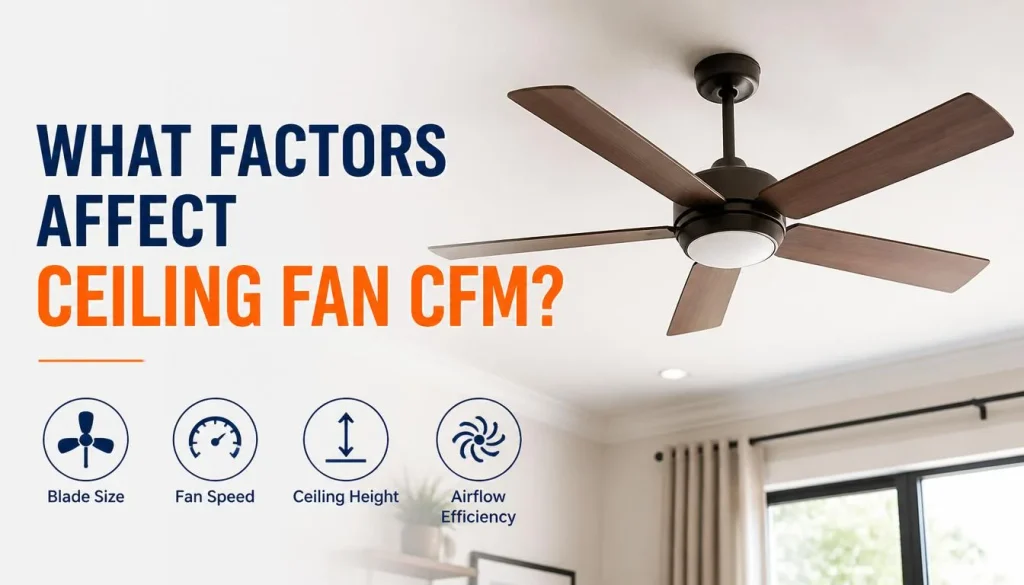
Two ceiling fans with similar diameters may produce different airflow ratings. Several design and operating factors influence performance.
Blade Span and Blade Design
Blade span refers to the diameter of the circle swept by the rotating blades.
A larger blade span can help a fan circulate air over a broader area, but blade size alone does not determine CFM. Blade shape, pitch, material, and the design of the entire fan also matter.
This is why you should compare the actual airflow specifications rather than assuming a larger fan will always move more air.
Blade Pitch and Motor Performance
Blade pitch describes the angle at which a blade is positioned relative to its plane of rotation.
Blade geometry and motor performance work together to influence airflow and power consumption. A well-designed fan can perform differently from another fan with a similar blade span but a less effective overall design.
The number of blades alone is not a reliable measure of airflow.
For more information, see our comparison of 3-blade vs. 5-blade ceiling fans.
RPM and Speed Settings
Changing a fan’s speed generally changes its airflow and power consumption.
However, the relationship depends on the fan’s design and operating characteristics. You should not assume that every fan will produce the same CFM at a particular RPM.
Compare the available speed settings and manufacturer-provided performance data when possible.
Ceiling Height and Fan Placement
Correct installation affects how effectively you experience moving air.
A fan mounted too high above the occupied area may provide less noticeable air movement where you sit or stand. A poorly positioned fan may also leave parts of the room with less circulation.
Follow the manufacturer’s instructions for mounting height, blade clearance, and suitable installation hardware.
Is Higher CFM Always Better for a Ceiling Fan?

Higher CFM is not automatically better. What matters is whether the fan supplies sufficient, comfortable airflow for the room and the people using it.
When Is Higher CFM Useful?
Higher airflow may be helpful in large rooms, open-plan living spaces, and areas where stronger air circulation is preferred.
However, a large room also presents challenges involving ceiling height, layout, and air distribution. A fan that circulates air effectively across one seating area might not provide equal airflow to a distant corner.
For larger spaces, explore our guide to the best ceiling fans for large rooms.
When Can Too Much Airflow Be Uncomfortable?
Some people prefer a gentle breeze, particularly when sleeping, reading, or working at a desk.
A fan with a high maximum CFM rating may still be suitable if it offers comfortable lower-speed settings. The important consideration is not just how much air the fan can move, but whether you can adjust the airflow to suit your needs.
Why Do Adjustable Speed Settings Matter?
Adjustable speeds let you control airflow as conditions change.
You might choose a lower setting at night and a higher setting during warmer parts of the day. Having several useful speed options can make a fan more versatile than one that performs comfortably only at a limited range of speeds.
Why Can a High-CFM Ceiling Fan Still Feel Weak?
If your ceiling fan has a high published CFM rating but the breeze feels weak, there are several possible explanations.
The fan may be poorly positioned. If the fan is mounted far above the occupied area or away from where airflow is needed, you may not feel its full effect.
The room may have an awkward layout. Long rooms, divided spaces, and rooms with several seating areas can make even air distribution more difficult.
You may be using a low-speed setting. A high maximum CFM rating does not mean the fan will deliver that airflow at every speed.
The airflow may not be reaching your location effectively. The way a fan distributes air depends on its design, mounting height, and surrounding obstacles.
The fan may not be operating as intended. If airflow has suddenly decreased, check the user manual for safe cleaning and maintenance guidance. Dust buildup, damaged components, or a mechanical problem may require attention. Turn off the power before performing any maintenance, and use a qualified professional for electrical repairs.
Before replacing the fan, investigate its installation, operating speed, condition, and suitability for the room.
How to Compare Two Ceiling Fans Using CFM
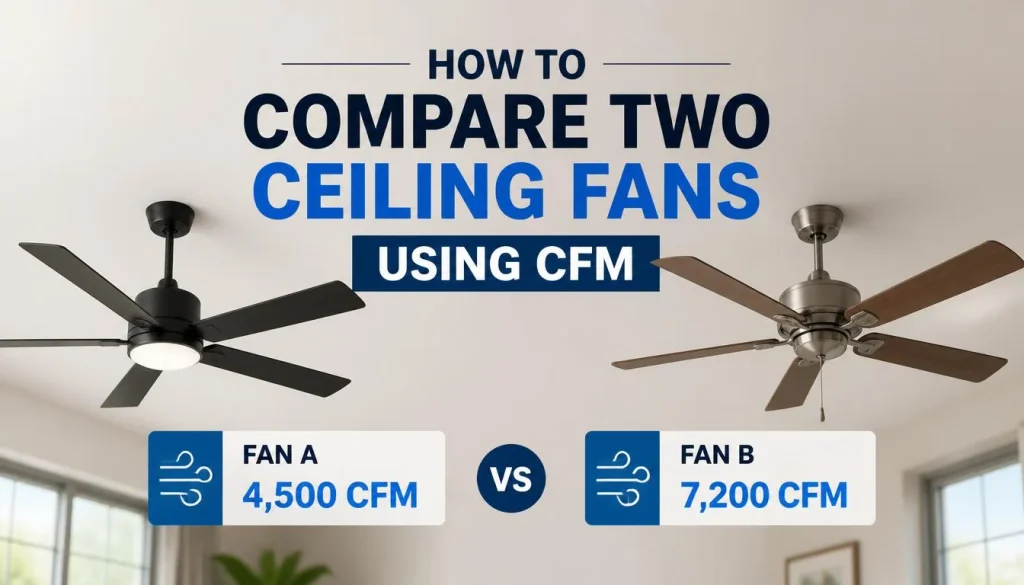
When comparing ceiling fans, use a consistent method rather than focusing on a single headline number.
Step 1: Compare Airflow Ratings on a Like-for-Like Basis
Check the published CFM ratings and determine whether they represent maximum-speed airflow or a weighted-average figure.
Comparisons are more meaningful when the measurement method and operating conditions are comparable.
Step 2: Check Power Consumption
Look at the wattage associated with the airflow figures.
A fan with slightly lower CFM may offer better airflow efficiency if it consumes substantially less power under comparable operating conditions.
Step 3: Consider the Room and Installation
Check the room dimensions, ceiling height, mounting requirements, and airflow distribution.
A fan should fit the space physically and provide comfortable air movement where it is needed.
Step 4: Check Noise and Speed Control
For bedrooms and home offices, low-speed performance and noise may be particularly important.
For a living room, stronger airflow at higher speeds may be more useful. Think about how you will actually use the fan rather than choosing solely by the highest CFM figure.
Step 5: Review the Manufacturer’s Documentation
Confirm the fan’s published airflow, power consumption, speed controls, installation requirements, and other specifications.
For additional guidance on matching fan size to room dimensions, read our ceiling fan size for room guide.
How Much CFM Do You Need for Your Room?
The amount of airflow you need depends on room size, ceiling height, room layout, fan design, and personal comfort.
A larger room may need a fan capable of circulating more air, but there is no single CFM figure that works for every room of the same size. Installation and the distribution of airflow also matter.
Start by measuring your room and identifying the type of airflow you find comfortable. Then compare suitable fan models using their published CFM ratings and power consumption.
For room-specific guidance and illustrative airflow ranges, visit our detailed guide to how much CFM you need for a ceiling fan.
Common Ceiling Fan CFM Myths to Avoid

Several common misconceptions can lead to poor buying decisions.
Myth 1: More blades always mean higher CFM.
Not necessarily. Blade count is only one part of the design. Blade shape, pitch, motor performance, and other factors also influence airflow.
Myth 2: Higher RPM always means stronger airflow.
RPM measures rotational speed, not total airflow. Compare CFM ratings to evaluate reported airflow.
Myth 3: The highest CFM fan is always the best choice.
The most suitable fan should provide sufficient and comfortable airflow for the room, with appropriate power consumption and speed control.
Myth 4: A larger fan always moves more air.
Blade span alone does not determine performance. Compare the manufacturer’s airflow specifications under comparable conditions.
Myth 5: Higher CFM automatically means better energy efficiency.
A fan can move more air while also consuming more electricity. Check airflow and power consumption together, and review the applicable efficiency rating where available.
Avoiding these mistakes will help you make a more informed comparison when shopping for a ceiling fan.
Frequently Asked Questions About Ceiling Fan CFM Explained
What Is a Good CFM for a Ceiling Fan?
A good CFM rating depends on the fan’s intended use, room dimensions, installation, and personal comfort. Instead of relying on a universal target, compare published airflow ratings and manufacturer recommendations for your space.
Is 4,000 CFM Good for a Ceiling Fan?
A 4,000 CFM rating can be suitable for many residential applications, but the number alone does not determine suitability. Consider the room size, fan design, mounting height, operating speed, and the amount of airflow you prefer.
Does Higher CFM Mean Better Cooling?
Higher CFM means greater reported airflow under the specified conditions. Moving air can make people feel cooler by increasing heat loss from their skin, but a ceiling fan does not directly reduce the room’s air temperature.
What Is the Difference Between CFM and RPM?
CFM measures the volume of air moved per minute, while RPM measures how many revolutions the fan makes per minute. They describe different aspects of performance, so one cannot replace the other when comparing fans.
Is CFM per Watt Important?
Yes. CFM per watt helps you assess how much airflow a fan produces relative to its electricity use. A higher value can indicate better airflow efficiency in a like-for-like comparison, although official efficiency metrics may use more comprehensive testing and calculations.
Can a Ceiling Fan Have High CFM and Low Power Consumption?
Yes. Fan design, motor technology, blade geometry, and operating speed can influence the relationship between airflow and power use. Compare the actual airflow and wattage specifications rather than assuming that every high-CFM fan consumes a large amount of electricity.
How Do I Know Whether a Fan’s CFM Rating Is Reliable?
Look for published specifications from the manufacturer and check the documentation describing airflow measurements. Where applicable, use recognized product labels and testing information to understand which performance figure is being reported.
Final Verdict: How to Use CFM When Choosing a Ceiling Fan
Understanding ceiling fan CFM makes it easier to compare airflow and choose a fan that suits your needs. A higher CFM rating indicates greater reported airflow under the specified conditions, but it does not automatically mean better comfort or energy efficiency.
For the best comparison, consider CFM alongside RPM, wattage, CFM per watt, blade design, speed settings, and installation requirements. Check that the airflow figures you compare use compatible measurement methods, and think about how you will use the fan every day.
Most importantly, choose a ceiling fan that provides comfortable air circulation for your room rather than simply selecting the model with the highest advertised CFM.
That approach will help you make a more informed decision, whether you are choosing a fan for a bedroom, a home office, or a spacious living room.

“The right fan can make a bigger difference than you think.”
Hi, I’m Michael Turner, an author and home appliance researcher at BestFanSolve.com.
My interest in fans started with a simple question: How do you know which fan is actually right for your needs? With so many types, features, brands, and technical specifications available, choosing a fan can quickly become confusing. I created BestFanSolve.com to make that process easier.
Through this website, I share practical fan reviews, buying guides, comparisons, troubleshooting tips, maintenance advice, and solutions to common fan problems. I focus on turning complicated product information into clear, useful guidance that everyday readers can actually understand and use.
Whether you’re searching for a quiet bedroom fan, a powerful fan for a large room, an energy-efficient option, or simply trying to figure out why your current fan isn’t working properly, my goal is to help you find the information you need before making a decision.
I believe good recommendations should be based on research, real-world considerations, honest pros and cons, and the specific needs of the user—not simply marketing claims.
Through BestFanSolve.com, I’m committed to helping readers find the right fan, solve common fan problems, and make smarter purchasing decisions with confidence.
— Michael Turner
Author & Home Appliance Researcher
BestFanSolve.com