A ceiling fan is supposed to provide steady, comfortable airflow. So when you switch it on and notice that the blades are turning much more slowly than usual, it can be frustrating. The fan may still be running, but the room does not feel as comfortable as it once did.
Why is your ceiling fan running slow? The problem could be something relatively simple, such as an incorrect speed setting or a remote control issue. However, a failing capacitor, worn motor bearings, a faulty speed controller, or an internal motor problem may also be responsible.
The important thing is to identify the actual cause before replacing parts or attempting a repair. In this guide, you will learn how to recognize the symptoms, understand eight common causes, try a few safe checks, and know when to contact a qualified electrician or ceiling fan technician.
Why Is My Ceiling Fan Running Slow?
A ceiling fan usually runs slowly because its motor is not receiving the correct control signal or cannot operate as intended. Common causes include a weak capacitor in certain AC ceiling fans, a faulty speed controller, remote receiver problems, worn motor bearings, or electrical and internal motor faults.
The first step is to determine whether the blades are actually rotating more slowly or whether the fan is simply moving less air than before. These are two different problems and may require different solutions.
Is Your Ceiling Fan Actually Running Slow or Just Producing Less Airflow?
Before troubleshooting the motor, make sure the fan’s rotation speed has genuinely decreased.
Sometimes a ceiling fan spins at its normal speed but does not seem to move enough air. This can happen because of blade design, blade pitch, fan direction, mounting position, or the room layout.
There are two important measurements to understand:
- RPM (revolutions per minute): How quickly the ceiling fan blades rotate.
- CFM (cubic feet per minute): The volume of air the fan moves under specified operating conditions.
A fan can have a relatively low RPM and still produce useful airflow because blade shape, blade pitch, span, and motor design all influence performance.
For a better understanding, see our guide to ceiling fan CFM and airflow performance. You can also read how much CFM you need for a ceiling fan when comparing airflow requirements.
If the blades are visibly rotating more slowly than they used to, continue with the troubleshooting steps below.
How to Identify the Cause of a Slow Ceiling Fan
The symptoms can provide useful clues about what is happening inside your fan.
| What You Notice | Possible Cause |
|---|---|
| Fan runs slowly on every speed | Capacitor, motor, or electrical supply problem |
| Fan runs slowly only on high speed | Speed control, capacitor, or motor problem |
| Fan works on only one speed | Capacitor, pull-chain switch, or electronic controller |
| Fan hums but rotates slowly | Capacitor, motor, or receiver problem |
| Fan needs a push to start | Possible capacitor or motor problem |
| Fan slows down after running for a while | Possible overheating or internal motor fault |
| Fan speed changes unexpectedly | Remote, receiver, or speed controller problem |
| Fan spins normally but produces weak airflow | Blade design, direction, mounting, or airflow issue |
These symptoms are not guaranteed diagnoses. Different faults can create similar problems, so the correct approach is to start with simple checks and avoid replacing components without proper testing.
8 Common Reasons Why Your Ceiling Fan Is Running Slow
1. A Weak or Faulty Ceiling Fan Capacitor
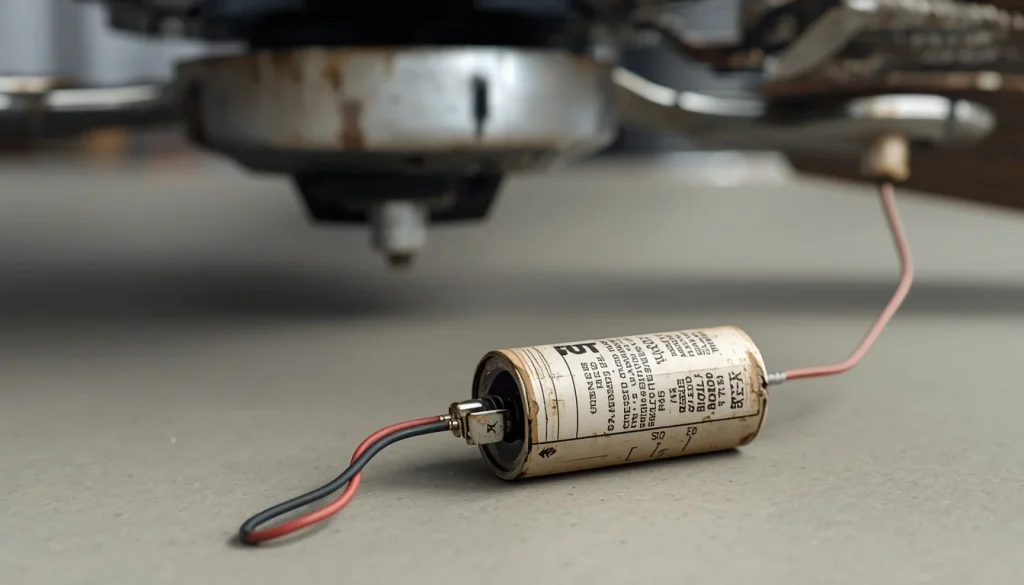
A failing capacitor is one of the common reasons an AC ceiling fan may struggle to start or operate at its normal speed.
A capacitor is an electrical component that helps certain AC fan motors start and operate correctly. In many traditional multi-speed ceiling fans, the capacitor also plays an important role in controlling the available speed settings.
When the capacitor becomes weak or damaged, the fan may behave differently from normal.
Common symptoms include:
- The fan starts more slowly than it used to.
- The blades rotate slower than normal.
- The fan struggles to maintain its usual speed.
- One or more speed settings stop working correctly.
- The motor hums, but the blades rotate very slowly.
A fan that needs a manual push to start may also have a capacitor or motor problem. Do not try to start it by pushing the blades while the fan is connected to power.
What should you do?
First, check whether the fan has the correct speed setting and a compatible controller. If the problem remains, the capacitor may need professional testing.
A replacement capacitor must match the fan’s specifications, including its electrical rating and capacitance. Installing an incorrect component can damage the fan or create a safety risk.
Also remember that traditional AC capacitor troubleshooting does not automatically apply to DC ceiling fans. Their speed control systems are different.
2. A Faulty Speed Regulator or Pull-Chain Switch
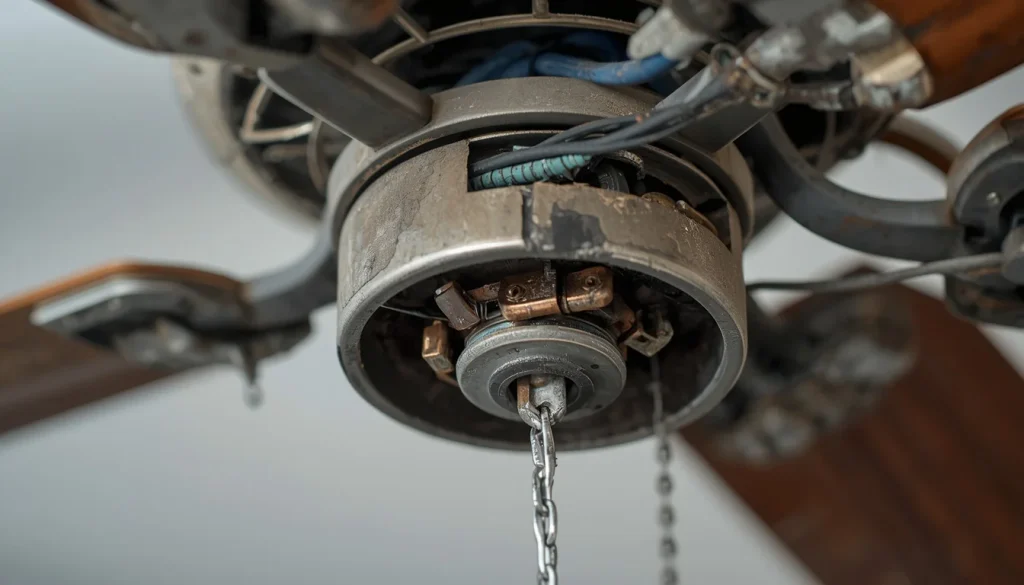
Your ceiling fan’s speed controller determines how the motor operates at different speed settings.
Depending on the fan model, it may use a wall-mounted speed regulator, a pull-chain switch, or an electronic control system.
If one of these controls becomes faulty, the fan may stop responding correctly.
For example, you may notice that:
- The fan runs only at its lowest speed.
- The highest speed feels weaker than before.
- Changing the pull chain does not produce a noticeable difference.
- Some speed settings work while others do not.
- The fan operates unpredictably after using the wall controller.
Possible causes include:
- A worn pull-chain switch.
- A damaged wall-mounted speed controller.
- An incompatible replacement switch.
- A faulty internal speed-control component.
- An ordinary light dimmer being used instead of a compatible fan controller.
How to address the problem
Check the fan’s speed setting and make sure the controller is designed for that specific fan.
Never assume that a standard light dimmer can safely control a ceiling fan. Light dimmers and fan-speed controls serve different purposes.
If the pull chain feels broken or the speed settings no longer respond, the switch may need replacement. Internal switch replacement involves electrical connections and should be handled by someone qualified to do the work.
3. Remote Control or Receiver Problems
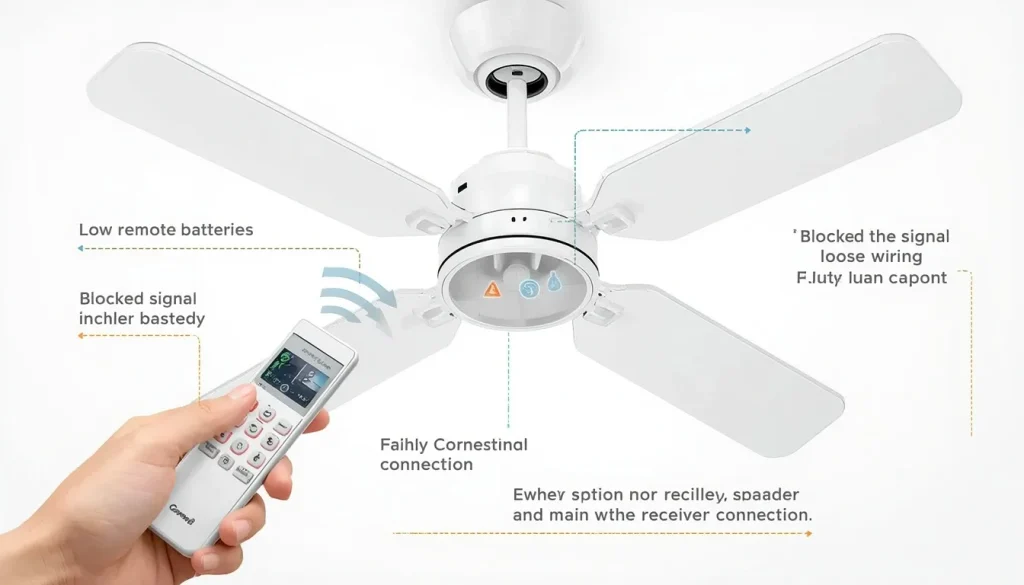
Many modern ceiling fans use remote controls to adjust their speed.
The remote sends signals to a receiver, which communicates with the fan’s electronic control system. If the remote or receiver does not work correctly, the fan may not respond properly to speed commands.
You might notice that the fan:
- Remains on one speed.
- Does not respond when you press the speed buttons.
- Changes speed inconsistently.
- Works from the wall switch but not from the remote.
- Operates differently after a power interruption.
What you can check safely:
- Replace the remote’s batteries with fresh ones.
- Make sure you are using the correct remote for your fan.
- Follow the manufacturer’s instructions to re-pair the remote if necessary.
- Check whether the fan responds when you use another approved control method.
If the remote still does not work, the receiver or electronic controller may need inspection.
Do not open the ceiling fan canopy or remove the receiver while the electrical supply is connected. A qualified technician should inspect or replace internal electronic components.
4. A Reverse Switch That Is Not Fully Engaged
Some ceiling fans have a small reverse-direction switch on the motor housing. Other models allow you to change direction using a remote or electronic control.
This switch changes the direction of blade rotation for seasonal comfort. However, if a physical reversing switch is left between its intended positions, it can interfere with the fan’s operation.
Hunter Fan also identifies an incorrectly positioned reverse switch as one possible cause of ceiling fan speed or operating problems.
What to do:
- Turn off the fan.
- Wait until the blades have stopped completely.
- If your model has a physical direction switch, check that it is fully positioned on one side rather than left in the middle.
- Consult the manufacturer’s manual before operating the fan again.
Do not move the direction switch while the blades are spinning unless the manufacturer’s instructions specifically permit it.
If the fan still runs slowly, the reverse switch may not be the underlying problem. The controller, capacitor, or motor may require further inspection.
5. Low Voltage or Electrical Supply Problems
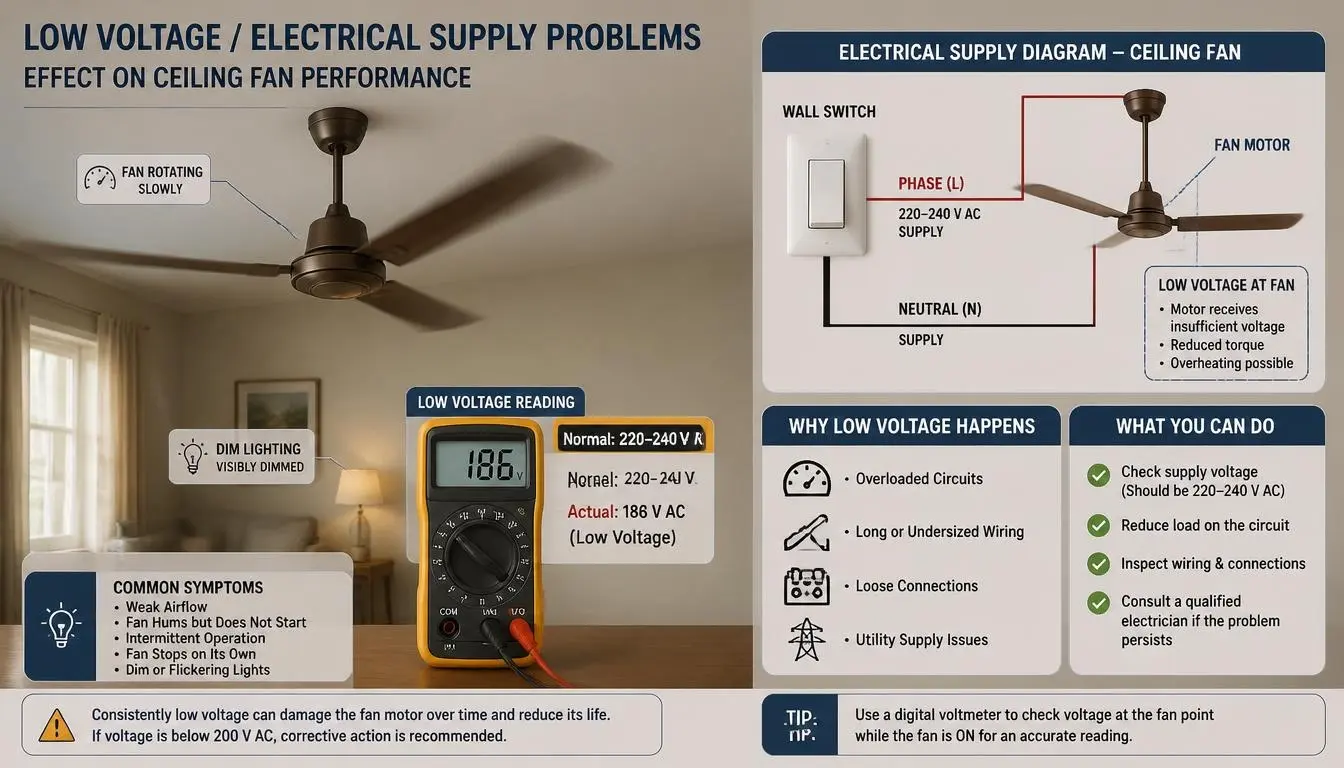
A ceiling fan needs a suitable and stable electrical supply to operate correctly.
Problems with the electrical supply, damaged wiring, or loose connections may interfere with the fan’s operation.
For example, you might notice:
- The fan speed changes unexpectedly.
- The fan becomes slower without changing its speed setting.
- The light and fan behave unusually at the same time.
- Other electrical devices connected to the same circuit also show problems.
- The fan operates intermittently.
However, a slow fan does not automatically mean that your home’s voltage is too low. A faulty capacitor, controller, or motor can produce similar symptoms.
What should you do?
Avoid opening electrical connections or testing live wiring yourself. If you suspect a supply problem, arrange an inspection by a qualified electrician.
Electrical problems should not be ignored, especially when you notice flickering lights, burning smells, unusual buzzing, or repeated interruptions in operation.
6. Worn or Damaged Motor Bearings
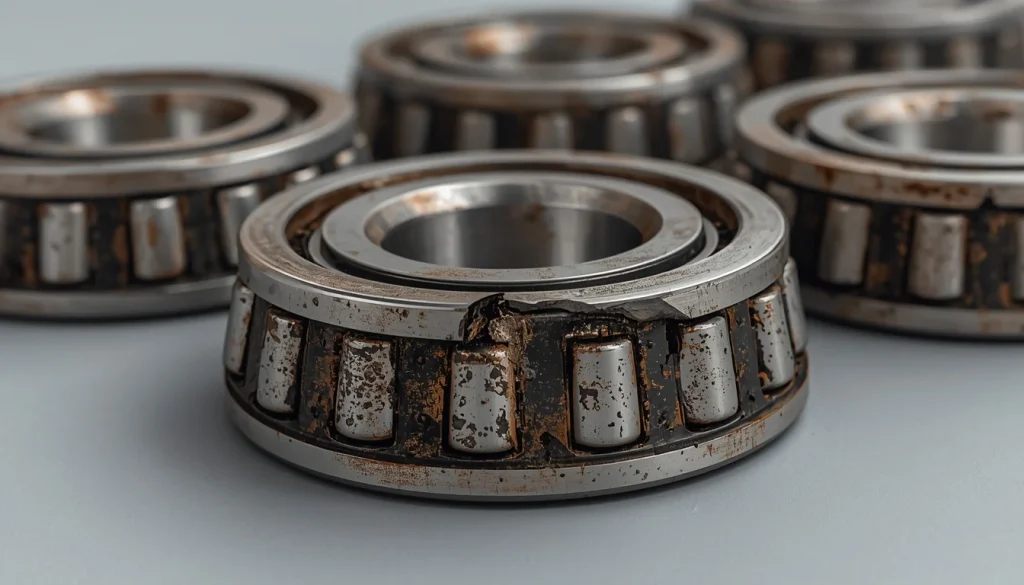
Motor bearings allow the rotating parts of a ceiling fan to move smoothly.
Over time, bearings may become worn, damaged, or affected by excessive friction. When this happens, the motor may struggle to rotate the blades as freely as it once did.
Common warning signs include:
- The fan rotates more slowly than usual.
- You hear grinding, rumbling, or squeaking sounds.
- The fan does not operate as smoothly as before.
- The problem becomes more noticeable after extended use.
If your slow-running fan also makes unusual noises, read our guide on why a ceiling fan makes noise and how to fix it.
What is the solution?
The correct repair depends on the fan’s design.
Some motors have serviceable bearings, while others use sealed components that are not intended for routine lubrication or repair.
Do not spray general-purpose lubricant into the motor housing. It may damage electrical insulation, attract dust, or fail to reach the actual problem area.
A technician can determine whether the bearings can be serviced or whether the motor needs replacement.
7. Motor Overheating or Internal Motor Damage
A ceiling fan motor can become less reliable when its internal components are damaged or operating abnormally.
Overheating may be related to excessive friction, electrical faults, damaged windings, or another internal problem.
One possible symptom is a fan that starts normally but becomes slower after running for some time.
You may also notice:
- A burning or electrical smell.
- Unusual humming or buzzing.
- Repeated changes in operating speed.
- The fan stopping unexpectedly.
- Excessive heat around the motor housing.
A damaged motor winding can also affect the fan’s ability to maintain normal operation.
What should you do?
Turn the fan off immediately if you notice a burning smell, smoke, or unusual electrical sounds. Isolate the electrical supply at the breaker or consumer unit if it is safe to do so.
Do not continue running the fan to see whether it improves. Do not touch internal electrical components or attempt to repair the motor winding yourself.
A qualified electrician or ceiling fan technician can inspect the motor and determine whether repair or replacement is appropriate.
8. Mechanical Obstruction or Incorrect Installation
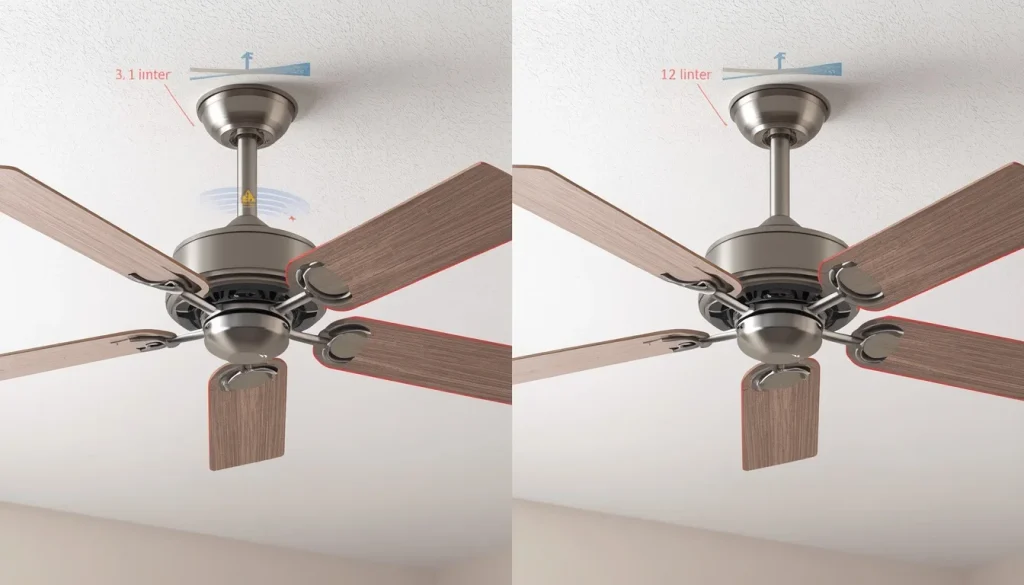
Although electrical faults are common causes of slow rotation, mechanical problems should not be overlooked.
A physical obstruction, incorrectly fitted component, or damaged internal part can prevent a ceiling fan from rotating freely.
For example:
- A loose component may rub against another part.
- A damaged blade holder may interfere with normal operation.
- An installation problem may put unnecessary strain on the fan assembly.
- A component may have shifted after maintenance or repair.
Dust buildup can also affect airflow or contribute to blade imbalance. However, dirty blades alone should not automatically be blamed for a genuine reduction in motor speed.
What should you check?
Turn the fan off and allow the blades to stop completely. Look for visible obstructions, obvious damage, or loose external components that can be checked safely according to the manufacturer’s instructions.
Never force the blades to rotate or bend a blade holder to make the fan move more freely.
If the fan also shakes noticeably, our guide on why a ceiling fan wobbles and how to fix it may help you understand the separate balance and mounting issues.
If the obstruction or damage is inside the motor housing, arrange a professional inspection.
How to Fix a Ceiling Fan That Is Running Slow
You do not need to start by replacing the capacitor or motor. Work through these basic checks first.
Step 1. Check the Fan’s Speed Setting
Make sure the fan is set to the speed you actually want.
If your fan uses a pull chain, check that the correct speed has been selected. If it uses a remote, confirm that the speed button is working.
A simple incorrect setting can sometimes make the fan appear less powerful than usual.
Step 2. Replace the Remote Batteries
If your ceiling fan uses a remote control, install fresh batteries and test it again.
Follow the manufacturer’s instructions if the remote needs to be paired with the receiver.
If the fan still does not respond correctly, the receiver or electronic controller may require professional inspection.
Step 3. Check the Reverse Switch Position
If your fan has a physical reverse switch, make sure it is fully positioned in the intended direction.
Always switch off the fan and wait until the blades stop before touching the switch.
Check the user manual if you are unsure how your particular model changes direction.
Step 4. Clean the Fan Blades and Look for Visible Obstructions
Dust can accumulate on ceiling fan blades and affect their balance or airflow.
To clean them safely:
- Switch off the fan.
- Wait until all blades have stopped moving.
- Use a suitable duster or soft microfiber cloth.
- Clean the upper and lower surfaces of every blade.
- Check for visible cracks, damage, or loose external components.
Avoid putting pressure on the blades or bending them while cleaning.
Cleaning may improve airflow and reduce dust-related imbalance, but it will not repair a faulty capacitor or damaged motor.
Step 5. Check Wall Controller Compatibility
If you recently replaced a wall switch or installed a new speed regulator, confirm that it is compatible with your fan.
An ordinary light dimmer should not be treated as a replacement for a ceiling fan speed controller.
This is especially important for DC ceiling fans, which commonly use dedicated electronic controls.
Step 6. Get the Capacitor, Receiver, or Motor Professionally Tested
If the fan still runs slowly after the basic checks, an internal component may be responsible.
A qualified technician can inspect and test:
- The capacitor, if the fan uses one.
- The pull-chain switch or speed controller.
- The remote receiver.
- The motor and its internal components.
- Electrical connections and supply conditions.
Do not attempt to replace internal electrical parts based only on symptoms. The correct component must match the exact fan model and manufacturer specifications.
For additional guidance, see Hunter Fan’s ceiling fan troubleshooting guide.
Is It Safe to Run a Ceiling Fan That Is Running Slowly?
That depends on why the fan is running slowly.
A fan with an incorrect remote setting may only need a simple adjustment. However, a fan with a damaged motor, faulty electrical connection, or overheating problem can create a safety risk.
Stop using the fan if you notice:
- A burning or melting-plastic smell.
- Smoke or visible sparks.
- Crackling or unusual electrical buzzing.
- Excessive heat around the motor housing.
- Sudden, repeated changes in speed.
- Grinding noises or signs of serious mechanical damage.
Switch off the fan and isolate its electrical supply at the breaker or consumer unit if safe to do so. Do not open the motor housing or touch exposed wiring.
The UK safety organisation Electrical Safety First advises homeowners to avoid electrical work beyond their competence and to use a qualified professional when necessary.
You should also follow the fan manufacturer’s safety instructions and the electrical regulations applicable in your country.
When Should You Repair or Replace Your Ceiling Fan?
Not every slow-running fan needs to be replaced.
In some cases, the problem may involve a faulty remote, speed switch, or another replaceable component. A technician may be able to repair the fan without replacing the entire unit.
However, replacement may be more practical when:
- The motor has serious internal damage.
- Compatible replacement parts are no longer available.
- The fan has repeated electrical or mechanical failures.
- Repair costs are close to the cost of a suitable replacement.
- The fan is old and has become unreliable.
Before making a decision, consider the fan’s age, warranty, condition, repair cost, and availability of genuine replacement parts.
A professional inspection can help you avoid replacing a fan when a smaller repair would solve the problem.
How to Prevent Your Ceiling Fan from Running Slowly Again
Regular care can help your ceiling fan remain reliable and reduce the chance of recurring problems.
Here are a few sensible maintenance habits:
Clean the blades regularly. Remove accumulated dust using a soft cloth or suitable duster. This helps maintain cleaner blades and can reduce dust-related imbalance.
Use the correct speed controller. Make sure any wall control, remote receiver, or replacement switch is approved for your fan model.
Pay attention to unusual sounds. Grinding, humming, or repeated buzzing may indicate a problem that deserves attention before the fan stops working properly.
Follow the manufacturer’s maintenance instructions. Different fan models have different motor designs, bearing arrangements, and control systems.
Address electrical problems promptly. If the fan starts operating unpredictably, arrange a professional inspection rather than repeatedly switching it on and off.
Check replacement parts carefully. Use compatible components recommended for the exact fan model. A part that looks similar may not have the correct electrical rating or connections.
For more information about how motor type affects fan performance and control systems, read our guide to DC vs. AC ceiling fans.
Frequently Asked Questions
Why Is My Ceiling Fan Running Slow Even on the Highest Setting?
A ceiling fan that runs slowly even at its highest setting may have a weak capacitor, worn motor bearings, an incompatible speed controller, an electrical supply problem, or internal motor damage.
Start by checking the speed setting and remote or wall control. If the fan still rotates more slowly than normal, arrange a professional inspection.
Can a Bad Capacitor Make a Ceiling Fan Run Slowly?
Yes. A failing capacitor can affect the starting and speed performance of many traditional AC ceiling fans.
The fan may start slowly, struggle to maintain its usual speed, or stop working correctly on certain settings.
However, not every ceiling fan uses the same capacitor-based control system. Check the fan’s model and manufacturer’s instructions before assuming that the capacitor is responsible.
Why Does My Ceiling Fan Only Work on One Speed?
A fan that operates on only one speed may have a faulty capacitor, pull-chain switch, wall controller, remote receiver, or electronic control system.
The cause depends on the fan design. Check the control settings and remote batteries first. If the problem continues, a technician may need to test the internal speed-control components.
Why Does My Ceiling Fan Need a Push to Start?
A ceiling fan that needs a manual push to start may have a failing capacitor or a motor problem.
Do not attempt to push the blades while the fan is connected to power. Switch it off and arrange an inspection by a qualified technician.
Why Does My Ceiling Fan Hum but Spin Slowly?
A humming ceiling fan that rotates slowly may have a capacitor problem, a faulty control component, an electronic receiver issue, or an internal motor fault.
Turn the fan off if the humming is unusual or accompanied by heat or a burning smell. Avoid repeatedly trying to start it until the cause has been checked.
Can a Faulty Reverse Switch Affect Ceiling Fan Speed?
An incorrectly positioned physical reverse switch can interfere with some fans’ operation. However, it is not the cause of every slow-speed problem.
Switch off the fan, wait for the blades to stop, and check the switch position according to the manufacturer’s instructions.
Why Does My Ceiling Fan Slow Down After Running for a While?
A fan that becomes slower after running for some time may have an overheating motor, damaged internal components, excessive mechanical friction, or an electrical control problem.
Turn it off if you notice excessive heat, a burning smell, or unusual noises. A technician should inspect the fan before it is used again.
Do DC Ceiling Fans Have the Same Slow-Speed Problems as AC Fans?
No. Some symptoms may be similar, but AC and DC ceiling fans use different motor and speed-control technologies.
Many traditional AC models use capacitors as part of their speed-control system. DC models generally rely on electronic controllers and compatible receivers.
For that reason, an AC capacitor replacement should not automatically be considered a solution for a DC fan.
Is It Dangerous to Run a Slow Ceiling Fan?
Not always, but a slow-running fan can indicate an electrical or mechanical problem.
If the fan smells burnt, makes unusual electrical noises, becomes excessively hot, or operates unpredictably, stop using it and arrange a professional inspection.
Do not ignore warning signs simply because the blades are still rotating.
Final Thoughts
A ceiling fan that runs slowly can have several different causes, ranging from a simple control issue to a failing capacitor, worn bearings, or motor damage.
The best approach is to identify the symptoms before attempting a repair. Check the speed setting, remote batteries, reverse switch, and visible condition of the blades first. These basic checks may help you rule out a few common problems without opening the fan or handling electrical components.
If the fan continues to run slowly, especially when it produces unusual noise, excessive heat, or a burning smell, stop using it and contact a qualified electrician or ceiling fan technician.
With the right diagnosis and compatible replacement parts, you may be able to restore normal operation without replacing the entire fan.

“The right fan can make a bigger difference than you think.”
Hi, I’m Michael Turner, an author and home appliance researcher at BestFanSolve.com.
My interest in fans started with a simple question: How do you know which fan is actually right for your needs? With so many types, features, brands, and technical specifications available, choosing a fan can quickly become confusing. I created BestFanSolve.com to make that process easier.
Through this website, I share practical fan reviews, buying guides, comparisons, troubleshooting tips, maintenance advice, and solutions to common fan problems. I focus on turning complicated product information into clear, useful guidance that everyday readers can actually understand and use.
Whether you’re searching for a quiet bedroom fan, a powerful fan for a large room, an energy-efficient option, or simply trying to figure out why your current fan isn’t working properly, my goal is to help you find the information you need before making a decision.
I believe good recommendations should be based on research, real-world considerations, honest pros and cons, and the specific needs of the user—not simply marketing claims.
Through BestFanSolve.com, I’m committed to helping readers find the right fan, solve common fan problems, and make smarter purchasing decisions with confidence.
— Michael Turner
Author & Home Appliance Researcher
BestFanSolve.com