

Choosing the best ceiling fan for a large room is not as simple as buying the biggest fan you can find. A fan that looks impressive but moves too little air may leave parts of your living room feeling uncomfortable. On the other hand, an oversized fan installed at the wrong height may not distribute airflow as effectively as you expect.
The right choice depends on several factors, including room size, ceiling height, airflow rating, motor efficiency, noise level, and installation requirements.
Whether you are furnishing a spacious living room in the USA, an open-plan home in the UK, a great room in Canada, or a large family space in Australia, this guide will help you compare suitable ceiling fans and understand what matters before making a purchase.
This guide uses published manufacturer specifications and official energy-efficiency information to help you compare different options. It does not claim that the products have been independently tested side by side. Prices, product specifications, and availability may vary by country.
Best Ceiling Fans for Large Rooms at a Glance
Here is a quick comparison of seven ceiling fans worth considering for different large-room needs.
| Ceiling Fan | Best For | Blade Span | Key Features |
|---|---|---|---|
| Big Ass Fans Haiku | Premium performance | 84 inches | Modern design, smart controls, efficient motor |
| Fanimation Odyn Custom | Extra-large spaces | Up to 84 inches | High airflow capacity, DC motor |
| Aeratron AE+3 | Energy efficiency | Up to 60 inches | Quiet operation, efficient motor |
| Hunter Warrant | Large rooms with lighting | 60 inches | Integrated LED light, DC motor |
| Minka-Aire Xtreme H2O | Covered outdoor areas | 65 inches | Wet-location rating, remote control |
| Hunter Phenomenon | Smart-home features | 60 inches | Integrated lighting, smart controls |
| Home Decorators Collection Altura DC | Large-room value | 68 inches | Oversized blade span, published efficiency data |
These products represent different use cases rather than a definitive ranking based on independent testing. Always verify the exact model specifications before purchasing, particularly if you live outside North America.
Important: Electrical voltage, frequency, warranty coverage, and product availability differ between the USA, UK, Canada, and Australia. Do not assume that a fan sold in one country is suitable for installation in another.
7 Best Ceiling Fans for Large Rooms

1. Big Ass Fans Haiku 84-Inch — Best Premium Ceiling Fan for Large Rooms
If you want a premium ceiling fan for a spacious living room, open-plan area, or large great room, the Big Ass Fans Haiku is worth considering.
Its minimalist design looks different from a traditional ceiling fan, but the appeal goes beyond appearance. The fan features three precision-designed airfoils, a high-efficiency motor, and smart features intended to support comfortable airflow.
The manufacturer advertises airflow of up to 17,369 CFM for certain Haiku configurations. Exact specifications depend on the model and configuration, so check the current product documentation before making a decision.
Why it stands out
- An 84-inch configuration for larger spaces.
- Designed for smooth, quiet operation.
- Smart features and optional lighting.
- Modern styling with different finish options.
- Suitable for buyers who prioritize design and premium features.
Potential drawbacks
- It belongs to the premium price category.
- Its large diameter requires careful planning for clearance and installation.
- Accessories and lighting can increase the total cost.
- It may be excessive for a moderately sized room.
Best for: Homeowners who want a premium fan for a large living room or great room and are comfortable paying more for design and features.
Check the official Big Ass Fans Haiku product page for current size options and model-specific specifications.
2. Fanimation Odyn Custom 84-Inch — Best for Extra-Large Spaces
Some rooms need more than the airflow offered by an ordinary ceiling fan. An open-plan living area, large family room, or spacious covered patio may benefit from a larger fan designed to move substantial volumes of air.
The Fanimation Odyn Custom is one option to investigate.
The manufacturer lists the 84-inch configuration with a maximum airflow rating of 11,363 CFM. Depending on the configuration, the range also offers a DC motor, multiple speed settings, control options, and outdoor-rated versions.
These features make it an interesting option when room size and airflow matter more than finding the least expensive fan.
Why it stands out
- An 84-inch option for substantial rooms.
- High published airflow capacity.
- DC motor and multiple speed settings.
- Control and lighting options, depending on the configuration.
- Certain versions are designed for outdoor installations.
Potential drawbacks
- Its large size requires sufficient clearance.
- Installation planning is particularly important with a large ceiling fan.
- Some North American versions use 120V AC, 60Hz power and are not automatically suitable for other electrical systems.
- Its size may be unsuitable for smaller rooms or low ceilings.
Best for: Owners of extra-large indoor spaces or appropriately designed outdoor areas who need substantial airflow.
Review the official Fanimation Odyn Custom product information and choose a version approved for your local electrical system and installation conditions.
3. Aeratron AE+3 60-Inch — Best for Energy Efficiency and Quiet Operation
A large ceiling fan does not necessarily need to consume a great deal of electricity. An efficient motor and well-designed blades can deliver useful airflow without requiring a high power draw.
The Aeratron AE+3 is worth considering if you want a modern, relatively minimalist fan with energy efficiency as a priority.
The manufacturer lists a 60-inch version with airflow of up to approximately 8,146 CFM and high-speed energy consumption of around 22.2 watts. The product range also offers remote control and a design intended to support smooth operation.
The 60-inch version may suit some large rooms, although the required fan size still depends on ceiling height, layout, and airflow distribution.
Why it stands out
- A large-room option with a 60-inch blade span.
- Low published power consumption relative to its stated airflow.
- A streamlined three-blade design.
- Remote control and reversible operation.
- Regional product listings may be available.
Potential drawbacks
- It does not have the oversized blade span of an 84-inch fan.
- Very wide or irregularly shaped rooms may need a different arrangement.
- The design may not suit every traditional interior.
- Regional availability, voltage, and included accessories should be checked.
Best for: Buyers who value quiet operation and energy efficiency but do not necessarily need an 80-inch or larger fan.
See the Aeratron AE+3 product range for the available configurations and technical details.
4. Hunter Warrant 60-Inch — Best Large-Room Ceiling Fan with a Light
If your living room needs both air circulation and overhead lighting, a fan with an integrated light can simplify the installation.
The Hunter Warrant is a 60-inch ceiling fan designed for larger indoor spaces. Its published specifications include airflow of 6,785 CFM at high speed, a DC motor, multiple speed settings, and an integrated LED light.
The listed airflow efficiency is 276 CFM/W, and the fan’s stated power consumption is 16 watts. Verify these figures against the current manufacturer listing for the precise model you intend to buy.
Why it stands out
- A 60-inch blade span intended for large rooms.
- Integrated LED lighting.
- Reversible DC motor.
- Multiple speed settings.
- Published airflow and efficiency information.
Potential drawbacks
- The integrated lighting design may not suit every room.
- High or vaulted ceilings may require a suitable downrod.
- A very large room may need a larger fan or multiple fans.
- Availability and electrical compatibility depend on the regional model.
Best for: Living rooms, large bedrooms, and family spaces where lighting and air circulation are both important.
Check the official Hunter Warrant product page for current specifications, mounting information, and warranty terms.
5. Minka-Aire Xtreme H2O 65-Inch — Best for Large Covered Patios and Outdoor Spaces
A covered patio or outdoor entertaining area presents different challenges from an indoor living room. Moisture, exposure, and the materials used in the fan all matter.
The Minka-Aire Xtreme H2O is a 65-inch ceiling fan designed for exterior use. Its product specifications identify a DC motor, an outdoor-rated configuration, reversible rotation, and remote control.
The published specification lists airflow of up to 9,036 CFM.
A suitable outdoor rating matters when a fan is installed in an area exposed to moisture or rain. Always confirm the product’s permitted installation locations and follow the manufacturer’s requirements.
Why it stands out
- A 65-inch blade span.
- High published airflow capacity.
- DC motor and remote control.
- Outdoor-rated configurations.
- A design suited to contemporary outdoor spaces.
Potential drawbacks
- The listed configuration may not include an LED light.
- A particularly large outdoor space may need more than one fan.
- Remote and wall-control compatibility should be checked.
- Availability and electrical requirements vary by market.
Best for: Covered patios, outdoor living spaces, and other installations where a suitable outdoor-rated fan is required.
Review the Minka-Aire Xtreme H2O specification sheet to verify the model’s features and installation requirements.
6. Hunter Phenomenon 60-Inch — Best Smart Ceiling Fan for Large Rooms
Smart controls are useful when you want to adjust airflow without walking across a room or when you prefer to include the fan in a smart-home setup.
The Hunter Phenomenon is a 60-inch indoor ceiling fan with integrated LED lighting and smart-control capabilities. Published product specifications list airflow of 7,476 CFM at high speed, energy use of 25 watts, and airflow efficiency of 191 CFM/W.
Its smart features make it worth considering for a connected home, although compatibility depends on the precise model and supported platform.
Why it stands out
- Smart-home control capability.
- Integrated LED lighting.
- A 60-inch blade span.
- Reversible DC motor.
- Published airflow and energy information.
Potential drawbacks
- Smart features may not be useful if you prefer simple wall controls.
- Compatibility depends on the model and smart-home system.
- A 60-inch fan may not be the best fit for every very large room.
- The North American version should not be assumed to work with a different country’s electrical supply.
Best for: Homeowners who want smart controls, integrated lighting, and substantial airflow in a large indoor room.
Check the official Hunter Phenomenon product page for current features and compatibility.
7. Home Decorators Collection Altura DC 68-Inch — Best Value-Oriented Large-Room Option
Not everyone needs premium smart features or an 84-inch fan. Sometimes, the priority is a larger blade span, efficient operation, and a straightforward design.
The Home Decorators Collection Altura DC is a 68-inch fan-only model listed in the ENERGY STAR certified product database.
The database record for model 68-ATRDC lists a 68-inch blade span, 345 CFM/W airflow efficiency, and high-speed power consumption of 31.2 watts.
Its actual value depends on the purchase price, availability, and installation requirements in your market. It should not automatically be considered the cheapest option everywhere.
Why it stands out
- A 68-inch blade span.
- Published efficiency information in the ENERGY STAR database.
- A fan-only configuration for rooms where a separate light fixture is preferred.
- A straightforward option to compare against premium models.
Potential drawbacks
- The listed configuration does not include a light kit.
- Availability may be limited by country.
- The published product record is for the US market.
- It requires appropriate ceiling support and clearance.
Best for: Buyers who want a large-diameter indoor fan and are comparing efficiency and overall value rather than smart features.
See the ENERGY STAR product record for the Altura DC to verify the listed model’s details.
What Size Ceiling Fan Do You Need for a Large Room?
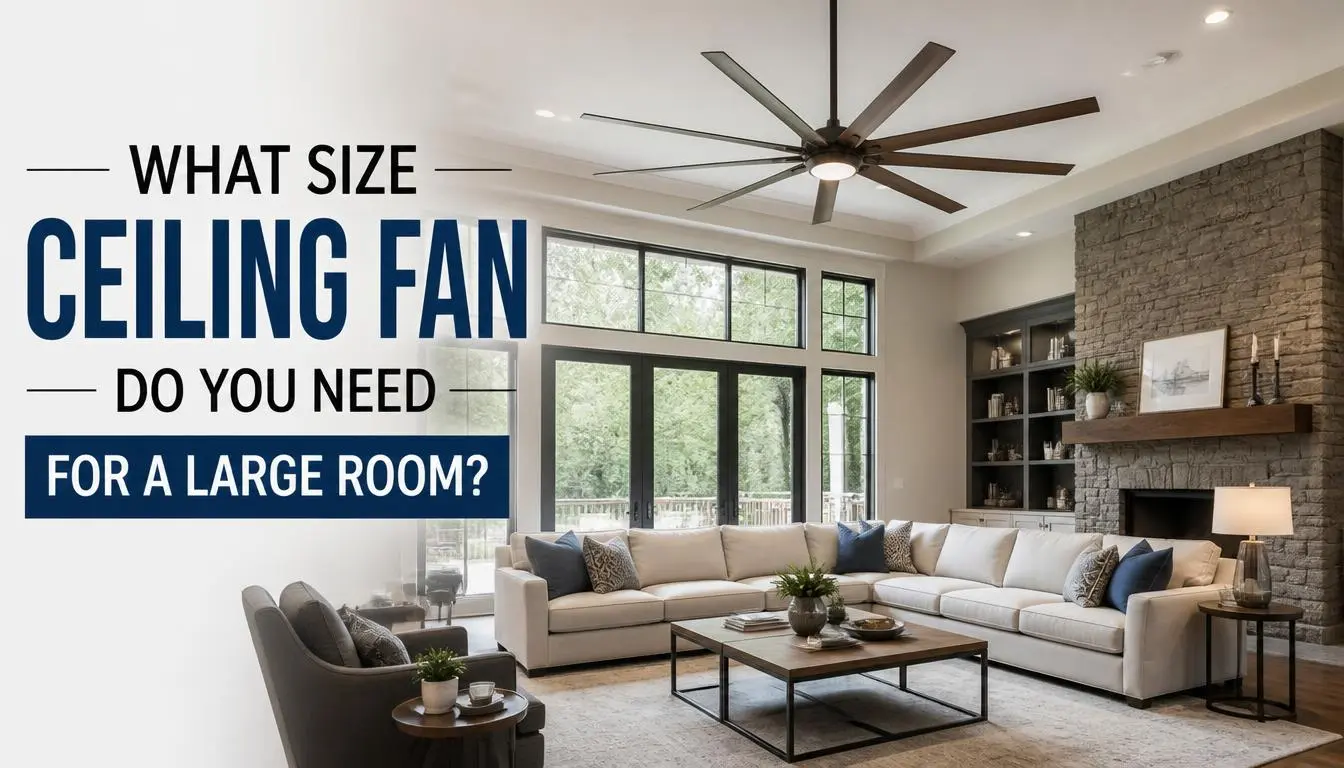
Blade span is one of the first things to consider when choosing a ceiling fan for a large room. It is the diameter of the circle made by the rotating blades, not the length of an individual blade.
A fan that is too small may provide a pleasant breeze directly underneath it but leave other seating areas without enough air movement. A suitable fan distributes airflow more effectively across the occupied space.
The right size depends on room dimensions, ceiling height, the fan’s airflow rating, and the shape of the room.
Large-Room Ceiling Fan Size Chart
The following chart is a practical starting point rather than a universal sizing rule.
| Room Size | Approximate Area | Fan Size to Investigate |
|---|---|---|
| 225–400 sq. ft. | 20.9–37.2 m² | 50–60 inches |
| 400–500 sq. ft. | 37.2–46.5 m² | 56–68 inches |
| 500–600 sq. ft. | 46.5–55.7 m² | 68–84 inches |
| More than 600 sq. ft. | More than 55.7 m² | An appropriately sized oversized fan or multiple fans |
These ranges extend beyond standard consumer sizing charts. For rooms larger than 400 square feet, check the manufacturer’s recommended room coverage, airflow rating, and mounting instructions rather than relying on blade span alone.
For a more detailed explanation, read our guide to ceiling fan size for room.
Best Ceiling Fan Size for a 400 Sq. Ft. Room
A 400-square-foot room is approximately 37.2 square metres.
A fan in the 52–60-inch range may be a reasonable starting point, depending on ceiling height and room layout. If the room is long, has a vaulted ceiling, or contains several seating areas, compare higher-airflow models rather than choosing by blade span alone.
Best Ceiling Fan Size for a 500 Sq. Ft. Room
A 500-square-foot room measures approximately 46.5 square metres.
For this size, investigate fans around 60–72 inches and compare their published airflow ratings. A 60-inch fan with strong airflow may perform better than a larger but less effective model under certain conditions.
If the room is open-plan or irregularly shaped, consider whether one fan can circulate air adequately across the entire occupied area.
Best Ceiling Fan Size for a 600 Sq. Ft. Room
A 600-square-foot room measures approximately 55.7 square metres.
An oversized fan in the 68–84-inch range may be worth considering. However, a long, narrow room can benefit from a different arrangement than a nearly square living room.
Measure the room, check the manufacturer’s room-coverage recommendations, and review clearance requirements before deciding.
60-Inch vs. 72-Inch vs. 84-Inch Ceiling Fans
A 60-inch fan is a good starting point for many large living rooms. It offers a larger blade span than a standard 44–52-inch fan while remaining manageable in a broad range of residential spaces.
A 72-inch fan is worth comparing when the room is particularly large, has a high ceiling, or requires airflow over a wider area.
An 84-inch fan is more specialised. It can be useful for large great rooms and open-plan spaces, but it needs sufficient clearance and a mounting arrangement appropriate for its size.
Do not assume that a larger fan always performs better. Motor performance, blade design, airflow, installation height, and air distribution all affect the result.
One Large Ceiling Fan vs. Two Smaller Fans
One large ceiling fan may work well in a relatively open, square-shaped room. Two smaller fans may be a better arrangement for some long rooms, L-shaped spaces, or rooms with separate seating and dining areas.
Consider using two fans when:
- The room is unusually long or has multiple functional areas.
- One central fan leaves occupied areas without adequate airflow.
- The layout allows each fan to be positioned safely and appropriately.
Before installing two fans, check their combined cost, wiring requirements, ceiling support, clearances, and independent control options.
How Much CFM Do You Need for a Large Room?

CFM stands for cubic feet per minute. It measures the volume of air a fan moves under specified test conditions.
For a large room, CFM is an important specification because it helps you compare the airflow capacity of different fans. However, a high CFM number alone does not guarantee that every part of the room will feel comfortable.
A very wide room, a room with high ceilings, and a long open-plan space can all need different airflow arrangements.
What CFM Rating Is Best for a Large Room?
There is no single CFM rating that is best for every large room.
A useful approach is to compare fans with published high-speed airflow ratings, then check their recommended room size and installation requirements.
For instance, a fan listed at 6,500 CFM may be adequate for one large living room, while a much larger space or a room with multiple occupied areas may benefit from a fan with higher airflow or a multiple-fan setup.
Also consider whether the manufacturer publishes airflow at different speeds. A fan is more versatile when it can deliver a comfortable breeze without needing to run at maximum speed all the time.
For more detail, read our guide to how much CFM you need for a ceiling fan.
CFM vs. Airflow Efficiency
CFM tells you how much air a fan moves. Airflow efficiency tells you how effectively it uses electricity to move that air.
Efficiency is often expressed as CFM per watt, written as CFM/W. In general, a higher efficiency rating indicates more airflow per unit of power under the relevant measurement method.
ENERGY STAR publishes efficiency criteria and certified-product information to help consumers compare qualifying models. You can review its ceiling fan efficiency criteria.
Check that the ratings you compare use the same definitions and testing methods. Manufacturer figures from different sources are not always directly comparable.
Does a Higher CFM Fan Always Work Better?
Not necessarily.
A fan may have a high maximum CFM rating but still be a poor fit for a particular room if its air distribution is unsuitable, its installation height is wrong, or its operation creates an uncomfortable breeze.
A useful large-room fan should balance:
- Adequate airflow for the occupied space.
- Comfortable airflow at the speeds you actually use.
- Appropriate blade span and installation height.
- Acceptable noise and vibration.
- Reasonable energy consumption.
The goal is not simply to purchase the highest CFM number. It is to choose a fan that makes the room more comfortable.
What to Look for When Buying a Ceiling Fan for a Large Room
1. Blade Span and Blade Design
Blade span determines the diameter of the area swept by the blades. Larger fans generally suit larger spaces, but blade span alone does not tell you how much air a fan will move.
Blade pitch, blade shape, motor performance, rotational speed, and blade material also affect airflow.
The number of blades is not a reliable shortcut for deciding which fan produces more air. A three-blade fan is not automatically stronger than a five-blade fan, or vice versa.
For a closer comparison, read our article on 3-blade vs. 5-blade ceiling fans.
2. DC vs. AC Motor
DC ceiling fans often offer low power consumption, several speed settings, and smooth operation. These features can make them attractive for a large room where the fan may run for extended periods.
AC models can still be good choices. Their value depends on the purchase price, design, performance, control options, and energy consumption.
Do not assume that every DC fan is more economical over its lifetime. Compare the motor’s actual power consumption, the hours you expect to use the fan, and the difference in upfront cost.
Our DC vs. AC ceiling fan guide explains the main differences and helps you compare the two motor types.
3. Ceiling Height and Downrod Length
Ceiling height matters because it determines how the fan can be mounted and where the airflow will reach occupants.
A standard mounting arrangement may not be suitable for a vaulted or unusually high ceiling. Depending on the model, you may need an extension downrod or an approved sloped-ceiling mounting kit.
Low ceilings require special attention too. Choose a fan that meets the manufacturer’s clearance guidance rather than assuming that a larger fan will fit safely.
ENERGY STAR’s ceiling fan basics and installation guidance provides additional information about fan size, placement, and mounting systems.
4. Noise Level and Motor Quality
A noisy fan can become irritating when people are watching television, reading, working, or sleeping.
Noise can result from the motor, loose mounting hardware, blade imbalance, or vibration transmitted through the ceiling.
Look for manufacturer noise specifications when available. Also check the construction quality, mounting system, and warranty.
Remember that a published decibel figure may apply only to particular operating conditions. Room acoustics and installation quality affect the noise you hear in everyday use.
5. Energy Efficiency and Running Costs
When a ceiling fan will run for several hours a day, its energy consumption deserves attention.
Compare published wattage, airflow efficiency, speed settings, and relevant energy certification. An efficient model that meets your airflow needs may be a better long-term choice than a fan selected solely for its blade size.
You can use the ENERGY STAR certified ceiling fan database to investigate qualifying models.
6. Integrated Lights and Smart Controls
An integrated light can simplify the installation and help reduce the need for separate overhead lighting.
Before choosing one, check the light output in lumens, dimming options, colour temperature, and whether the light can be replaced or serviced easily.
Smart features can be helpful if you want app-based controls, voice control, automation, or scheduled operation. However, they should not take priority over the fan’s basic airflow performance and compatibility with your home’s electrical system.
7. Indoor and Outdoor Ratings
A ceiling fan designed for a dry indoor room should not automatically be installed on a patio or exposed outdoor area.
Check the product’s stated location rating and permitted installation conditions. Damp-rated fans are intended for appropriate moisture-exposed environments, while wet-rated models are designed for locations with greater exposure to water, subject to the manufacturer’s instructions.
For outdoor spaces, also consider corrosion resistance, the weather suitability of the blades and housing, and the electrical installation requirements.
8. Warranty, Maintenance, and Replacement Parts
A large ceiling fan may be costly and difficult to replace, especially if it is installed on a high ceiling.
Before purchasing, review the motor warranty, warranty coverage for other components, availability of replacement parts, and service arrangements in your country.
Do not assume that a warranty from one region will apply to a model purchased from another region.
How Much Does It Cost to Run a Large Ceiling Fan?
Running costs depend on the fan’s power consumption, how many hours it operates, and the price you pay for electricity.
You can estimate the cost with this formula:
Electricity used (kWh) = Fan power (watts) ÷ 1,000 × Hours of use
Then calculate:
Running cost = Electricity used (kWh) × Your electricity rate per kWh
Example: A 25-Watt Ceiling Fan
Suppose your ceiling fan uses 25 watts and operates for eight hours each day.
- Daily energy use: 25 ÷ 1,000 × 8 = 0.2 kWh.
- Annual energy use: 0.2 × 365 = 73 kWh.
- Annual running cost: 73 × your local electricity price per kWh.
For example, if your electricity rate were 0.25 in your local currency per kWh, the estimated annual fan-only running cost would be 18.25 in that currency.
This example excludes the energy used by any integrated light. Actual consumption will vary with speed, standby power, and the specific fan model.
The calculation works whether your electricity bill is in US dollars, Canadian dollars, pounds, or Australian dollars. Use your own current tariff for a meaningful estimate.
How to Install and Position a Ceiling Fan in a Large Room
A correctly sized fan will not deliver its full benefits if it is mounted incorrectly.
Before installation, confirm the ceiling structure, mounting hardware, electrical supply, and blade clearance. Large ceiling fans can be heavy, and their mounting points must be capable of supporting the load.
The US ENERGY STAR installation guidance recommends mounting a ceiling fan at least seven feet above the floor and 18 inches from walls, with an installation height of eight to nine feet above the floor where the ceiling allows. Local requirements and manufacturer instructions may differ, particularly outside the United States.
Use the appropriate locally approved fan-rated mounting box or support. A typical lighting fixture box should not be assumed to be suitable for a ceiling fan.
For a high or sloped ceiling, use a compatible mounting system and the downrod length specified for the fan. If the wiring, structural support, or mounting arrangement is uncertain, use a qualified installer.
Read ENERGY STAR’s ceiling fan installation and usage tips for additional information.
How We Chose These Ceiling Fans for Large Rooms
This article uses published manufacturer specifications and official energy-efficiency records to identify models worth comparing for different large-room needs.
The evaluation considered blade span, stated airflow, energy consumption, available controls, integrated lighting, location rating, and installation requirements where those details were available.
This is a research-based shortlist, not a claim that the seven models were independently tested side by side. Product features and specifications can change, so buyers should confirm the exact model details before making a decision.
We also considered the needs of readers in the USA, UK, Canada, and Australia. However, the seven products do not have identical availability in every market.
Before purchasing, confirm that:
- The model’s electrical voltage and frequency are suitable for your home.
- The fan meets applicable local electrical and installation requirements.
- The product and its accessories are available in your country.
- The warranty and after-sales support apply to your region.
- The fan’s recommended room size and mounting requirements suit your space.
These checks are particularly important if you are considering importing a fan from another country.
Common Mistakes to Avoid When Buying a Ceiling Fan for a Large Room

Buying by blade span alone: A large fan is not necessarily the most effective option. Always compare airflow, motor performance, and room suitability.
Ignoring the room’s shape: A long or L-shaped room may need a different airflow arrangement than a square room with the same floor area.
Choosing the wrong mounting height: The fan must be installed according to its clearance and mounting requirements.
Assuming a high CFM rating means better efficiency: A fan that moves more air may also consume more power. Review both airflow and efficiency.
Overlooking noise and vibration: Check the mounting system, blade balance, motor specifications, and warranty.
Buying a model that is not electrically compatible: A North American model is not automatically appropriate for use in a UK or Australian home.
Leaving the fan running in an empty room: Ceiling fans make people feel cooler by moving air across the skin; they do not directly lower the room’s air temperature. Turning the fan off when nobody is in the room avoids unnecessary electricity use. The U.S. Department of Energy’s home-cooling guidance explains this principle.
Frequently Asked Questions
What Is the Best Ceiling Fan Size for a 20×20 Room?
A 20×20-foot room has an area of 400 square feet, or approximately 37.2 square metres. A 52–60-inch fan is a reasonable starting point for comparison, but ceiling height, airflow ratings, and room layout should influence the final decision.
Is a 60-Inch Ceiling Fan Big Enough for a Large Room?
Yes, a 60-inch fan can suit many large rooms. However, very large spaces, high ceilings, and open-plan layouts may need a larger model or more than one fan. Compare published airflow and room-coverage guidance before buying.
Is a 72-Inch Ceiling Fan Better for a Great Room?
A 72-inch fan can be useful in a spacious great room because it has a larger blade span than a typical 52-inch model. It is not automatically better for every space, though. Check the fan’s airflow rating, mounting requirements, and recommended room size.
How Much CFM Do I Need for a 500 Sq. Ft. Room?
There is no universal CFM requirement for every 500-square-foot room. Look for a fan designed for large spaces, compare high-speed airflow figures, and account for ceiling height and room shape. An open-plan room may require a different solution than a square room of the same area.
Is One Large Ceiling Fan Better Than Two Smaller Fans?
One large fan may be sufficient for an open, reasonably square room. Two smaller fans can work better in some long or irregularly shaped spaces where a single fan cannot distribute airflow adequately. Compare the room layout and installation costs before deciding.
Are High-CFM Ceiling Fans Noisy?
Not necessarily. Noise depends on motor quality, speed, blade design, installation, and vibration. Compare published noise ratings when available and remember that higher airflow does not automatically mean louder operation.
Are DC Ceiling Fans Worth It for Large Rooms?
A DC fan can be a good investment if its lower power consumption, speed options, or operating characteristics fit your needs. Whether it is worth the extra upfront cost depends on the price difference, expected use, and actual wattage of the models you compare.
What Is the Best Ceiling Fan for a High Ceiling?
Look for a model with appropriate downrod and mounting options, adequate airflow, and suitable clearance. The Big Ass Fans Haiku and Fanimation Odyn Custom ranges include configurations worth investigating for large spaces, but the correct model depends on the ceiling height and local installation requirements.
How Much Electricity Does a Large Ceiling Fan Use?
It depends on the model and speed. For example, a fan using 25 watts for eight hours consumes 0.2 kWh per day. Multiply its daily or annual energy use by your own electricity rate to estimate the running cost.
Can a Ceiling Fan Cool an Entire Large Room?
A ceiling fan can improve comfort by moving air through the occupied part of a room. It does not reduce the air temperature itself. For a very large or irregular room, correct sizing, placement, and airflow coverage are important, and more than one fan may be useful.
Final Verdict: Which Ceiling Fan Should You Choose for a Large Room?
The best ceiling fan for a large room is the one that matches your space, not necessarily the one with the largest blade span or the highest advertised CFM rating.
For a premium, design-focused installation, the Big Ass Fans Haiku is worth investigating. The Fanimation Odyn Custom is an option for extra-large spaces where high airflow is a priority. The Aeratron AE+3 deserves consideration if energy efficiency and quiet operation are important, while the Hunter Warrant and Hunter Phenomenon offer different combinations of integrated lighting and controls. The Minka-Aire Xtreme H2O is worth comparing for outdoor installations, and the Home Decorators Collection Altura DC is another option to investigate for buyers prioritizing a larger blade span and published efficiency information.
Before making your decision, measure the room, confirm the required mounting arrangement, compare airflow and energy consumption, and check local product availability and electrical compatibility.
A well-chosen ceiling fan should provide comfortable air movement where people actually spend time, operate at a suitable noise level, and meet your household’s needs without paying for features or capacity you do not need.

“The right fan can make a bigger difference than you think.”
Hi, I’m Michael Turner, an author and home appliance researcher at BestFanSolve.com.
My interest in fans started with a simple question: How do you know which fan is actually right for your needs? With so many types, features, brands, and technical specifications available, choosing a fan can quickly become confusing. I created BestFanSolve.com to make that process easier.
Through this website, I share practical fan reviews, buying guides, comparisons, troubleshooting tips, maintenance advice, and solutions to common fan problems. I focus on turning complicated product information into clear, useful guidance that everyday readers can actually understand and use.
Whether you’re searching for a quiet bedroom fan, a powerful fan for a large room, an energy-efficient option, or simply trying to figure out why your current fan isn’t working properly, my goal is to help you find the information you need before making a decision.
I believe good recommendations should be based on research, real-world considerations, honest pros and cons, and the specific needs of the user—not simply marketing claims.
Through BestFanSolve.com, I’m committed to helping readers find the right fan, solve common fan problems, and make smarter purchasing decisions with confidence.
— Michael Turner
Author & Home Appliance Researcher
BestFanSolve.com