
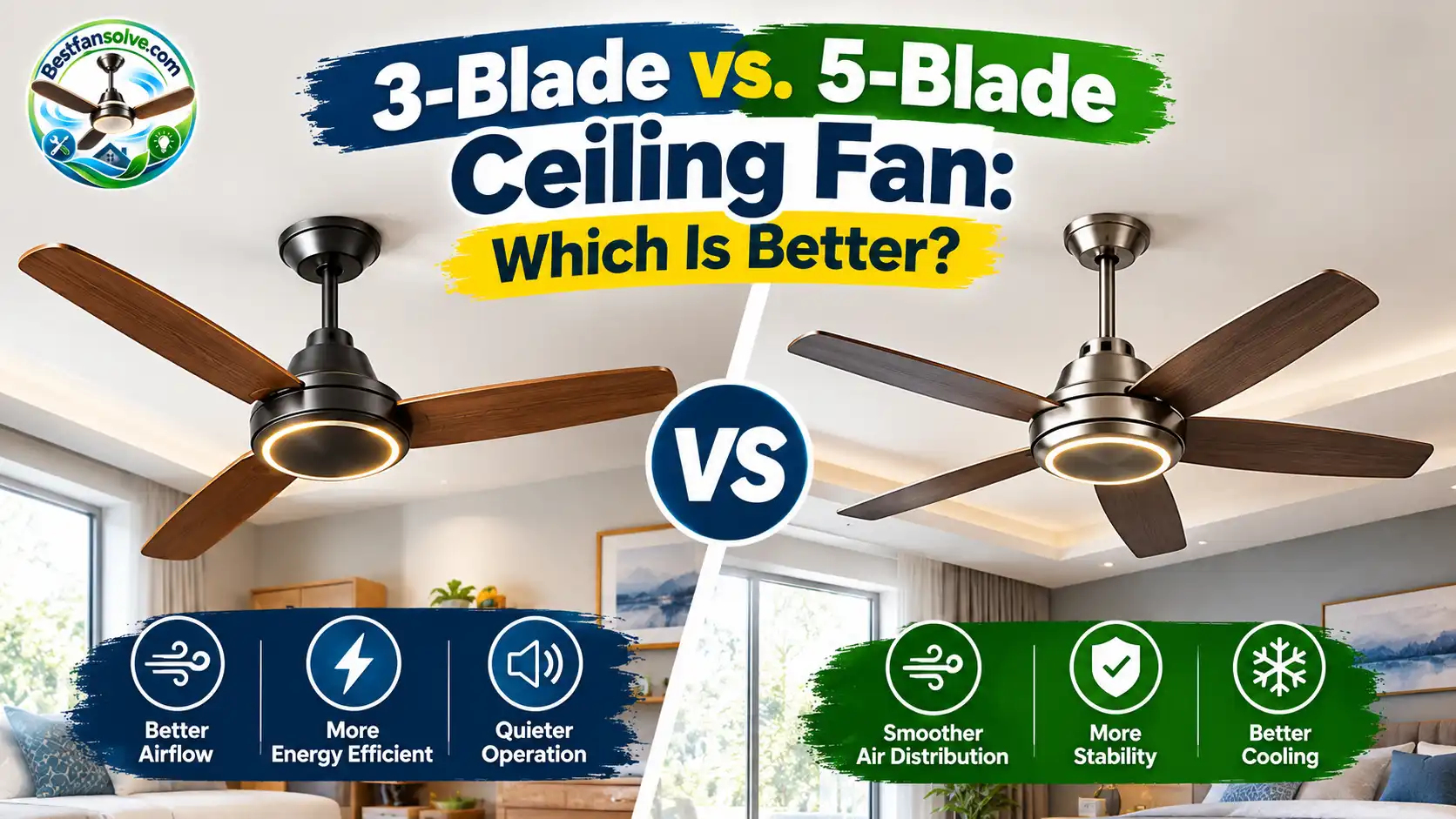
Choosing between a 3-blade and a 5-blade ceiling fan might seem like a simple design decision. However, if you want a fan that moves plenty of air, operates quietly, and keeps electricity costs under control, there are a few more things to consider.
Some people prefer the sleek, modern appearance of a three-blade fan, while others like the fuller look of a five-blade design. But does having more blades actually make a ceiling fan better? Does a three-blade fan move more air or use less electricity?
The truth is that neither blade count is automatically better. Airflow depends on the fan’s blade design, motor, speed, diameter, and overall engineering. Energy use and noise also vary between individual models.
In this guide, we’ll compare 3-blade vs. 5-blade ceiling fans, examine real manufacturer specifications, and explain how to choose the right option for your bedroom, living room, or other space.
3-Blade vs. 5-Blade Ceiling Fan: Key Differences at a Glance
Before looking at the technical details, here’s a quick comparison of the two designs.
| Feature | 3-Blade Ceiling Fan | 5-Blade Ceiling Fan |
|---|---|---|
| Appearance | Usually sleek and modern | Often fuller and more traditional |
| Airflow | Depends on the specific model | Depends on the specific model |
| Electricity use | Determined by motor power and efficiency | Determined by motor power and efficiency |
| Noise level | Depends on motor, blade design, and installation | Depends on motor, blade design, and installation |
| Air movement | Can provide strong airflow | Can provide strong airflow |
| Energy efficiency | Compare the CFM-per-watt rating | Compare the CFM-per-watt rating |
| Price | Varies by brand and features | Varies by brand and features |
| Best choice | Depends on performance and personal preference | Depends on performance and personal preference |
The biggest takeaway is that blade count alone doesn’t tell you how well a ceiling fan will perform. Two fans with the same diameter can produce different airflow levels and consume different amounts of electricity.
To make a good buying decision, look beyond the number of blades and compare the specifications that matter to you.
How Does the Number of Ceiling Fan Blades Affect Performance?
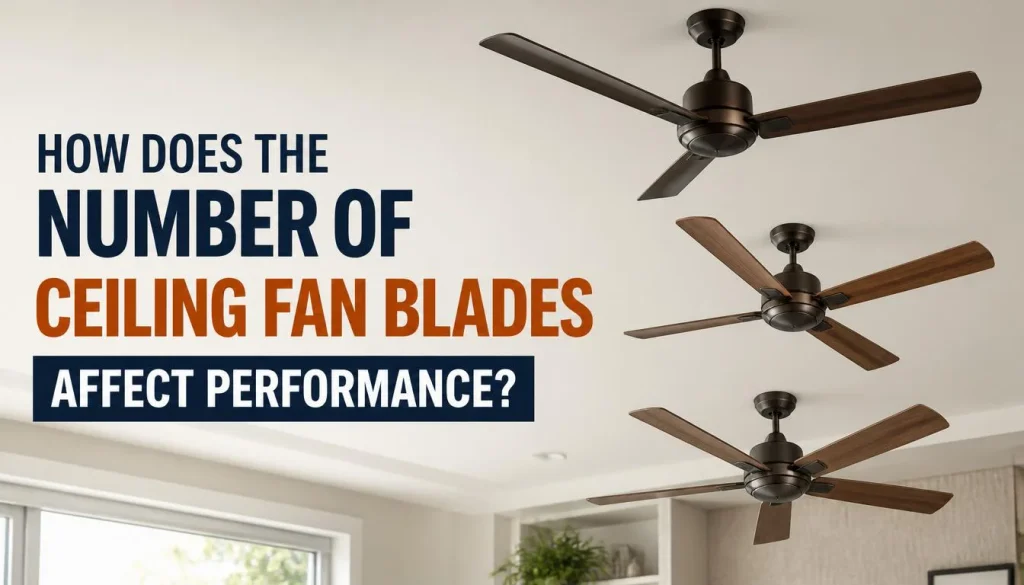
Ceiling fans move air by rotating their blades. As each blade passes through the air, its shape and angle help generate airflow.
Changing the number of blades changes the fan’s overall aerodynamic design. However, adding blades doesn’t automatically increase the amount of air a fan moves.
Several factors work together to determine performance.
Blade Pitch and Shape
Blade pitch refers to the angle at which a blade is positioned relative to its rotation. Blade shape and width also affect how the blade moves air.
A well-designed three-blade fan can deliver excellent airflow, while a carefully engineered five-blade model can also perform very well.
The important point is that blade count cannot compensate for a poorly designed blade. When comparing two models, look for manufacturer specifications rather than judging performance by appearance.
Motor Quality and Fan Speed
The motor powers the blades and determines how they rotate under different operating conditions.
A fan’s maximum speed can influence airflow, but RPM alone doesn’t tell the whole story. Blade pitch, diameter, motor design, and resistance from the moving air all affect the result.
A fan operating at a lower RPM may still deliver substantial airflow if its blades are designed efficiently.
This is why comparing two fans based only on their blade count or maximum RPM can lead to the wrong conclusion.
Blade Diameter Matters Too
Blade span is the overall diameter of the circle covered by the rotating blades. A larger blade span can help a fan circulate air across a wider area, provided the motor and blade design are suitable.
For example, a 52-inch ceiling fan and a 42-inch ceiling fan shouldn’t be compared solely by the number of blades. Their sizes differ, which affects how they move air and where they are best used.
If you’re unsure which diameter suits your room, read our guide on what size ceiling fan you need, including the room-size chart.
Which Moves More Air: 3-Blade or 5-Blade Ceiling Fan?
This is probably the biggest question people have when comparing these two designs.
The answer depends on the specific models. A three-blade fan can produce more airflow than a five-blade fan, but the opposite can also be true.
What Is CFM?
CFM stands for cubic feet per minute. It measures the volume of air a fan moves under specified operating conditions.
A higher CFM rating generally indicates greater total airflow at the stated operating speed. However, that doesn’t necessarily mean the fan will feel more comfortable in every room.
Air velocity is another useful measurement. It describes how quickly air moves through a particular area. The amount of air a fan circulates and the speed of the air you feel are related, but they aren’t identical.
For a practical comparison, check the manufacturer’s published CFM ratings, preferably at the same speed setting and under comparable test conditions.
A Real Example: Comparing Two 52-Inch Ceiling Fans
Let’s look at two models from the same manufacturer: the three-blade configuration of the Fanimation Kute and the five-blade Fanimation Kute5.
According to their official product specifications:
| Specification | Fanimation Kute, 52-Inch | Fanimation Kute5, 52-Inch |
|---|---|---|
| Blade configuration | 3 blades | 5 blades |
| Blade span | 52 inches | 52 inches |
| Airflow at high speed | 6,701 CFM | 6,495 CFM |
| High-speed air velocity | 542 (manufacturer-listed value) | 528 (manufacturer-listed value) |
Sources: Fanimation Kute specifications and Fanimation Kute5 specifications.
In this particular comparison, the three-blade model has the higher published high-speed airflow rating. The difference is about 3.2% relative to the five-blade model’s rating.
That doesn’t prove three-blade fans always move more air. It simply demonstrates why checking actual model specifications is more useful than assuming that five blades must produce stronger airflow.
These figures also don’t establish which fan is more energy efficient, because airflow alone doesn’t tell you how much electrical power each fan consumes.
Which Fan Produces a Stronger Breeze?
If you prefer a noticeable breeze while sitting or relaxing, pay attention to the fan’s airflow performance and the way its air movement feels at the speeds you normally use.
A high maximum CFM rating can be useful, but you should also consider lower-speed performance. Someone who wants gentle airflow while sleeping may prefer a fan that offers comfortable, adjustable speeds rather than one selected exclusively for maximum output.
The best choice is the fan that provides suitable airflow for your room and comfort preferences.
Which Ceiling Fan Is More Energy Efficient: 3 Blades or 5 Blades?
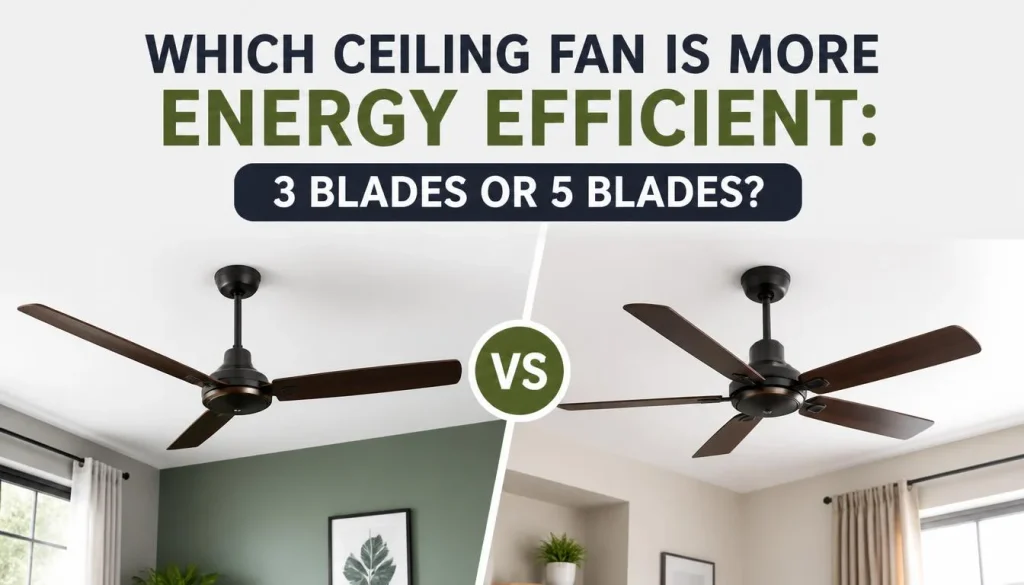
A common belief is that a three-blade ceiling fan always uses less electricity because it has fewer blades. That isn’t a reliable rule.
Electricity consumption depends on the motor, blade design, operating speed, controls, and overall efficiency of the model.
A three-blade fan may use less power than a particular five-blade fan, but another five-blade model may be more efficient than a poorly matched three-blade alternative.
Compare Watts and CFM per Watt
Two specifications are especially useful when shopping for an energy-efficient ceiling fan.
Watts (W) indicate how much electrical power a fan consumes while operating under the specified conditions.
CFM per watt (CFM/W) indicates how much airflow a fan produces for each watt of power consumed. A higher value generally means better airflow efficiency at the relevant operating conditions.
For example, imagine two fans providing the same airflow at the speeds being compared. If one uses less power, it offers better airflow per watt at those operating points.
For additional guidance, consult ENERGY STAR’s ceiling fan efficiency criteria. The program evaluates airflow and efficiency according to fan size and applicable testing requirements.
When shopping in the USA, check for relevant ENERGY STAR certification where available. In the UK, Canada, and Australia, also check the applicable local product information and energy requirements.
How to Calculate Your Ceiling Fan’s Running Cost
You can estimate electricity costs without knowing whether the fan has three or five blades.
Use this formula:
Electricity consumed (kWh) = Power (W) ÷ 1,000 × Hours of use
Then calculate:
Running cost = Electricity consumed (kWh) × Your electricity rate per kWh
Suppose a fan uses 35 watts and runs for eight hours daily over 30 days.
35 ÷ 1,000 × 8 × 30 = 8.4 kWh
Multiply 8.4 kWh by your actual electricity tariff to estimate the monthly running cost.
The example is illustrative, not a claim about the power consumption of either fan design. For an accurate comparison, use each model’s actual power-consumption data at the speed you intend to use.
Which Ceiling Fan Is Quieter: 3 Blades or 5 Blades?
If you’re buying a ceiling fan for a bedroom, home office, or quiet living space, noise can be just as important as airflow.
However, the number of blades doesn’t guarantee a quieter fan.
What Causes Ceiling Fan Noise?
Most noticeable ceiling fan noise comes from a combination of factors, including:
- Motor noise during operation.
- Air moving around the blades.
- Vibration caused by an unbalanced fan.
- Loose screws, mounting hardware, or other installation issues.
- Mechanical wear or problems with individual components.
Blade design and speed can affect the sound a fan produces, but neither a three-blade nor a five-blade design is automatically quieter in every situation.
A poorly installed five-blade fan may produce more noise than a properly installed three-blade fan. Similarly, a well-engineered five-blade model may operate very quietly.
How to Choose a Quiet Fan for a Bedroom
Start by checking whether the manufacturer provides noise information for the specific model. Where comparable sound ratings are available, use them rather than assuming that blade count determines noise.
Also consider the fan’s low-speed operation, motor type, speed controls, and installation requirements. A fan that offers comfortable airflow at a lower setting can be particularly useful if you dislike strong air movement while sleeping.
If a fan develops new rattling, clicking, or excessive vibration, inspect it according to the manufacturer’s instructions. Switch off the power before checking accessible mounting hardware, and use a qualified electrician when electrical or mounting repairs are needed.
Pros and Cons of 3-Blade Ceiling Fans
A three-blade ceiling fan is often a good option for homeowners who like a clean, streamlined appearance.
Advantages of 3-Blade Fans
Modern appearance: Three-blade designs often suit contemporary, minimalist, and industrial-style interiors.
Potentially strong airflow: Some three-blade models provide excellent airflow. The actual performance depends on their specifications rather than the blade count alone.
A wide range of designs: Three-blade fans are available in different sizes, finishes, and mounting configurations.
Simple visual profile: The fewer blades may create a less visually busy look, which some homeowners prefer in smaller or modern rooms.
Disadvantages of 3-Blade Fans
Not automatically energy efficient: You still need to compare wattage and airflow efficiency.
Design may not suit every room: Some people prefer the fuller appearance of a five-blade fan.
Performance varies considerably: A three-blade fan with a weak motor or unsuitable blade design may not meet your airflow needs.
In other words, three blades are a design characteristic, not a guarantee of superior performance.
Pros and Cons of 5-Blade Ceiling Fans
Five-blade fans are popular with homeowners who prefer a fuller ceiling fixture or a more traditional appearance.
Advantages of 5-Blade Fans
Fuller appearance: Five-blade designs can complement traditional interiors, larger decorative fixtures, and certain classic styles.
Strong airflow is possible: A well-designed five-blade fan can circulate substantial amounts of air.
Plenty of design choices: These fans come in various finishes, blade materials, sizes, and control options.
Suitable for different room styles: The additional blades may create a more balanced visual appearance in some spaces, depending on the fixture’s design.
Disadvantages of 5-Blade Fans
Performance is model-dependent: Five blades don’t guarantee more airflow or better cooling.
Energy use must still be checked: The motor and operating characteristics determine power consumption.
The appearance may feel too busy: Some homeowners prefer the cleaner silhouette of a three-blade fan.
Price depends on the complete product: More blades don’t automatically mean a more expensive fan. Brand, materials, motor technology, and extra features can have a greater influence on the final price.
Which Blade Count Is Best for Your Room?
The right ceiling fan depends on the dimensions of the room, your airflow needs, the available mounting space, and your design preferences.
Best for Bedrooms
For a bedroom, focus on quiet operation, adjustable speed settings, comfortable airflow, and energy efficiency.
Either a three-blade or a five-blade fan can be suitable. If you prefer a gentle breeze while sleeping, look carefully at low-speed performance instead of choosing the model with the highest advertised CFM.
Also make sure the fan is correctly sized for your bedroom.
Best for Living Rooms
Living rooms often benefit from a fan that provides comfortable airflow across the main seating area.
Consider the size and layout of the room, ceiling height, furniture placement, and the fan’s airflow rating. Both blade configurations can work well if the model is appropriately sized and positioned.
Aesthetics may become a bigger consideration here because the fan is often a visible part of the room’s decor.
Best for Large Rooms
For a large room, check blade span and airflow specifications before deciding between three and five blades.
A well-sized fan with sufficient airflow may perform better than a smaller fan with a blade configuration you assume is superior. Long or open-plan spaces may need more than one appropriately positioned fan for better coverage.
Room size should guide your selection, not blade count alone.
Best for Low Ceilings
Low ceilings require particular attention to installation height and clearance.
A flush-mount or low-profile model may be more appropriate than a fan designed to hang from a long downrod. Check the complete installed dimensions, including any light kit, along with the manufacturer’s minimum clearance and local safety requirements.
The number of blades does not determine whether a fan is suitable for a low ceiling.
Best for Covered Patios and Outdoor Areas
If you’re installing a ceiling fan in a covered patio or another outdoor area, check the product’s environmental rating.
A damp-rated fan may suit some protected, humid locations, while a space exposed to direct rain generally requires a model specifically rated for wet locations.
Do not assume that an indoor fan is suitable for outdoor use simply because it has three or five blades.
What Else Should You Check Before Buying?
Blade count is only one part of a ceiling fan’s overall design. Before making a purchase, compare these additional features.
Blade material: Wood, composite, and other blade materials have different appearances and maintenance requirements. Choose a material suitable for your intended location and follow the manufacturer’s care instructions.
Blade size and design: Blade span, pitch, shape, and overall construction influence airflow. Compare the specifications rather than judging a fan by its appearance alone.
Lighting: Some ceiling fans include a light kit, while others offer compatible lighting as a separate accessory. Check the product description carefully before comparing prices.
Remote controls and speed settings: Multiple speed settings can help you adjust airflow to suit different conditions. Smart controls may also be useful if you want to operate the fan through compatible devices.
Warranty and installation: Review the warranty terms, mounting requirements, and any additional accessories needed for installation.
Overall value: Compare the price against airflow, power consumption, noise performance, build quality, and useful features. A more expensive fan isn’t necessarily the better option for your room.
For a more complete walkthrough of these factors, see our guide to choosing the right ceiling fan for every room.
How to Choose Between a 3-Blade and 5-Blade Ceiling Fan
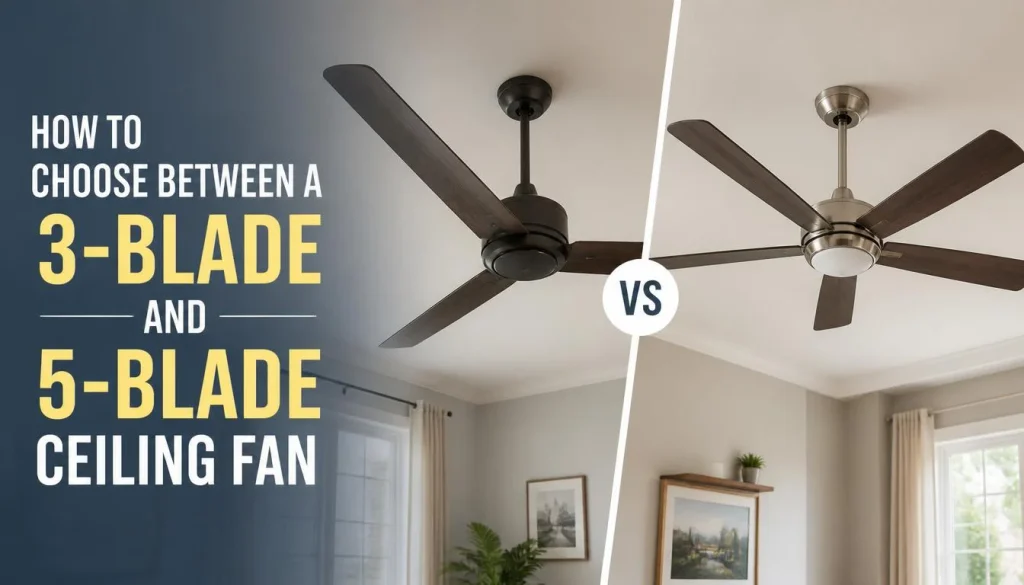
Still unsure which one to buy? Follow these practical steps before making your final decision.
Step 1: Measure your room. Calculate the floor area and determine an appropriate fan size. Check the manufacturer’s recommendations and allow for safe blade clearance.
Step 2: Compare airflow ratings. Look at the published CFM figures for the models you’re considering. If possible, compare their performance at equivalent speed settings.
Step 3: Check energy efficiency. Compare watts and CFM per watt at relevant operating conditions. Estimate running costs using your local electricity tariff.
Step 4: Consider noise and comfort. For bedrooms and home offices, prioritize quiet operation, low-speed performance, and adjustable controls.
Step 5: Choose the design you prefer. Once you’ve narrowed the options based on practical requirements, choose the appearance that best suits your room.
Step 6: Review the complete specifications. Check mounting type, lighting, controls, warranty, environmental rating, and installation requirements before ordering.
This approach helps you choose a fan based on performance and comfort instead of relying on an assumption about blade count.
Frequently Asked Questions
Is a 3-Blade Ceiling Fan Better Than a 5-Blade Fan?
Neither design is universally better. A three-blade fan may appeal to you because of its modern appearance, while a five-blade fan may better suit your decor. Compare their airflow, energy efficiency, noise, and overall specifications to decide which performs better for your needs.
Do 5-Blade Ceiling Fans Move More Air?
Not necessarily. The number of blades alone doesn’t determine airflow. A three-blade fan can have a higher CFM rating than a five-blade model, depending on motor power, blade pitch, diameter, and aerodynamic design.
Are 3-Blade Ceiling Fans More Energy Efficient?
Not always. Energy efficiency depends on how much power the fan consumes relative to the airflow it produces. Compare wattage and CFM per watt rather than choosing based on the number of blades.
Which Ceiling Fan Is Quieter for Sleeping?
Either type can be quiet enough for a bedroom. Look for a model with good low-speed performance, suitable noise specifications where available, and a well-designed motor. Proper installation and balancing are also important.
Does Blade Count Affect RPM?
Blade count can influence the aerodynamic characteristics of a fan, but there is no universal RPM rule for three-blade versus five-blade models. Motor design, blade geometry, speed settings, and operating conditions all matter.
Compare actual airflow and power-consumption data instead of assuming that higher RPM always means better performance.
Is a 3-Blade or 5-Blade Ceiling Fan Better for a Large Room?
Either may work well if the fan is correctly sized and delivers sufficient airflow. Check the room dimensions, blade span, published CFM, mounting height, and room layout before choosing.
Is a 3-Blade or 5-Blade Ceiling Fan With Light Better?
The better choice depends on your lighting needs, airflow requirements, and preferred appearance. Check whether the light kit is included or sold separately, and compare the complete product specifications and cost.
How Many Blades Should a Good Ceiling Fan Have?
There is no single ideal number of blades for every home. Three-blade and five-blade fans can both offer good performance. Choose based on verified airflow, energy efficiency, noise, room suitability, build quality, and design.
Conclusion
When comparing a 3-blade vs. 5-blade ceiling fan, it’s easy to focus on the most visible difference. However, the number of blades alone won’t tell you which fan will deliver the best results.
Three-blade fans often appeal to homeowners who prefer a sleek, modern design, while five-blade fans may suit those who want a fuller, more traditional look. Both can provide excellent airflow, and neither is automatically quieter or more energy efficient.
Before buying, compare the manufacturer’s CFM ratings, power consumption, efficiency, operating noise, blade span, and installation requirements. Make sure the fan is appropriate for your room and offers the level of airflow you actually need.
The best ceiling fan isn’t necessarily the one with more or fewer blades. It’s the one that delivers the right combination of airflow, comfort, efficiency, and design for your home.

“The right fan can make a bigger difference than you think.”
Hi, I’m Michael Turner, an author and home appliance researcher at BestFanSolve.com.
My interest in fans started with a simple question: How do you know which fan is actually right for your needs? With so many types, features, brands, and technical specifications available, choosing a fan can quickly become confusing. I created BestFanSolve.com to make that process easier.
Through this website, I share practical fan reviews, buying guides, comparisons, troubleshooting tips, maintenance advice, and solutions to common fan problems. I focus on turning complicated product information into clear, useful guidance that everyday readers can actually understand and use.
Whether you’re searching for a quiet bedroom fan, a powerful fan for a large room, an energy-efficient option, or simply trying to figure out why your current fan isn’t working properly, my goal is to help you find the information you need before making a decision.
I believe good recommendations should be based on research, real-world considerations, honest pros and cons, and the specific needs of the user—not simply marketing claims.
Through BestFanSolve.com, I’m committed to helping readers find the right fan, solve common fan problems, and make smarter purchasing decisions with confidence.
— Michael Turner
Author & Home Appliance Researcher
BestFanSolve.com