
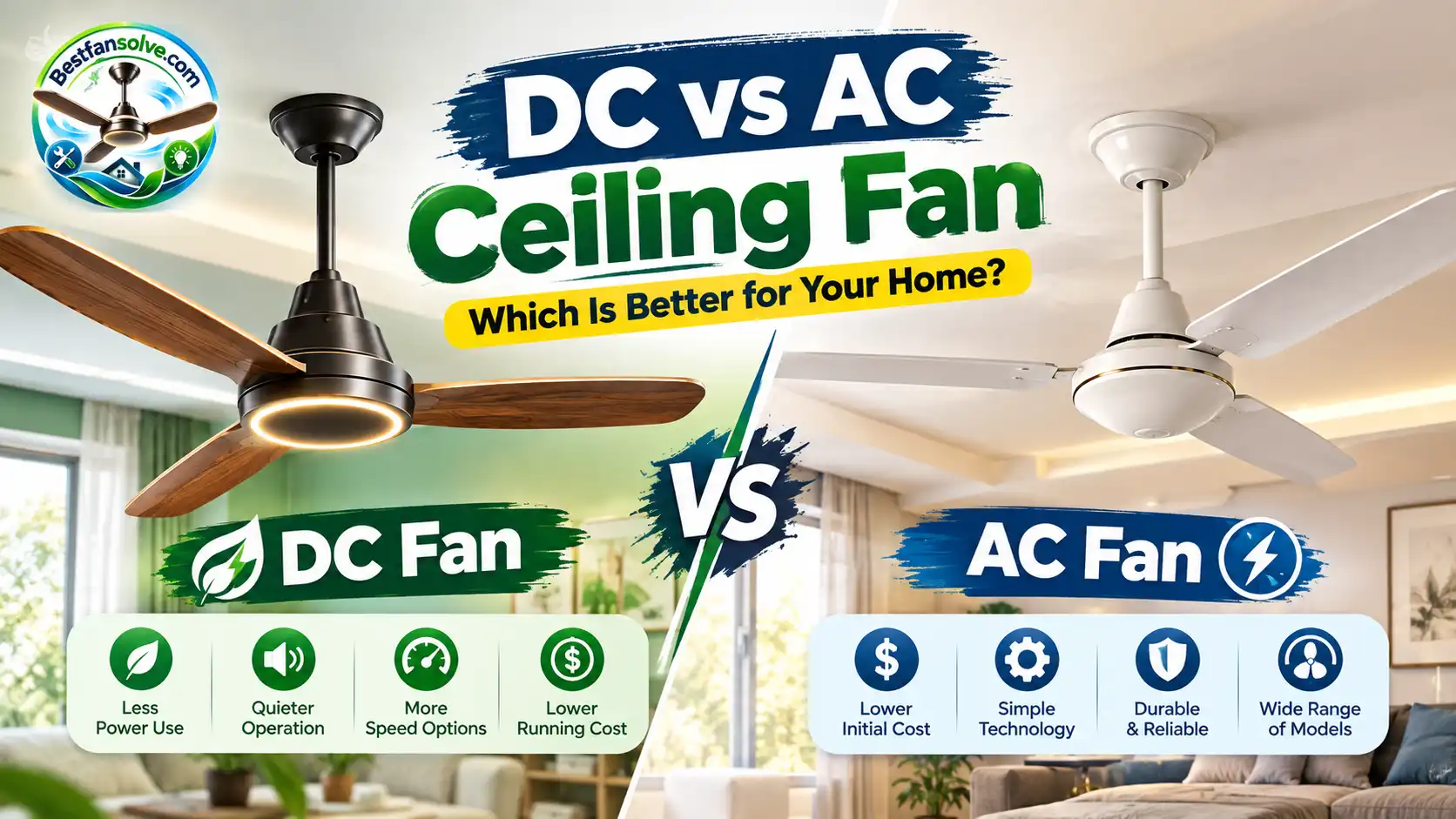
Choosing between a DC and an AC ceiling fan can be confusing, especially when both types look similar but have different motors, energy requirements, controls, and prices. One fan may cost less to buy, while another may use less electricity over years of regular use.
So, which is better: a DC or an AC ceiling fan?
A DC ceiling fan is often the better choice for people who prioritize energy efficiency, quiet operation, and more speed settings. An AC ceiling fan can be a sensible option for buyers who want a lower upfront price and a straightforward fan for occasional use. However, the best choice depends on the individual fan’s airflow, power consumption, features, and total cost.
In this guide, we’ll compare DC vs. AC ceiling fans in detail, explain how to calculate electricity costs, and show you what to check before buying. By the end, you’ll have a practical way to choose a fan that suits your room, budget, and everyday needs.
DC vs. AC Ceiling Fan: Quick Comparison
Before looking at the technical details, here’s how the two types generally compare.
| Feature | DC Ceiling Fan | AC Ceiling Fan |
|---|---|---|
| Motor type | Direct current, commonly a brushless DC motor | Alternating current motor |
| Energy efficiency | Generally more efficient, depending on the model | Efficiency varies by model |
| Electricity consumption | Often lower at comparable airflow | Can be higher at comparable airflow |
| Operating noise | Often quieter at low speeds | May produce more motor hum |
| Speed settings | Often more speed options | Often fewer speed options |
| Initial purchase price | Usually higher | Usually lower |
| Controls | Commonly remote or dedicated electronic controls | May use a pull chain, compatible wall control, or remote |
| Airflow | Depends on motor, blade design, and fan size | Depends on motor, blade design, and fan size |
| Maintenance | Electronic controller may require model-specific replacement parts | Some designs use conventional, more widely available components |
| Running costs | Often lower | Often higher |
| Best suited for | Frequent use, bedrooms, and efficiency-focused homes | Budget-conscious purchases and occasional use |
These are general tendencies, not guarantees. Some AC fans perform better than some DC models, so always compare the specifications of the actual products you’re considering.
What Is an AC Ceiling Fan?
An AC ceiling fan uses an alternating current motor to rotate its blades and circulate air around a room. AC stands for alternating current, the type of electricity commonly supplied to homes.
Traditional AC ceiling fans have been widely used for decades. They are available in a variety of sizes, styles, and price ranges, making them an accessible option for many households.
How Does an AC Ceiling Fan Work?
An AC motor uses an electromagnetic field to produce rotation. The motor turns the fan blades, creating airflow that helps people feel cooler.
Many traditional residential AC ceiling fans use induction motor designs with capacitors and compatible speed controls. The exact arrangement depends on the model.
When you change the speed using a compatible controller, the fan operates at a different speed and moves a different amount of air.
Advantages of AC Ceiling Fans
1. Lower upfront cost
AC ceiling fans often have lower purchase prices than comparable DC models. If your budget is limited, this can make an AC fan an attractive option.
2. Familiar controls
Many traditional AC fans use simple pull chains or conventional controls designed for their particular motor.
3. Plenty of replacement options
Because AC ceiling fans have been common for a long time, you may find a wide selection of models and compatible replacement parts. Availability still depends on the brand and product design.
4. Suitable for occasional use
If you only operate a fan for a few hours at a time, the electricity savings from a more efficient model may take longer to offset its higher purchase price.
Disadvantages of AC Ceiling Fans
AC fans have some potential drawbacks.
They may consume more electricity than comparable, efficient DC models. Some offer fewer speed settings, making it harder to find a very gentle airflow for sleeping.
Motor noise can also be noticeable in certain models, particularly if the fan is poorly installed or has worn components.
However, these limitations aren’t universal. A well-designed AC ceiling fan can still provide excellent airflow, acceptable noise levels, and good value.
What Is a DC Ceiling Fan?
A DC ceiling fan uses a direct current motor. Many modern DC ceiling fans use brushless DC (BLDC) motors controlled by internal electronics.
Although the motor operates on direct current, the fan can still be designed to connect to a home’s ordinary AC electrical supply. Its internal electronics convert and regulate the incoming power for the motor.
This is one reason DC ceiling fans may cost more than traditional AC models: they require a suitable electronic controller in addition to the motor.
How Does a DC Ceiling Fan Work?
A typical DC ceiling fan has a motor and electronic controller that regulate rotation and speed.
The controller manages the electrical power supplied to the motor, allowing the fan to operate efficiently across different speed settings.
Brushless DC motors avoid some of the electrical losses associated with conventional AC induction motors. As a result, DC motors are generally more efficient and often quieter, although overall fan performance still depends on the complete design.
The U.S. Department of Energy discusses these motor differences in its technical analysis of ceiling fan motor technologies.
Advantages of DC Ceiling Fans
1. Lower electricity consumption in many models
An efficient DC fan can deliver the desired airflow while using less electrical power. This is particularly useful when the fan operates for several hours daily.
2. More speed settings
Many DC ceiling fans offer additional speed levels, giving you greater control over airflow.
3. Quiet operation
A well-designed DC fan can operate very quietly at lower speeds, making it an appealing choice for bedrooms, nurseries, and home offices.
4. Flexible control features
Depending on the model, you may get a remote control, timer, reverse function, sleep mode, or smart-home compatibility.
5. Potential long-term savings
If you use the fan regularly, lower electricity consumption may help offset a higher initial purchase price.
Disadvantages of DC Ceiling Fans
DC fans aren’t perfect for every household.
They often cost more upfront than comparable AC models. Their electronic controllers can also make repairs more model-specific, and replacing a proprietary remote or receiver may be inconvenient if the manufacturer no longer supports the product.
Compatibility is another consideration. A DC fan may not work properly with an existing AC fan-speed regulator or a conventional dimmer switch.
Before buying, check the manufacturer’s specifications, controller compatibility, warranty, and replacement-part availability.
8 Key Differences Between DC and AC Ceiling Fans
Understanding these differences will help you choose a fan based on how you’ll actually use it, rather than simply choosing one because it has a newer motor.
1. Energy Efficiency and Electricity Consumption
Energy efficiency is one of the biggest reasons people consider DC ceiling fans.
In many cases, a DC fan can produce useful airflow with less electrical power than a comparable AC fan. However, efficiency depends on the motor, blade design, fan size, and operating speed.
A DC label alone doesn’t guarantee lower electricity consumption than every AC alternative.
The more useful question is: How much airflow does the fan provide for each watt of electricity it uses?
For an initial comparison, look at the fan’s rated power consumption in watts. Then compare that figure with its airflow under similar operating conditions.
A fan using 25 watts while delivering your required airflow may be a better choice than one using 40 watts to provide a similar result.
If you’d like to understand how much airflow you actually need, read our guide to how much CFM you need for a ceiling fan.
2. CFM per Watt: How to Compare Real Efficiency
CFM stands for cubic feet per minute. It measures the volume of air a fan moves.
CFM per watt, written as CFM/W, measures airflow efficiency. A higher CFM/W value means the fan delivers more airflow for each watt used under the relevant test conditions.
The calculation is straightforward:
Airflow efficiency = Airflow (CFM) ÷ Power consumption (watts)
For example, suppose two fans provide the following performance at their respective tested settings:
| Specification | Fan A | Fan B |
|---|---|---|
| Airflow | 5,000 CFM | 5,000 CFM |
| Power consumption | 25 W | 40 W |
| Airflow efficiency | 200 CFM/W | 125 CFM/W |
Fan A provides the same rated airflow using less power. Its airflow efficiency is therefore higher.
These figures are illustrative, not specifications for actual products.
For US shoppers, the ENERGY STAR ceiling fan efficiency criteria explain how fan efficiency is assessed. The program’s efficiency metric considers performance at multiple speeds and standby mode for applicable fan categories.
When comparing products, also check the applicable test method and certification requirements in your country.
3. Noise Levels: Which Motor Is Quieter?
If you plan to use a ceiling fan while sleeping, noise can be just as important as energy efficiency.
DC ceiling fans often have an advantage because their motors can run quietly, particularly at lower speeds.
AC ceiling fans can also be quiet, but some models produce a noticeable motor hum. In either type, installation problems, loose screws, worn bearings, or blade imbalance can create clicking, knocking, or vibrating sounds.
It’s important to distinguish motor noise from the sound of moving air.
A fan running at high speed may create more airflow noise even if its motor is quiet.
For a bedroom, consider the following:
- Look for low-speed noise information when the manufacturer provides it.
- Read reviews that specifically mention overnight use.
- Choose a model with stable, balanced blades.
- Check that the mounting hardware and ceiling support are suitable.
The independent Australian consumer organisation CHOICE’s ceiling fan buying guide recommends checking a fan’s noise at low speed, especially when choosing one for a bedroom.
Verdict: A DC ceiling fan is often a good starting point for quiet operation, but the actual fan’s design and installation matter more than the motor label alone.
4. Airflow: Does a DC Fan Move More Air?
Not necessarily.
A DC motor doesn’t automatically make a fan more powerful. A fan’s airflow also depends on its blade span, blade shape, pitch, motor performance, and overall design.
For example, a well-designed AC ceiling fan with a suitable blade span may move more air than a smaller or poorly designed DC model.
When comparing airflow, check:
- CFM rating: The manufacturer’s stated airflow under the relevant test conditions.
- Blade span: The overall diameter covered by the rotating blades.
- Power consumption: How many watts the fan uses to deliver the stated airflow.
- Speed range: Whether the fan can provide both gentle and stronger airflow.
- Room suitability: Whether the airflow matches your room’s size and layout.
A fan also needs to be appropriately sized for its room. Buying a highly efficient fan that is too small may leave you disappointed with its performance.
Our guide to choosing the right ceiling fan explains the other factors that influence a good buying decision.
5. Purchase Price: Which Fan Costs Less?
AC ceiling fans generally have a lower upfront price, although premium AC models can cost more than basic DC models.
DC models often cost more because of their motor and electronic control systems.
However, the cheapest fan isn’t necessarily the most economical option over its lifetime.
Suppose an AC fan costs $90 and a comparable DC fan costs $150. The DC fan costs $60 more initially.
Whether that extra money is worthwhile depends on the fan’s electricity consumption, how frequently you use it, and how long you expect to keep it.
For an occasional-use guest room, the lower-priced AC fan could be the more practical purchase. For a bedroom where the fan runs nightly, paying more for an efficient DC model may make better financial sense.
The important thing is to evaluate the total cost rather than the purchase price alone.
6. Speed Settings and Everyday Comfort
AC and DC ceiling fans may offer different levels of speed control.
Many traditional AC fans provide three main speed settings. Many DC models offer five, six, or more settings, although the exact number varies.
Additional speed options can be useful when you want gentle airflow at night but stronger circulation during the afternoon.
Instead of choosing between low, medium, and high, you may be able to select a more precise airflow level.
This can improve comfort, especially in bedrooms and home offices.
Still, having more settings doesn’t automatically make a fan better. The fan must also provide a useful range of airflow without excessive noise or vibration.
When shopping, check both the number of speed settings and the actual airflow performance.
7. Remote Controls, Wall Switches, and Smart Features
Control compatibility is an important difference between many AC and DC ceiling fans.
Traditional AC fans may use pull chains, compatible wall speed controls, or remote receivers. DC fans often rely on a dedicated electronic controller and remote.
Some DC fans can be operated with a wall-mounted control, while others use a remote for full functionality. Smart features also vary between models.
If you’re replacing an existing fan, don’t assume you can reuse every part of your old setup.
In particular, an ordinary light dimmer or an incompatible fan-speed regulator may interfere with the electronics. Hunter Fan’s guidance on using controls with an existing wall switch explains why compatible controls matter.
Before buying, confirm whether the fan supports:
- Your existing wall switch.
- Its intended remote or wall controller.
- Separate control of the fan and light, if applicable.
- Timer, sleep, or smart-home features you actually need.
The manufacturer’s installation manual should be your final reference.
8. Maintenance, Repairs, and Expected Lifespan
Neither DC nor AC ceiling fans are guaranteed to last longer simply because of their motor type.
A fan’s lifespan depends on component quality, operating conditions, installation, maintenance, and the availability of replacement parts.
Traditional AC fans may have relatively familiar components, such as capacitors in certain designs. DC fans may use electronic controllers or receivers that require a compatible replacement.
That doesn’t mean every AC fan is easier to repair or every DC fan is expensive to maintain. A well-supported DC model may be easier to service than an obscure AC model.
Before purchasing, check:
- The motor and component warranty.
- Availability of the correct controller or receiver.
- Whether replacement remotes can be ordered.
- Availability of service centres or technical support.
- The cost of likely replacement parts.
For a fan you’ll use every day for years, reliable after-sales support can be just as valuable as a lower electricity bill.
How Much Does It Cost to Run a DC vs. AC Ceiling Fan?
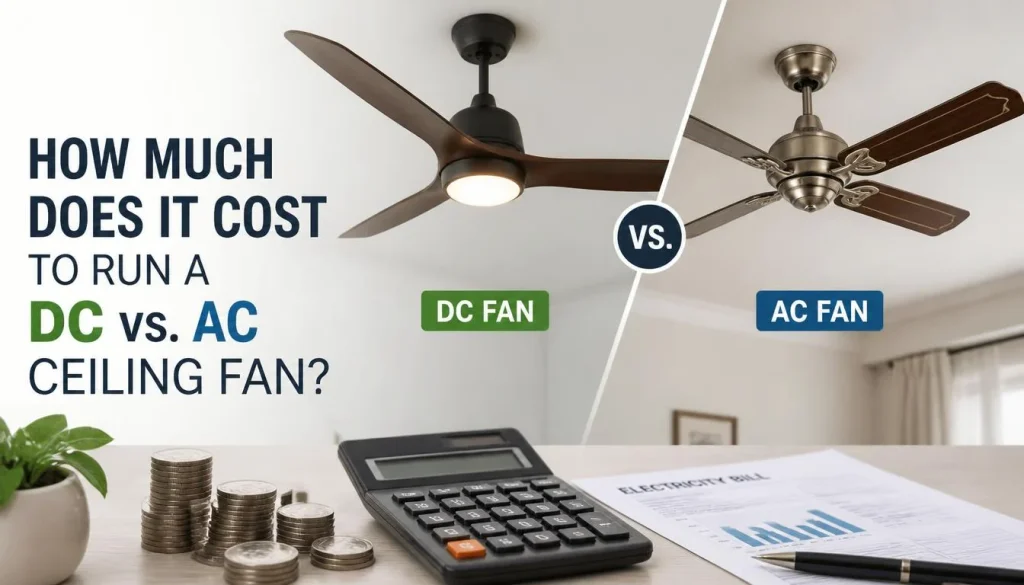
The difference in running cost depends on wattage, operating hours, and your electricity rate.
A DC fan often uses less electricity than a comparable AC model, but the amount you save depends on the actual products being compared.
How to Calculate Ceiling Fan Electricity Costs
Use this formula to estimate energy consumption:
Energy consumption (kWh) = (Watts × Hours of use × Number of days) ÷ 1,000
Then calculate the cost:
Running cost = Energy consumption (kWh) × Electricity price per kWh
For example, a 50-watt fan running for 8 hours uses:
(50 × 8) ÷ 1,000 = 0.4 kWh per day.
At an assumed electricity price of $0.20 per kWh, that equals $0.08 per day.
Your actual electricity tariff may be different, so replace the assumed rate with your own price.
Example: Comparing AC and DC Fan Running Costs
Let’s use a hypothetical comparison between two fans with similar airflow at the speeds being considered.
Assumptions:
- AC fan power consumption: 60 watts.
- DC fan power consumption: 30 watts.
- Daily use: 8 hours.
- Annual use: 365 days.
- Electricity price: $0.20 per kWh.
These are example figures, not typical or guaranteed specifications for all AC and DC fans.
| Calculation | AC Ceiling Fan | DC Ceiling Fan |
|---|---|---|
| Power consumption | 60 W | 30 W |
| Daily energy use | 0.48 kWh | 0.24 kWh |
| Annual energy use | 175.2 kWh | 87.6 kWh |
| Annual running cost at $0.20/kWh | $35.04 | $17.52 |
Under these assumptions, the DC fan saves $17.52 per year in electricity costs.
Actual savings will vary with the fan’s wattage, the speed selected, daily usage, standby power, and local electricity prices.
For an Australian perspective, CHOICE’s 2026 ceiling fan guide estimated average annual running costs of approximately AUD $25 for AC fans and AUD $17 for DC fans under its stated assumptions of eight hours of use daily for six months and an electricity price of AUD $0.40 per kWh. Those Australian estimates should not be applied directly to households in other countries.
When Can Energy Savings Offset the Higher Purchase Price?
To estimate the payback period, divide the extra purchase price by the annual electricity savings.
Payback period = Extra purchase cost ÷ Annual electricity savings
Using the earlier example, suppose the DC fan costs $60 more and saves $17.52 annually.
$60 ÷ $17.52 = approximately 3.4 years.
That means the estimated electricity savings would offset the extra purchase price after about three years and five months, assuming the usage and electricity price remain unchanged.
This calculation excludes repair costs, maintenance, financing, and any differences in airflow or features.
It also assumes the fans offer comparable performance. If the DC fan delivers less airflow, the comparison may not be fair.
If your fan runs only occasionally, the payback period will generally be longer. If you use it for many hours each day, the energy savings may accumulate more quickly.
Which Is Better for Different Rooms?
The best motor type also depends on where the fan will be installed and how you plan to use it.
| Room or Situation | Recommended Approach | Why |
|---|---|---|
| Bedroom | Consider a DC fan | Quiet low-speed operation and flexible settings can improve overnight comfort |
| Living room | Compare efficient AC and DC models | Airflow, room size, and energy consumption matter most |
| Home office | Consider a quiet DC model | Fine speed adjustments can help maintain comfortable airflow |
| Guest room | AC may offer good value | Lower upfront cost may matter more if the fan is rarely used |
| Rental property | Compare purchase cost and serviceability | Easy maintenance and suitable controls may be priorities |
| Garage or covered patio | Choose based on location rating and usage | Outdoor suitability, moisture protection, and airflow are essential |
These recommendations are starting points rather than fixed rules. A high-quality AC fan can be an excellent bedroom choice, and an inexpensive DC fan isn’t automatically the best option for a living room.
What About Room Size and Blade Span?
Motor type is only one part of choosing a fan.
A small fan may not circulate enough air in a large living room, regardless of whether it has an AC or DC motor.
Likewise, an oversized fan may produce more airflow than you need in a compact bedroom.
Before deciding, measure your room and check the manufacturer’s recommended blade span.
Our detailed guide, What Size Ceiling Fan Do I Need? Room Size Chart & Calculator, can help you choose an appropriate size.
You can also compare blade designs in our article on 3-blade vs. 5-blade ceiling fans. Remember that the number of blades alone doesn’t determine airflow or efficiency.
Does a DC Ceiling Fan Use Electricity When Turned Off?
It depends on how the fan is designed and how it is disconnected from the power supply.
Some remote-controlled or smart DC ceiling fans may consume a small amount of electricity in standby mode while waiting for a remote signal or maintaining connected features.
Other models may have negligible standby consumption or behave differently when their supply is switched off.
This is worth checking because a fan may continue to draw a small amount of power even when the blades aren’t moving.
The ENERGY STAR ceiling fan criteria include standby performance in the applicable weighted efficiency metric, reinforcing the importance of considering more than high-speed wattage alone.
For the most accurate comparison, check the manufacturer’s published standby wattage or the relevant certified product listing.
If you don’t need remote or smart features, a model with simpler controls may better suit your priorities. Don’t assume, however, that every DC fan consumes significant standby power.
Do Ceiling Fan Light Kits Increase Power Consumption?
Yes. When a fan includes a light, the light uses electricity in addition to the power consumed by the motor.
For example, suppose a fan motor uses 30 watts and its LED light uses 15 watts. If both run simultaneously, the combined power consumption is approximately 45 watts.
If you operate the fan without the light, the light’s wattage shouldn’t be included in the motor-only running-cost calculation.
This distinction matters when comparing products, particularly when one fan includes an integrated light and another doesn’t.
Check whether the product’s advertised power consumption refers to the fan motor alone, the light kit alone, or the complete operating system.
Also check whether replacement bulbs or integrated LED modules are available if the light stops working.
Do DC Ceiling Fans Need Special Wiring?
Not necessarily, but they do need compatible electrical connections and controls.
Many household DC ceiling fans are designed to operate from the standard AC electrical supply used in their intended market. Their internal electronics then manage the power supplied to the DC motor.
However, the wiring and control arrangement varies by product.
A DC fan may work with a standard on/off wall switch but require its supplied remote or a dedicated controller for speed adjustment. An existing AC fan-speed regulator or light dimmer may not be compatible.
Before replacing an existing fan:
- Check the manufacturer’s installation instructions.
- Confirm the electrical supply and product specifications match your country.
- Verify that the wall switch and control system are compatible.
- Check whether the fan requires a receiver or dedicated controller.
- Arrange installation by a qualified or licensed electrician as required by local regulations.
Requirements differ across the USA, UK, Canada, and Australia, so don’t assume that the same wiring arrangement or product approval applies everywhere.
Never attempt electrical modifications without the proper qualifications.
What to Check Before Buying a DC or AC Ceiling Fan
Before making your final decision, compare the following details across the actual models you’re considering.
1. Airflow rating
Check the manufacturer’s CFM rating or the equivalent airflow specification used in your market. Make sure the fan can serve your room adequately.
2. Power consumption
Look at the wattage at the speeds you’ll actually use. A low high-speed wattage doesn’t tell you the whole story if you usually operate the fan at low speed.
3. Airflow efficiency
Compare CFM per watt when reliable, comparable figures are available. Higher efficiency can mean less electricity is needed to provide a given amount of airflow.
4. Noise
For bedrooms and workspaces, look for credible low-speed noise information and reviews that mention real-world operation.
5. Controls
Confirm whether the fan uses a remote, wall control, pull chain, or smart-home system. Check compatibility before purchasing.
6. Warranty and replacement parts
Verify the availability of controllers, receivers, remotes, and other service parts.
7. Light kit
If the fan has a light, check the additional power consumption, whether the light can be replaced, and how independently it can be controlled.
8. Installation requirements
Check ceiling height, mounting type, available support, blade clearance, voltage compatibility, and the manufacturer’s installation instructions.
9. Reverse function
If you want to circulate warm air during colder months, check that the fan supports reverse operation and follow the manufacturer’s instructions.
10. Total cost of ownership
Consider the purchase price, expected electricity consumption, repair support, warranty, and how long you plan to use the fan.
A little comparison before buying can prevent the common mistake of choosing a fan based only on price or motor type.
Common Mistakes to Avoid When Choosing a Ceiling Fan Motor
A few common assumptions can lead to the wrong purchase.
Assuming every DC fan is more powerful: Motor type alone doesn’t determine airflow. Compare tested airflow and fan design.
Choosing only by upfront price: A cheaper AC fan may cost less initially but use more electricity. A DC fan may offer savings if it runs frequently.
Ignoring standby consumption: A remote-controlled fan may draw a small amount of power while waiting for commands.
Buying the wrong fan size: An efficient motor cannot compensate for a fan that is unsuitable for the room.
Reusing incompatible controls: An existing dimmer or fan-speed controller may interfere with the new fan’s electronics.
Assuming all DC fans are quiet: Blade noise, motor quality, loose hardware, and installation problems can affect the actual sound level.
Ignoring repair support: A replacement controller that is difficult to obtain can make a fan less convenient to maintain.
The best buying decision comes from comparing the complete product, not relying on a single specification.
Final Verdict: Should You Choose a DC or AC Ceiling Fan?
For many households, a DC ceiling fan is an excellent choice because it often combines lower power consumption, quiet operation, and flexible speed control. Those advantages can be especially useful in bedrooms, living rooms, and other spaces where the fan operates for several hours every day.
An AC ceiling fan can still be the smarter purchase if you have a limited budget, use the fan occasionally, or find a model that already offers the airflow and features you need.
Here’s the simplest way to decide:
Choose a DC ceiling fan if:
- You use your fan regularly.
- Lower electricity consumption is a priority.
- You want quiet operation and more speed settings.
- The extra purchase cost is justified by your expected savings and features.
Choose an AC ceiling fan if:
- You want a lower upfront price.
- The fan will run only occasionally.
- You find a model with sufficient airflow and acceptable noise.
- Its controls, warranty, and maintenance requirements suit your needs.
Before making your final choice, compare the wattage, airflow, controls, and purchase price of at least two suitable models. Calculate their estimated running costs using your local electricity tariff.
The goal isn’t simply to buy a DC or AC fan. It’s to choose a ceiling fan that keeps you comfortable, uses electricity sensibly, and offers good value for the years you plan to own it.
Frequently Asked Questions
1. Is a DC ceiling fan better than an AC ceiling fan?
A DC fan is often better for energy efficiency, quiet low-speed operation, and flexible speed control. An AC fan may be better when upfront cost is the main concern. The right choice depends on the specific models, their airflow, and your usage.
2. Do DC ceiling fans use less electricity?
Many DC ceiling fans use less electricity than comparable AC models, particularly when delivering similar airflow. However, savings vary with the motor, blade design, speed setting, and operating hours. Compare actual power consumption rather than relying on the motor type alone.
3. Are DC ceiling fans quieter?
DC fans are often quieter at lower speeds, but not every model is silent. Blade noise, bearings, mounting hardware, and installation can all affect the sound you hear.
4. Are DC ceiling fans worth the extra money?
They can be worth the extra expense if you use the fan frequently and the electricity savings offset the higher purchase price. Calculate the potential annual savings and payback period before deciding.
5. Can I replace an AC ceiling fan with a DC ceiling fan?
In many cases, yes, provided the new fan is suitable for the installation and its electrical and control requirements are met. The existing wall switch or speed controller may not be compatible, so check the manufacturer’s instructions and use a qualified electrician when required.
6. Does a DC ceiling fan need special wiring?
Not necessarily. Many residential DC fans are designed to connect to a conventional AC household supply through their internal electronics. However, some models need dedicated controls or particular wiring arrangements. Follow the product manual and local electrical requirements.
7. Does a DC ceiling fan move more air than an AC fan?
Not automatically. Airflow depends on blade design, blade span, motor performance, speed, and other engineering choices. Compare the stated or tested airflow ratings of suitable models.
8. How many watts does a DC ceiling fan use?
There isn’t one wattage that applies to all DC ceiling fans. Consumption varies by model and speed. Check the manufacturer’s wattage specifications at low and high speed, along with any published standby consumption.
9. Is a BLDC ceiling fan the same as a DC ceiling fan?
BLDC stands for brushless direct current. It describes a type of DC motor commonly used in modern ceiling fans. The terms are closely related, but you should still check the actual motor design and specifications of the product.
10. Which ceiling fan motor is best for a bedroom?
A quiet, efficient DC ceiling fan is often a good option for a bedroom because it can offer gentle airflow and more speed settings. However, a well-designed AC fan can also work very well. Prioritize low-speed noise, airflow, room size, and reliable controls.
11. Can I use a wall dimmer with a DC ceiling fan?
You should not assume that a standard light dimmer or traditional fan-speed control will work with a DC fan. The wrong control can interfere with the electronics or prevent proper operation. Use only controls approved by the fan’s manufacturer.
12. Do DC ceiling fans save enough electricity to justify replacing an existing AC fan?
Not always. If your existing AC fan works well and you use it for only a few hours, replacing it solely to save electricity may not make financial sense. Compare its actual consumption with a suitable DC replacement and estimate the payback period before making a decision.

“The right fan can make a bigger difference than you think.”
Hi, I’m Michael Turner, an author and home appliance researcher at BestFanSolve.com.
My interest in fans started with a simple question: How do you know which fan is actually right for your needs? With so many types, features, brands, and technical specifications available, choosing a fan can quickly become confusing. I created BestFanSolve.com to make that process easier.
Through this website, I share practical fan reviews, buying guides, comparisons, troubleshooting tips, maintenance advice, and solutions to common fan problems. I focus on turning complicated product information into clear, useful guidance that everyday readers can actually understand and use.
Whether you’re searching for a quiet bedroom fan, a powerful fan for a large room, an energy-efficient option, or simply trying to figure out why your current fan isn’t working properly, my goal is to help you find the information you need before making a decision.
I believe good recommendations should be based on research, real-world considerations, honest pros and cons, and the specific needs of the user—not simply marketing claims.
Through BestFanSolve.com, I’m committed to helping readers find the right fan, solve common fan problems, and make smarter purchasing decisions with confidence.
— Michael Turner
Author & Home Appliance Researcher
BestFanSolve.com