
Are DC ceiling fans better than AC models? In many cases, yes. DC ceiling fans often use less electricity, offer more speed settings, and provide quiet operation at lower speeds. However, they usually cost more upfront, and not every DC fan performs better than every AC model.
The right choice depends on how often you use your fan, how much airflow your room needs, your budget, and the features you value most.
For a bedroom where the fan runs every night, a DC model may be worth the extra expense. For a guest room that needs occasional cooling, a reasonably priced AC ceiling fan could be the more practical option.
In this guide, we will compare DC and AC ceiling fans, explain their advantages and disadvantages, calculate potential electricity savings, and help you decide which type offers better value for your home.
Are DC Ceiling Fans Better Than AC Fans? The Quick Answer
DC ceiling fans are often the better choice for homeowners who prioritize energy efficiency, quiet low-speed operation, and flexible speed control. AC ceiling fans remain a sensible option when the initial purchase price matters more than long-term electricity savings.
Here is a quick comparison:
| Feature | DC Ceiling Fan | AC Ceiling Fan |
|---|---|---|
| Energy efficiency | Often more efficient, depending on the model | Efficiency varies by model |
| Electricity consumption | Often lower at comparable airflow | May use more power at comparable airflow |
| Noise | Often quiet at lower speeds | Noise levels vary by model |
| Speed settings | Frequently offers more options | Often has fewer speed options |
| Initial purchase price | Usually higher | Usually lower |
| Controls | Often uses a remote or dedicated electronic controller | May use a pull chain, compatible wall control, or remote |
| Airflow | Depends on blade design, motor, size, and speed | Depends on blade design, motor, size, and speed |
| Maintenance | Electronic controls may require specific replacement parts | Parts and servicing depend on the design |
| Best use | Frequent operation and efficiency-focused households | Budget-conscious purchases and occasional use |
These are general tendencies, not guarantees. A well-designed AC fan can outperform a poorly designed DC fan, so compare actual product specifications before making your decision.
What Is a DC Ceiling Fan and How Does It Work?
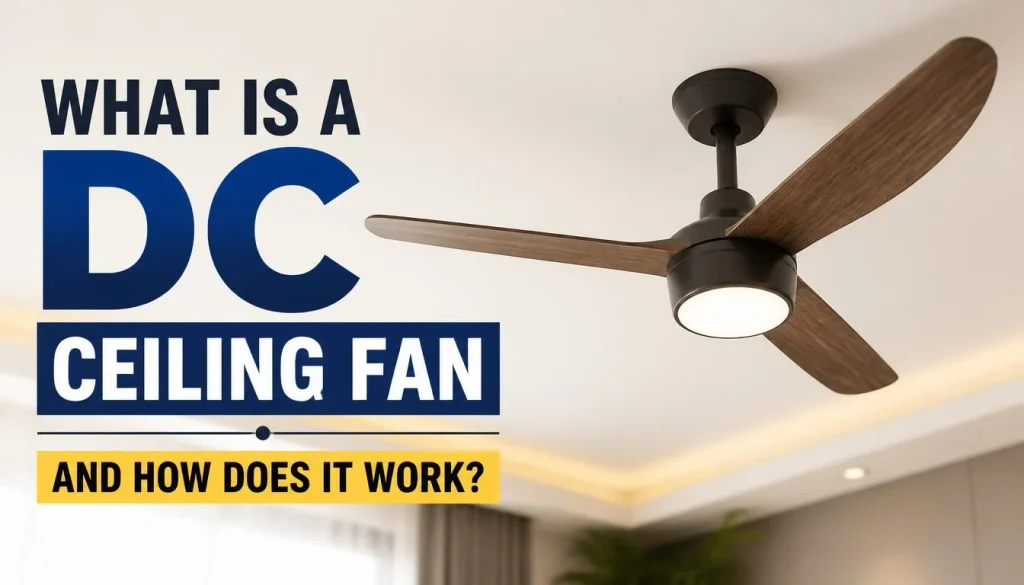
A DC ceiling fan uses a motor powered by direct current (DC). Many modern models use brushless DC motors, which rely on electronic controls to regulate speed.
Although the motor operates using DC power, many household DC ceiling fans are designed to connect to the standard AC electrical supply in their intended market. The fan’s internal electronics manage the power supplied to the motor.
This arrangement can help the fan operate efficiently across a range of speeds.
Advantages of DC Ceiling Fan Motors
DC ceiling fans often have several practical benefits:
- Lower power consumption: Many models can deliver useful airflow while drawing less electrical power than comparable AC fans.
- More precise speed control: Additional speed settings allow you to adjust the breeze to suit your comfort.
- Quiet low-speed operation: A well-designed DC fan can be particularly suitable for bedrooms and home offices.
- Modern control features: Depending on the model, you may get a remote, timer, sleep mode, or smart-home integration.
However, a DC motor alone does not guarantee excellent performance. Blade geometry, motor quality, fan size, and the electronic controller all contribute to the final result. ENERGY STAR’s ceiling fan performance guide explains why the entire fan design matters.
What Is an AC Ceiling Fan?
An AC ceiling fan uses an alternating-current motor. This is a long-established technology used in residential ceiling fans.
AC fans remain popular because they are widely available and often cost less to purchase. Many models offer straightforward controls and can provide plenty of airflow for everyday use.
Why Choose an AC Ceiling Fan?
An AC fan may be a good fit if you:
- Want to keep the initial purchase price low.
- Need a fan for a room that is rarely occupied.
- Find a model that offers the airflow and noise performance you need.
- Prefer a familiar control system.
- Do not expect electricity savings to justify a more expensive DC model.
Modern AC fans are not automatically inefficient or noisy. Their performance varies with the motor, blade design, speed control, construction quality, and operating conditions.
The best approach is to compare the complete product rather than judging it solely by its motor type.
Do DC Ceiling Fans Use Less Electricity?
Electricity consumption is one of the main reasons people consider switching from an AC ceiling fan to a DC model.
Many DC ceiling fans use less power than comparable AC models, especially when providing similar airflow. The actual difference, however, depends on the two models being compared and the speed at which they operate.
A fan using fewer watts is not necessarily more efficient if it also moves considerably less air.
How to Compare DC and AC Fan Efficiency
Start by checking each fan’s published power consumption in watts. Then compare its airflow rating, usually measured in cubic feet per minute (CFM).
For a simple comparison at a particular operating speed, use this formula:
Airflow efficiency = Airflow (CFM) ÷ Power consumption (watts)
Suppose two fans provide the following performance at comparable tested settings:
| Specification | Fan A | Fan B |
|---|---|---|
| Airflow | 5,000 CFM | 5,000 CFM |
| Power consumption | 25 watts | 40 watts |
| Airflow per watt | 200 CFM/W | 125 CFM/W |
In this hypothetical example, Fan A provides the same rated airflow while using less power.
These numbers are illustrative, not specifications for actual products. Also, an official efficiency rating may use a more comprehensive testing method than a single-speed calculation. In the United States, ENERGY STAR’s ceiling fan efficiency criteria explain how efficiency is assessed for eligible products.
For a more detailed explanation of airflow ratings, read our guide to ceiling fan CFM and what it means.
How to Calculate Ceiling Fan Electricity Costs
You can estimate how much a fan costs to run using its wattage, daily operating time, and your local electricity rate.
First, calculate energy consumption:
Energy consumption (kWh) = Watts × Hours of use × Days used ÷ 1,000
Then calculate the running cost:
Running cost = Energy consumption (kWh) × Electricity price per kWh
For example, consider two fans with similar airflow:
- AC ceiling fan: 60 watts
- DC ceiling fan: 30 watts
- Daily use: 8 hours
- Annual use: 365 days
- Illustrative electricity rate: $0.20 per kWh
The AC fan would use:
60 × 8 × 365 ÷ 1,000 = 175.2 kWh per year.
The DC fan would use:
30 × 8 × 365 ÷ 1,000 = 87.6 kWh per year.
Under these assumptions, the estimated annual running costs would be:
| Calculation | AC Fan | DC Fan |
|---|---|---|
| Annual energy use | 175.2 kWh | 87.6 kWh |
| Annual electricity cost | $35.04 | $17.52 |
The estimated saving is $17.52 per year.
This is an example, not a prediction of what every household will save. Actual consumption varies with the fan’s power draw at the speeds you use, standby power, operating hours, and local electricity prices.
For readers in the USA, UK, Canada, and Australia, use your own electricity tariff and the currency applicable to your household. For a more meaningful estimate, compare the power consumption of the actual fan models you are considering.
When Will a DC Ceiling Fan Pay for Itself?
A DC fan may cost more upfront, but lower electricity consumption can offset some or all of that difference over time.
Use this formula:
Payback period = Extra purchase cost ÷ Annual electricity savings
Suppose a comparable AC fan costs $90 and a DC fan costs $150. The DC model costs $60 more.
If the DC fan saves $17.52 annually, the estimated payback period is:
$60 ÷ $17.52 = approximately 3.4 years.
Under these assumptions, the electricity savings would equal the extra purchase cost after roughly three years and five months.
The calculation excludes installation, repairs, maintenance, financing, and differences in features or performance. It also assumes that both fans provide suitable, comparable airflow and that usage and electricity prices remain unchanged.
If you use your fan for only a few hours each month, the payback period could be much longer. If it runs for many hours each day, the savings may accumulate more quickly.
Are DC Ceiling Fans Quieter Than AC Fans?
DC ceiling fans often have an advantage when it comes to quiet operation at lower speeds. This can make them appealing for bedrooms, nurseries, and home offices.
However, not every DC fan is quiet, and some AC models are also designed for smooth, quiet performance.
It is important to distinguish between motor noise and the sound of moving air. Even a quiet motor can create noticeable airflow noise when the fan runs at high speed.
What Causes a Ceiling Fan to Make Noise?
Unwanted sound does not always mean the motor is the problem.
Common causes include:
- Loose screws or mounting hardware.
- Unbalanced blades.
- Worn bearings or other mechanical components.
- Vibration from unsuitable mounting hardware.
- Motor noise or excessive airflow noise.
A well-balanced fan with a sturdy housing and suitable bearings can operate more smoothly. Proper installation matters just as much.
Which Fan Is Better for a Bedroom?
If you are choosing a fan primarily for sleeping, a DC model is worth considering because its low-speed performance and additional speed settings may make it easier to find a comfortable breeze.
Look for a model that offers:
- A genuinely useful low-speed setting.
- Quiet-operation information from the manufacturer.
- Balanced blades and stable mounting hardware.
- Suitable airflow for the room.
- A convenient remote or compatible wall control.
Our guide to the best ceiling fan for a bedroom covers the other features worth considering when creating a comfortable sleeping environment.
Do DC Ceiling Fans Move More Air Than AC Fans?
Not necessarily.
A DC motor does not automatically make a ceiling fan more powerful. Airflow depends on several factors, including motor performance, blade span, blade shape, blade pitch, rotational speed, and the overall design of the fan.
A well-designed AC fan can move more air than a smaller or poorly designed DC model.
What Does CFM Tell You?
CFM stands for cubic feet per minute. It measures the volume of air moved by a fan under specified operating conditions.
When comparing fans, check:
- The published airflow rating.
- The power consumption associated with that performance.
- The available speed settings.
- The fan’s blade span and design.
- Whether the fan is appropriate for your room.
For example, a fan with a high maximum CFM rating may be suitable for a spacious living room but feel too forceful at its highest setting in a small bedroom.
You need enough airflow for the room without sacrificing comfort or using more electricity than necessary.
Our guide on how much CFM you need for a ceiling fan explains how to assess airflow requirements.
Does Blade Size Affect Fan Performance?
Yes. Blade span affects the area covered by the rotating blades, while blade shape and pitch influence how the fan moves air.
A larger fan is not automatically more efficient, and a higher blade pitch does not guarantee better airflow. All these characteristics need to work with the motor’s capabilities.
Before buying, check our ceiling fan blade size guide and ceiling fan size guide for different rooms.
If you are choosing between different blade designs, our article on ceiling fan blade pitch and its effect on airflow provides more detail.
What Are the Disadvantages of DC Ceiling Fans?
Although DC ceiling fans have several advantages, they are not the perfect choice for every home.
Understanding their limitations can help you avoid paying extra for features you do not need.
1. Higher Upfront Cost
Many DC ceiling fans cost more than comparable AC models because of their motor and electronic control systems.
That higher purchase price may be justified if you use the fan regularly and achieve meaningful electricity savings. For occasional use, the difference may not be worthwhile.
2. Control Compatibility
Many DC models use a dedicated electronic controller or remote. Some can also work with compatible wall-mounted controls, but the available options vary by model.
An existing AC fan-speed regulator or ordinary light dimmer may not be suitable for a DC fan.
Check the manufacturer’s instructions before assuming that your existing controls can be reused.
3. Replacement Parts and Repairs
Some DC fans use proprietary receivers, remotes, or electronic controllers. Finding compatible replacements can be inconvenient if the manufacturer no longer supports the model.
That does not mean DC fans are necessarily less reliable than AC fans. Component quality, warranty coverage, installation, and after-sales support all matter.
Before buying, check the warranty and the availability of replacement remotes, controllers, and other service parts.
4. More Features Than You May Need
Some DC fans include timers, sleep modes, smart controls, and several speed settings.
These features can improve convenience, but they may not justify a higher price if you only need a simple fan with two or three useful speeds.
Choose based on the features you will actually use.
When Is a DC Ceiling Fan Worth the Extra Cost?

The answer depends largely on how often the fan runs and what you expect from it.
For Bedrooms and Overnight Use
A DC fan can be a good choice when you want quiet low-speed operation and regularly use the fan throughout the night.
The additional speed settings may also help you maintain a comfortable breeze rather than choosing between speeds that feel too weak or too strong.
For Living Rooms Used Every Day
A living room fan that operates for several hours daily may benefit from lower power consumption.
However, compare airflow, wattage, and purchase price before deciding. A suitably sized AC fan may still provide excellent value.
For spacious living areas, our guide to the best ceiling fans for large rooms can help you evaluate other factors that influence performance.
For Guest Rooms and Occasional Use
An AC fan may be the more economical choice if the room is rarely occupied.
When a fan operates infrequently, its running-cost savings are less likely to offset a substantial difference in purchase price.
For Home Offices
A DC fan may be attractive if you work in the room for long periods and value quiet operation and fine speed adjustments.
Nevertheless, a quiet AC model with sufficient airflow may work just as well. Compare actual performance rather than relying on the motor label.
Can You Replace an AC Ceiling Fan With a DC Fan?
In many homes, replacing an AC ceiling fan with a DC model is possible, but compatibility needs to be checked before installation.
Many household DC ceiling fans are designed to connect to the standard AC electrical supply used in their intended market. Their controls, wiring arrangements, and installation requirements can still differ.
Can You Use an Existing Wall Switch?
A standard on/off wall switch may be compatible with some DC fans, but an existing AC speed regulator may not be suitable.
Depending on the model, the fan may require its supplied remote or a dedicated electronic controller for speed adjustment.
Before replacing your fan:
- Read the manufacturer’s installation manual.
- Confirm the fan’s voltage and electrical specifications match your market.
- Check whether your existing wall switch can be reused.
- Confirm whether a dedicated receiver or controller is required.
- Verify that the ceiling mounting point is suitable for the new fan.
Electrical requirements differ between countries and installations. Follow local regulations and use a qualified or licensed electrician where required.
ENERGY STAR’s ceiling fan installation guidance provides useful information about suitable mounting support and safe installation.
Do DC Ceiling Fans Last Longer Than AC Fans?
There is no universal answer. A DC motor does not automatically guarantee a longer service life, and an AC motor is not inherently less durable.
Lifespan depends on component quality, operating conditions, installation, maintenance, and whether replacement parts remain available.
Some AC fans use conventional components that are relatively easy to source. Some DC fans rely on model-specific electronic controllers or receivers. However, the actual repairability of either type depends on the product and the manufacturer’s support.
Before choosing a model, compare:
- Motor and component warranty coverage.
- Availability of replacement parts.
- Access to customer service and repairs.
- The manufacturer’s installation and maintenance instructions.
- The likely cost of replacing a controller or remote.
For a fan that you expect to use every day for years, after-sales support deserves as much attention as energy efficiency.
How to Choose the Right DC or AC Ceiling Fan
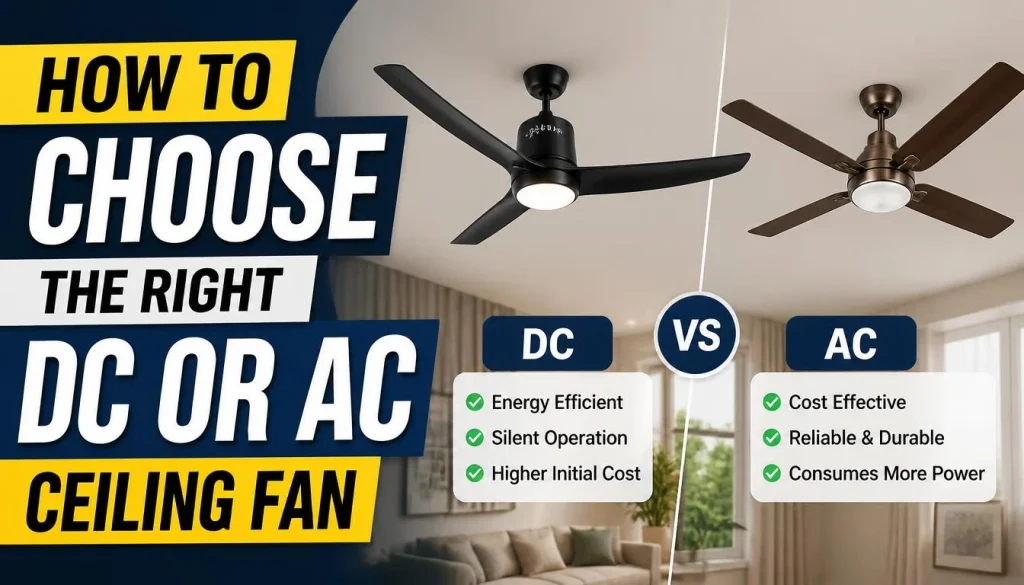
Once you understand the differences between the two motor types, use the following checklist to compare the actual fans available in your market.
1. Check the room size. A fan that is too small may not provide enough airflow, regardless of its motor technology.
2. Compare airflow ratings. Check published CFM figures or the applicable airflow specification for products sold in your country.
3. Compare power consumption. Look at the wattage associated with the speeds you expect to use most often.
4. Evaluate airflow efficiency. When comparable data is available, check CFM per watt rather than choosing based on wattage alone.
5. Consider noise at low speeds. This is particularly important in bedrooms and home offices.
6. Check control compatibility. Confirm whether the fan uses a remote, wall control, pull chain, or smart-home system.
7. Review the warranty and replacement parts. Verify that support and compatible components are available.
8. Account for installation requirements. Ceiling height, mounting support, blade clearance, and electrical compatibility all matter.
9. Calculate the total cost. Include purchase price, estimated electricity use, potential installation charges, and likely maintenance needs.
10. Choose the appropriate features. Reverse operation, integrated lighting, smart controls, and timers may be useful, but only when they suit your needs.
For a more complete buying checklist, read our guide on how to choose the right ceiling fan.
Frequently Asked Questions
Are DC ceiling fans better than AC ceiling fans?
DC ceiling fans are often better for energy efficiency, quiet operation at low speeds, and flexible speed control. AC fans can be better for buyers prioritizing a lower purchase price. The best choice depends on the specific models and how you plan to use them.
Do DC ceiling fans really save electricity?
Many DC fans use less electricity than comparable AC models, but the amount varies. Compare actual power consumption at similar airflow levels and calculate the running costs using your electricity rate.
Are DC ceiling fans quieter than AC fans?
DC fans often perform well at lower speeds, but not every model is quiet. Blade balance, motor quality, installation, and mounting hardware also affect the noise you hear.
Are DC ceiling fans worth the extra money?
They can be worthwhile if you use the fan frequently and the electricity savings, comfort, or additional features justify the higher purchase price. Calculate the estimated payback period before deciding.
Do DC ceiling fans move more air than AC fans?
Not automatically. Airflow depends on motor performance, blade design, fan size, and rotational speed. Compare published airflow ratings rather than assuming one motor type always moves more air.
Can I use a regular wall switch with a DC ceiling fan?
Some DC fans support a standard on/off wall switch, while others require specific controls for full operation. Check the manufacturer’s instructions before reusing an existing switch or speed regulator.
Do DC ceiling fans last longer than AC fans?
Not necessarily. Lifespan depends on build quality, installation, maintenance, operating conditions, and replacement-part availability. Compare the warranty and service support for individual models.
Do DC ceiling fans use electricity when turned off?
Some remote-controlled or smart ceiling fans draw a small amount of standby power while waiting for commands. The amount depends on the specific model. Check the manufacturer’s standby-power specifications if this matters to you.
Are DC ceiling fans better for bedrooms?
A DC fan may be a good option for a bedroom because many models offer quiet low-speed operation and additional speed settings. However, a well-designed AC fan can also be suitable if it provides comfortable airflow without distracting noise.
Are DC ceiling fans worth it for occasional use?
Not always. If you run the fan only occasionally, the electricity savings may be too small to justify the additional purchase cost. A suitable AC fan may offer better overall value.
Final Verdict: Are DC Ceiling Fans Better?
For many households, a DC ceiling fan is an excellent choice. It may offer lower electricity consumption, quiet operation at lower speeds, and more flexibility when adjusting airflow. These benefits can be especially useful in bedrooms, living rooms, and home offices where the fan runs for several hours each day.
An AC ceiling fan can still be the smarter purchase if your budget is limited, you use the fan infrequently, or you find a model that already meets your airflow and comfort requirements.
Before buying, compare at least two suitable models using their airflow ratings, power consumption, purchase prices, controls, and warranty coverage. Calculate the expected running cost using your local electricity tariff, and estimate how long any additional upfront expense would take to recover.
The bottom line: DC ceiling fans are often better for energy-conscious households that use their fans regularly, but AC ceiling fans can still offer excellent value. The best fan is the one that provides the right airflow, comfort, and long-term value for your home.

“The right fan can make a bigger difference than you think.”
Hi, I’m Michael Turner, an author and home appliance researcher at BestFanSolve.com.
My interest in fans started with a simple question: How do you know which fan is actually right for your needs? With so many types, features, brands, and technical specifications available, choosing a fan can quickly become confusing. I created BestFanSolve.com to make that process easier.
Through this website, I share practical fan reviews, buying guides, comparisons, troubleshooting tips, maintenance advice, and solutions to common fan problems. I focus on turning complicated product information into clear, useful guidance that everyday readers can actually understand and use.
Whether you’re searching for a quiet bedroom fan, a powerful fan for a large room, an energy-efficient option, or simply trying to figure out why your current fan isn’t working properly, my goal is to help you find the information you need before making a decision.
I believe good recommendations should be based on research, real-world considerations, honest pros and cons, and the specific needs of the user—not simply marketing claims.
Through BestFanSolve.com, I’m committed to helping readers find the right fan, solve common fan problems, and make smarter purchasing decisions with confidence.
— Michael Turner
Author & Home Appliance Researcher
BestFanSolve.com