
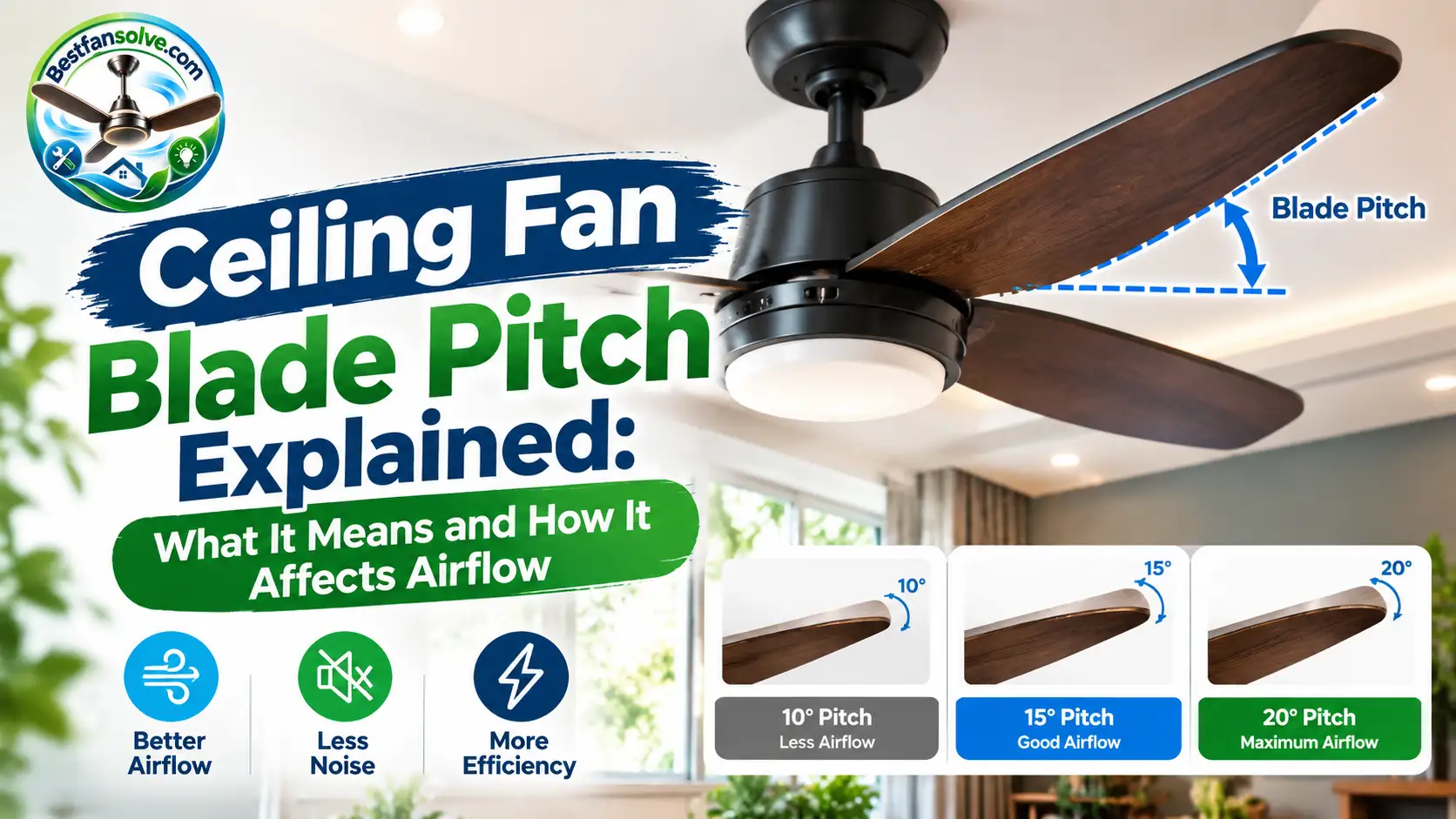
Have you ever wondered why one ceiling fan moves plenty of air while another seems weak, even when both have similar blade sizes? The answer may partly come down to ceiling fan blade pitch.
Blade pitch describes the angle of a fan blade relative to a reference plane. This angle influences how the blade interacts with the surrounding air, but it is only one part of a fan’s overall design. Motor performance, blade shape, rotational speed, and blade span also affect airflow and energy consumption.
Understanding ceiling fan blade pitch can help you compare different models, interpret manufacturer specifications, and avoid paying for a fan that does not meet your needs.
In this guide, you will learn what blade pitch means, how it affects airflow and efficiency, what different pitch angles tell you, and how to choose a ceiling fan based on performance rather than appearance alone.
What Is Ceiling Fan Blade Pitch?
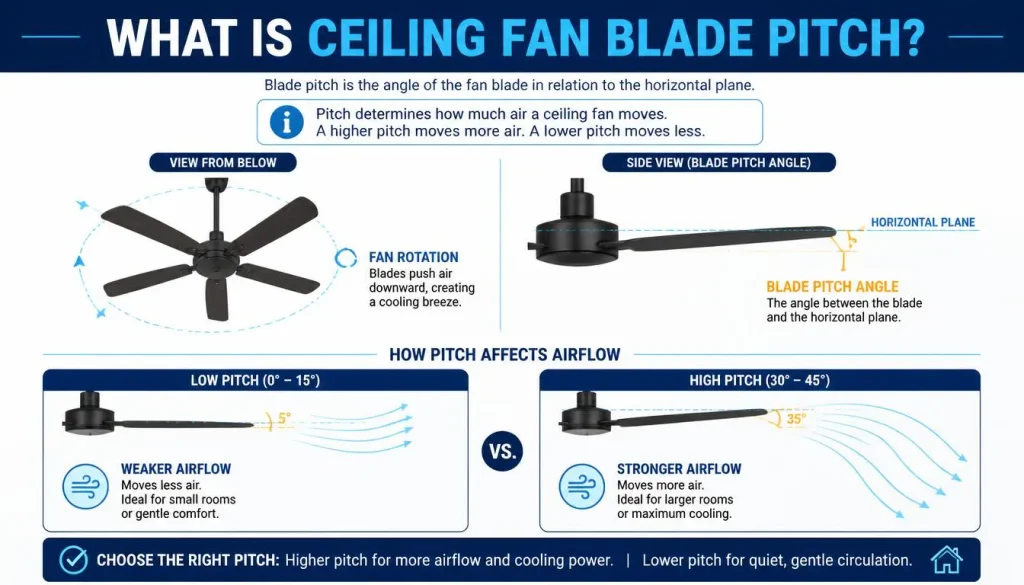
Ceiling fan blade pitch is the angle at which a blade is positioned relative to the fan’s plane of rotation. It is measured in degrees.
Think of a ceiling fan blade as a small surface designed to move air as it rotates. The blade’s angle influences how much air it pushes and how much resistance it creates while moving through the air.
A blade with a relatively shallow pitch presents a different angle to the air than one with a steeper pitch. All else being equal, increasing the pitch can increase airflow, but it can also increase aerodynamic resistance and the load on the motor.
The actual result depends on the complete fan design.
According to ENERGY STAR’s guide to ceiling fan performance components, blade pitch is an important factor in airflow, but motor design, speed, blade length, material, and blade count also influence performance.
How Is Ceiling Fan Blade Pitch Measured?
Blade pitch is expressed in degrees, such as 10°, 12°, or 15°.
A degree measurement describes the blade’s angle relative to a specified reference plane. However, the exact way manufacturers describe or measure blade geometry can differ, especially for curved or aerodynamically shaped blades.
For a simple, flat blade, the angle is easier to visualise. As the blade becomes more curved or twisted, its local angle may change along its length.
This is why published specifications and manufacturer documentation are generally more useful than trying to judge blade pitch by looking at a fan from the floor.
What Does a 12-Degree or 15-Degree Blade Pitch Mean?
A 12-degree blade pitch indicates one blade angle, while a 15-degree pitch indicates a steeper angle when both measurements use the same reference.
In general, a steeper angle can help a blade move more air. However, it can also create more aerodynamic drag, placing additional demands on the motor.
Consider two hypothetical ceiling fans:
- Fan A: Uses a 10° blade pitch and a motor designed to operate efficiently at its intended speed.
- Fan B: Uses a 15° blade pitch and a motor designed to handle the additional aerodynamic load.
Fan B may move more air, but you cannot determine the winner from blade pitch alone. Fan A could perform just as well or even better, depending on its blade geometry, motor, operating speed, and overall engineering.
The most reliable comparison comes from checking the manufacturer’s published airflow and power-consumption figures.
How Does Blade Pitch Affect Ceiling Fan Airflow?
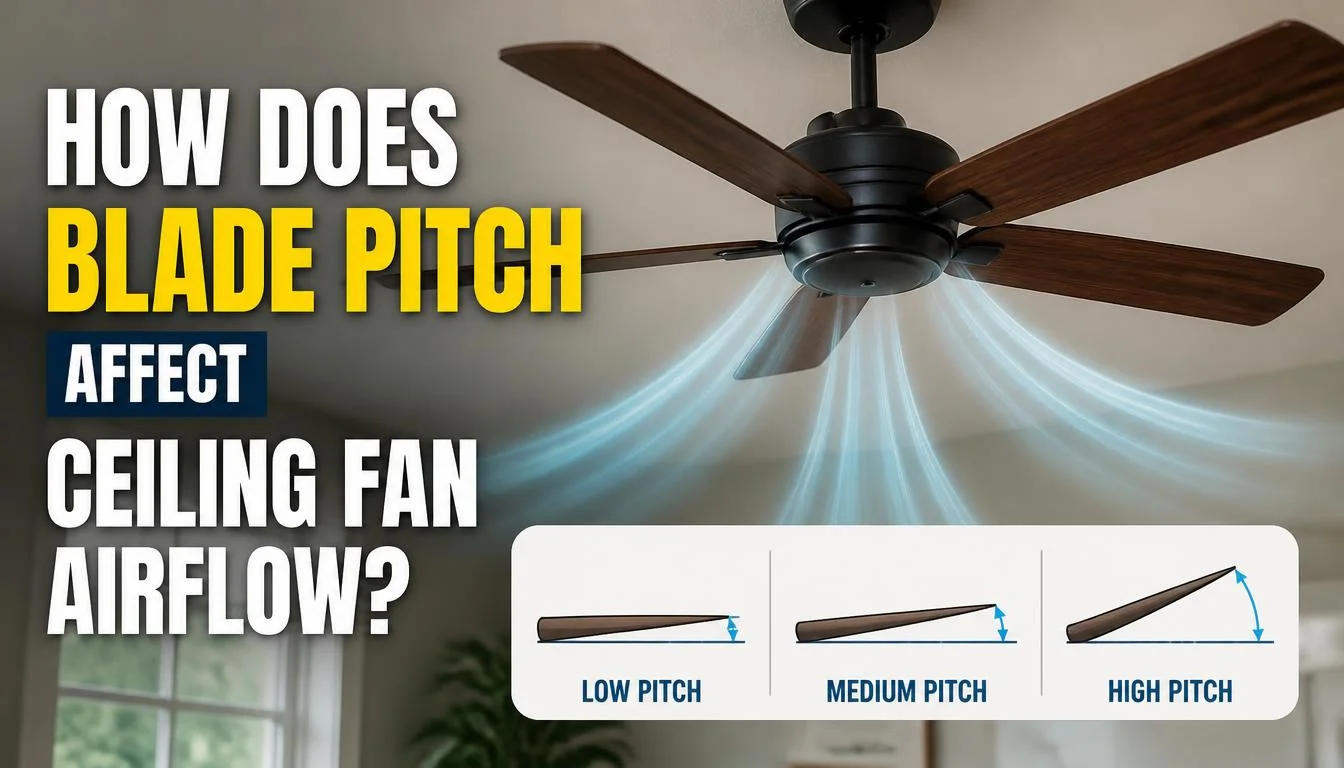
Blade pitch affects how a rotating blade interacts with the air around it. As the blade moves, its shape and angle help generate airflow through the room.
A steeper blade angle can increase the amount of air moved during each rotation. However, that benefit depends on whether the motor can maintain the required operating speed and whether the blade design uses the extra pitch effectively.
Does Higher Blade Pitch Mean More CFM?
Usually, a higher blade pitch can help increase airflow, but it does not guarantee a higher CFM rating.
CFM stands for cubic feet per minute. It measures the volume of air a fan moves under specified operating conditions.
For example, imagine two ceiling fans tested under comparable conditions. One delivers 4,000 CFM, while the other delivers 4,800 CFM. The second fan has the higher reported airflow, regardless of which one has the steeper blade pitch.
A fan with a higher pitch might deliver more airflow, but a different motor or blade design could change the outcome.
If you want to understand how manufacturers report airflow, read our guide to ceiling fan CFM explained. It explains what CFM means and why it should not be confused with motor speed or energy consumption.
What Happens When Blade Pitch Is Too Low?
A relatively shallow blade pitch may produce less airflow than a steeper design when other factors remain comparable.
However, a shallow pitch is not automatically a design flaw. Some fans use carefully engineered blades and motors to deliver useful airflow with a relatively low blade angle.
The important question is whether the complete fan provides enough airflow for your room at the speeds you intend to use.
If a fan feels weak, check its operating speed, installation, condition, and published performance ratings before assuming the blade pitch is the problem.
Can a Steeper Blade Pitch Reduce Energy Efficiency?
Yes, it can.
A steeper pitch can increase aerodynamic resistance. The motor may need to supply more torque to maintain the fan’s speed, which can increase power consumption if the design is not optimised for that load.
However, higher pitch does not automatically mean a fan will use more electricity overall. An efficient motor and well-designed blade can deliver substantial airflow without excessive power consumption.
This is why you should compare airflow and electricity use together instead of looking at the blade angle in isolation.
Does Blade Pitch Affect Ceiling Fan Noise?
Blade pitch can influence aerodynamic noise because it changes how the blades interact with the air. A steep pitch combined with high rotational speed may create additional turbulence or resistance in some designs.
Nevertheless, blade pitch is not the only source of noise.
Motor quality, bearings, blade balance, mounting hardware, and installation all matter. A properly engineered fan with a relatively steep pitch can operate quietly, while a poorly balanced fan with a shallow pitch may produce noticeable noise.
For a bedroom or home office, pay attention to the fan’s noise specifications, low-speed performance, and installation quality rather than relying on blade pitch alone.
What Is the Best Blade Pitch for a Ceiling Fan?

There is no single blade pitch that is best for every ceiling fan.
Residential ceiling fan designs commonly use blade angles in the approximate 8°–15° range, although designs vary. The appropriate angle depends on the blade geometry, motor characteristics, intended airflow, and the fan’s operating speed.
The University of California, Berkeley’s Fans for Cooling People Guidebook discusses how blade pitch, shape, and number influence airflow and efficiency.
Is 12–15 Degrees a Good Blade Pitch?
A pitch of 12°–15° is a useful reference range when comparing certain conventional residential ceiling fan designs. It should not be treated as a universal requirement or a guarantee of superior performance.
Academic modelling studies and manufacturer recommendations may identify different preferred angles because they use different assumptions, blade geometries, motors, and performance objectives.
For this reason, a 10° fan is not necessarily inferior to a 15° fan. A well-designed blade with a suitable motor may achieve effective airflow without needing a steeper angle.
When comparing fans, look beyond the published pitch and check the manufacturer’s airflow and energy-efficiency information.
8–10 Degrees vs. 12–15 Degrees: What’s the Difference?
The following table provides a general comparison. It describes potential design tendencies rather than guaranteed results.
| Feature | 8°–10° Blade Pitch | 12°–15° Blade Pitch |
|---|---|---|
| Blade angle | Relatively shallow | Relatively steep |
| Airflow potential | Depends on blade and motor design | May provide greater airflow when other factors are comparable |
| Aerodynamic resistance | May be lower under comparable conditions | May be higher under comparable conditions |
| Motor requirements | Depends on the complete design | May require more torque to maintain speed |
| Energy efficiency | Cannot be determined from pitch alone | Cannot be determined from pitch alone |
| Best choice | Depends on the intended performance | Depends on the intended performance |
The key takeaway is simple: blade pitch is a useful specification, but it cannot tell you everything about a ceiling fan.
Is a Higher Blade Pitch Always Better?
No. A higher blade pitch may help increase airflow, but there is a point at which additional resistance may outweigh the benefits for a particular motor and blade design.
Manufacturers design blades and motors to work together. Changing one part of that system can alter the performance of the entire fan.
Instead of choosing the highest available pitch, look for a model that provides the airflow you need while meeting your expectations for efficiency, noise, and comfort.
Blade Pitch vs. RPM vs. CFM vs. CFM per Watt
These four specifications describe different aspects of ceiling fan performance. Understanding the difference makes it easier to compare models accurately.
| Specification | What It Means | Why It Matters |
|---|---|---|
| Blade pitch | The blade’s angle relative to a reference plane | Influences airflow and aerodynamic resistance |
| RPM | Revolutions per minute | Indicates how quickly the fan rotates |
| CFM | Cubic feet per minute | Indicates the volume of air moved under specified conditions |
| Watts (W) | Electrical power consumption | Helps you evaluate electricity use |
| CFM per watt | Airflow divided by power consumption for the stated conditions | Helps compare airflow efficiency |
Blade Pitch vs. RPM
RPM tells you how quickly the fan rotates. Blade pitch influences how effectively the blade interacts with the air at that speed.
A high-RPM fan does not automatically move more air than a lower-RPM fan. Blade span, blade geometry, motor performance, and other design characteristics affect the outcome.
For example, a fan with a relatively low RPM may still deliver substantial airflow if it uses a suitable blade design and motor.
When comparing fans, use RPM as one piece of information rather than treating it as a substitute for published airflow ratings.
Blade Pitch vs. CFM
Blade pitch is a design characteristic, while CFM is a performance measurement.
Pitch can influence airflow, but CFM tells you how much air the tested fan actually moves under the specified conditions.
If two fans are available with different blade angles, comparing their published CFM ratings can provide a more practical indication of relative airflow than comparing the angles alone.
For help estimating airflow for your space, see our guide on how much CFM you need for a ceiling fan.
What Does CFM per Watt Tell You?
CFM per watt indicates how much airflow a fan delivers for each watt of electrical power consumed under the stated conditions.
For a straightforward comparison at the same operating condition, divide airflow by power consumption.
For example:
- Fan A delivers 4,000 CFM while using 40 watts.
- Fan B delivers 3,600 CFM while using 24 watts.
Fan A’s simple airflow-to-power ratio is 100 CFM/W. Fan B’s ratio is 150 CFM/W.
In this hypothetical example, Fan A delivers more total airflow, while Fan B delivers more airflow per watt.
The figures are illustrative, not specifications for actual products. For an official efficiency comparison, make sure you are comparing equivalent ratings. ENERGY STAR uses defined testing and efficiency criteria, which may differ from a simple single-speed calculation.
You can review the official ENERGY STAR ceiling fan efficiency criteria for more details.
What Other Factors Affect Ceiling Fan Airflow?
Blade pitch is only one part of the design. Several other factors can affect how much air a fan moves and how comfortable it feels in a room.
Blade Shape and Aerodynamic Design
Two blades with the same nominal pitch can behave differently because of their shape.
Flat blades and airfoil-style blades interact with air differently. An airfoil-style blade has a cross-section shaped to improve aerodynamic performance. Depending on the design, this can help increase airflow or reduce turbulence.
According to the Berkeley Fans for Cooling People Guidebook, airfoil-style blades can offer advantages in airflow and efficiency, although performance also depends on operating direction and the complete blade design.
Blade Span and Blade Size
Blade span is the diameter of the circle covered by the rotating blades. It affects how widely a fan can distribute air, although a larger blade span does not automatically guarantee greater airflow.
A larger fan also requires a suitable motor and appropriate installation space.
If you are unsure how blade dimensions affect your choice, our ceiling fan blade size guide explains how to select an appropriate blade size.
Blade Count
The number of blades can influence aerodynamic resistance, fan weight, and airflow characteristics.
However, adding blades does not automatically improve performance. A well-designed three-blade fan may deliver more airflow than a particular five-blade model.
You can learn more in our comparison of 3-blade vs. 5-blade ceiling fans.
Motor Quality and Operating Speed
The motor must provide enough torque to rotate the blades at the intended speed.
A steeper pitch can increase aerodynamic load, so the motor and blade design need to be properly matched. A fan that struggles to maintain its intended operating speed may not deliver the expected airflow.
Motor technology also affects energy use. If you are comparing different motor types, our guide to DC vs. AC ceiling fans explains the practical differences.
Blade Twist Along Its Length
Some aerodynamically designed blades do not maintain the same pitch from the hub to the outer tip.
The blade’s rotational speed is lower near the centre and higher near the tip. Adjusting the blade angle along its length can help designers balance airflow and resistance across different parts of the blade.
This is another reason why a single advertised pitch angle may not fully describe a blade’s aerodynamic performance.
How to Check and Measure Ceiling Fan Blade Pitch

If you want to find the blade pitch of a ceiling fan you already own, start with the manufacturer’s documentation.
Check the Manufacturer’s Specifications
Look at the official product page, technical specification sheet, or installation manual.
Some manufacturers publish the blade pitch directly, while others focus on airflow, motor power, speed, and energy efficiency. If the angle is not listed, contact the manufacturer rather than guessing from a product photograph.
Can You Measure Blade Pitch at Home?
Measuring a simple, flat blade can be possible with suitable angle-measuring equipment, but the result may not match the manufacturer’s published measurement method.
Curved, tapered, or twisted blades are particularly difficult to compare using a single measurement point. The measured angle may vary depending on where and how it is taken.
For most homeowners, verifying the manufacturer’s specification is more useful than attempting to measure the angle independently.
Before inspecting any blade, switch off the fan and isolate its electrical supply. Never measure a moving blade, climb an unstable ladder, or remove blades unless you can do so safely and in accordance with the manufacturer’s instructions.
Can You Adjust or Replace Ceiling Fan Blades With a Different Pitch?
Most residential ceiling fan blades are designed and balanced for a specific fan model. They are not intended to be bent or manually adjusted to change the pitch.
Bending a blade can affect its balance, create vibration, damage the material, and place additional stress on the motor or mounting assembly.
Replacing the original blades with an incompatible set can also change the fan’s performance and safety characteristics.
Use only replacement blades approved by the manufacturer for your particular model. If the correct replacement parts are unavailable, ask the manufacturer or a qualified technician about suitable options.
How to Choose a Ceiling Fan With the Right Blade Pitch

You do not need to become an aerodynamics expert to choose a good ceiling fan. A few practical checks can help you make a more informed decision.
1. Start With Your Room Size
Choose a fan with a suitable blade span for the room’s dimensions and layout. A fan that is too small may not distribute air effectively, while one that is too large may create an uncomfortable breeze or be unsuitable for the available mounting space.
Our ceiling fan size for room guide explains how to consider room dimensions when selecting a fan.
2. Compare Published Airflow Ratings
Look for the manufacturer’s CFM rating rather than assuming a steeper pitch means better airflow.
When comparing two fans, make sure the figures refer to comparable conditions and operating speeds. Maximum-speed airflow and other published performance figures may not use the same measurement basis.
3. Check Energy Efficiency
Consider both airflow and electricity consumption.
A fan that moves slightly less air but uses substantially less power may be a better choice for someone who operates it for many hours each day.
Where applicable, check recognised efficiency information and compare the manufacturer’s performance specifications.
4. Consider Noise and Comfort
For bedrooms, low-speed operation and sound levels may matter more than maximum airflow.
For a living room or a larger shared space, you may prefer stronger airflow. In either situation, adjustable speeds allow you to adapt the fan to your comfort needs.
5. Review the Complete Design
Before making a final decision, consider:
- Blade pitch and overall blade design.
- Blade span and blade clearance.
- Motor performance and operating speeds.
- Published CFM and energy-efficiency information.
- Noise, controls, and installation requirements.
For a broader walkthrough of the selection process, see our guide on how to choose the right ceiling fan.
Frequently Asked Questions About Ceiling Fan Blade Pitch Explained
What Is a Good Blade Pitch for a Ceiling Fan?
A blade pitch in the approximate 8°–15° range is common in many conventional residential ceiling fan designs, but the best angle depends on the complete design. Compare published airflow, efficiency, and motor specifications instead of choosing a fan based on blade pitch alone.
Is 15 Degrees a Good Ceiling Fan Blade Pitch?
A 15° blade pitch can be suitable for a residential ceiling fan if the blade and motor are designed to work together effectively. It does not guarantee higher airflow or better energy efficiency than a fan with a shallower pitch.
Does Higher Blade Pitch Mean More CFM?
A higher blade pitch can increase airflow when other factors remain comparable, but it does not guarantee a higher CFM rating. Motor design, RPM, blade shape, blade span, and aerodynamic resistance all influence the amount of air a fan moves.
Does Blade Pitch Affect Electricity Consumption?
Yes, blade pitch can affect the aerodynamic load on the motor and therefore influence power consumption. However, electricity use also depends on the motor, operating speed, and overall fan design. Check both airflow and power-consumption ratings when comparing models.
Does Blade Pitch Affect Ceiling Fan Noise?
It can. A steeper blade pitch may increase aerodynamic resistance or turbulence in some designs, but noise also depends on motor quality, blade balance, bearings, operating speed, and installation. Blade pitch alone cannot tell you how quiet a fan will be.
Can Ceiling Fan Blade Pitch Be Adjusted?
Most residential ceiling fan blades are not designed for manual pitch adjustment. Do not bend the blades to change the angle. Use only manufacturer-approved replacement blades and follow the model’s installation instructions.
Can Two Ceiling Fans With the Same Blade Pitch Have Different Airflow?
Yes. Two fans with the same nominal pitch can deliver different airflow because their blades may differ in shape, length, material, and aerodynamic design. Motor characteristics and operating speed also influence their performance.
Is Blade Pitch More Important Than RPM?
Neither specification tells the whole story. RPM indicates how quickly the fan rotates, while blade pitch affects how the blade interacts with the air. Published CFM ratings provide a more direct way to compare reported airflow, while power consumption and efficiency ratings help you evaluate energy use.
Final Verdict: What Matters Most in Ceiling Fan Blade Pitch?
Understanding ceiling fan blade pitch helps you compare fan designs, but the angle alone cannot tell you how well a fan will perform.
A steeper pitch can help increase airflow, yet it may also increase resistance and motor load. A shallower pitch can work effectively when the blades and motor are designed to complement each other.
When choosing a ceiling fan, consider blade pitch alongside CFM, RPM, power consumption, blade span, and the manufacturer’s performance specifications. Also think about your room size, installation requirements, noise preferences, and the amount of airflow you actually need.
The best ceiling fan is not necessarily the one with the steepest blade angle. It is the one that delivers comfortable airflow efficiently and reliably in your space.

“The right fan can make a bigger difference than you think.”
Hi, I’m Michael Turner, an author and home appliance researcher at BestFanSolve.com.
My interest in fans started with a simple question: How do you know which fan is actually right for your needs? With so many types, features, brands, and technical specifications available, choosing a fan can quickly become confusing. I created BestFanSolve.com to make that process easier.
Through this website, I share practical fan reviews, buying guides, comparisons, troubleshooting tips, maintenance advice, and solutions to common fan problems. I focus on turning complicated product information into clear, useful guidance that everyday readers can actually understand and use.
Whether you’re searching for a quiet bedroom fan, a powerful fan for a large room, an energy-efficient option, or simply trying to figure out why your current fan isn’t working properly, my goal is to help you find the information you need before making a decision.
I believe good recommendations should be based on research, real-world considerations, honest pros and cons, and the specific needs of the user—not simply marketing claims.
Through BestFanSolve.com, I’m committed to helping readers find the right fan, solve common fan problems, and make smarter purchasing decisions with confidence.
— Michael Turner
Author & Home Appliance Researcher
BestFanSolve.com