A noisy ceiling fan can make it difficult to fall asleep, especially when the rest of the bedroom is quiet. A steady hum, clicking sound, or irritating vibration can become surprisingly noticeable after you turn off the lights. If you are a light sleeper, even a fan that provides plenty of airflow may not be comfortable enough to run throughout the night.
The quietest ceiling fan for a bedroom should do more than run without an obvious motor hum. It should provide a gentle, comfortable breeze at low speed, fit your room properly, and operate without unnecessary vibration or distracting mechanical sounds.
The challenge is that not every manufacturer publishes a verified noise rating. Some fans are independently tested, while others are marketed as quiet without a comparable decibel measurement. That makes it important to look beyond product descriptions before choosing one.
In this guide, we compare seven ceiling fans worth considering for bedroom use in the USA, UK, Canada, and Australia. We also explain what makes a fan quiet, how to compare noise ratings, how to choose the right size, and what to do if your current ceiling fan keeps you awake.
Quick Comparison: Quietest Ceiling Fans for Bedrooms
The following models offer different advantages for people who want a quieter bedroom. This is a shortlist based on available independent testing and published specifications, rather than a claim that all seven have been tested under identical conditions.
| Ceiling Fan | Best For | Noise Evidence | Main Advantage |
|---|---|---|---|
| Aeratron AE3+ | Sleep-focused performance in Australia | CHOICE reports a 90% Bedroom score and 32 dB noise | Independent bedroom assessment |
| Minka-Aire Light Wave 52-inch | Premium design in the USA | Consumer Reports testing reports excellent noise performance at low and high speeds | Modern design and integrated light |
| Westinghouse Comet Indoor 52-inch | Value-focused buyers in the USA | Consumer Reports testing reports excellent noise performance at both speeds | Traditional design and integrated light |
| Honeywell Carnegie 52-inch | Quiet low-speed operation | Excellent low-speed noise result and very good high-speed result in Consumer Reports testing | Good balance of airflow and sound |
| Fanco Eco Silent Pro DC 52-inch | Low-power overnight operation in Australia | Published low-speed power data; no comparable independent noise rating found | Uses 1.3 watts on its lowest setting, according to the listed specifications |
| Claro Whisper Low Profile V2 DC 44-inch | Bedrooms with low ceilings in Australia | No comparable independent decibel result found | Compact installation profile and six speeds |
| Fantasia Mayfair Combi 42-inch | Low ceilings in the UK | Manufacturer describes quiet operation; no comparable independent noise figure found | Shallow mounting profile and integrated light |
Important: The models serve different markets. Before choosing one, confirm local availability, electrical compatibility, installation requirements, and warranty coverage.
How We Selected the Quietest Bedroom Ceiling Fans
Choosing a quiet ceiling fan requires more than comparing star ratings or reading a manufacturer’s description. We prioritized models with useful evidence about noise, comfortable low-speed operation, and features that suit overnight use.
This guide draws on independent testing where available, manufacturer specifications, and product information. BestFanSolve has not independently tested these seven models in a laboratory, so we distinguish third-party findings from manufacturer or retailer claims.
We considered five main factors.
Low-speed noise: A fan should be comfortable to run while you sleep, not just relatively quiet at its highest setting.
Airflow at low speed: A fan that barely moves air may produce little noise, but it will not necessarily keep you comfortable. Gentle airflow is particularly important in bedrooms.
Motor and blade performance: Motor hum, blade imbalance, and vibration can make an otherwise suitable fan irritating at night.
Controls and convenience: Multiple speeds, a remote, and a sleep timer help you adjust airflow without getting out of bed.
Availability and suitability: A model should fit the room and be compatible with the electrical system and installation requirements in your country.
For additional background, Consumer Reports’ ceiling fan testing and buying guide explains how airflow, noise, and adjustability contribute to overall fan performance.
7 Quietest Ceiling Fans for Bedrooms
1. Aeratron AE3+: Best for Sleep-Focused Performance
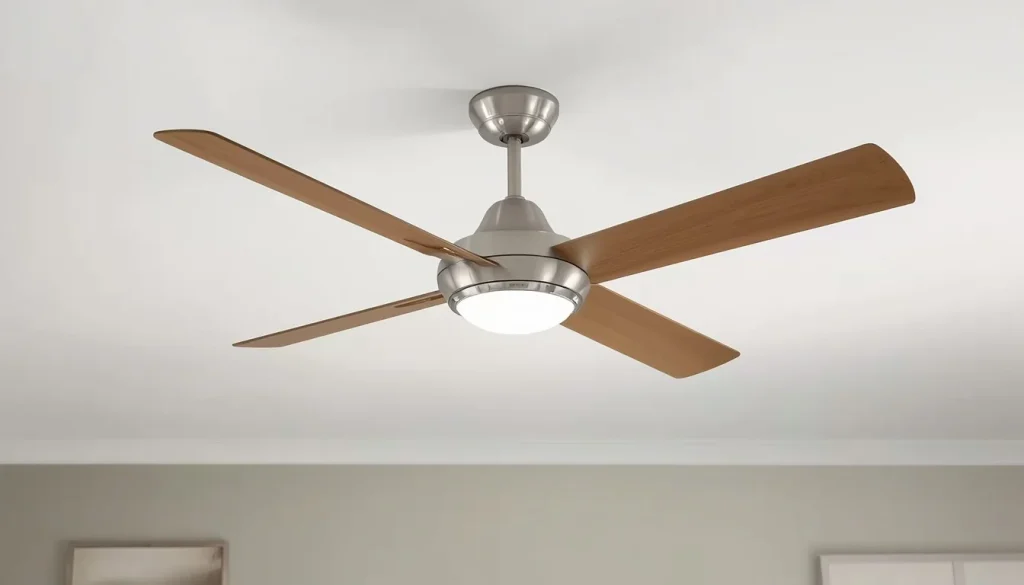
The Aeratron AE3+ is a strong candidate for people who prioritize quiet operation and gentle airflow over finding the lowest purchase price.
Unlike many ceiling fans promoted as whisper-quiet, the AE3+ has published independent bedroom assessment information. Australian consumer organization CHOICE lists a Bedroom score of 90% and a noise measurement of 32 dB. CHOICE evaluates bedroom suitability by considering how effectively a fan moves air on its lowest setting without disrupting sleep. Its published noise measurements are taken at medium speed.
That makes the results more useful than a generic quietness claim, although they should not be treated as directly comparable with figures measured using a different test method.
The AE3+ uses a DC motor and offers six speed settings. According to CHOICE’s product specifications, it consumes approximately 5 watts on low, 8 watts on medium, and 18 watts on high. A remote control and reverse function add convenience, while a lighting kit is available separately.
What makes it worth considering
- Independent bedroom performance information is available.
- Six speeds allow more flexibility when adjusting airflow for sleep.
- Low-speed power consumption is modest according to its published specifications.
- Remote control makes nighttime adjustments easier.
Potential drawbacks
The AE3+ is a premium-priced option, and local availability outside Australia may be limited. It is also important to check the exact model and included accessories before buying.
Best for: Australian buyers who want evidence of bedroom performance and are willing to prioritize comfort over the lowest initial cost.
Read the Aeratron AE3+ review from CHOICE for its published specifications and test information.
2. Minka-Aire Light Wave 52-inch: Best Premium Option for the USA
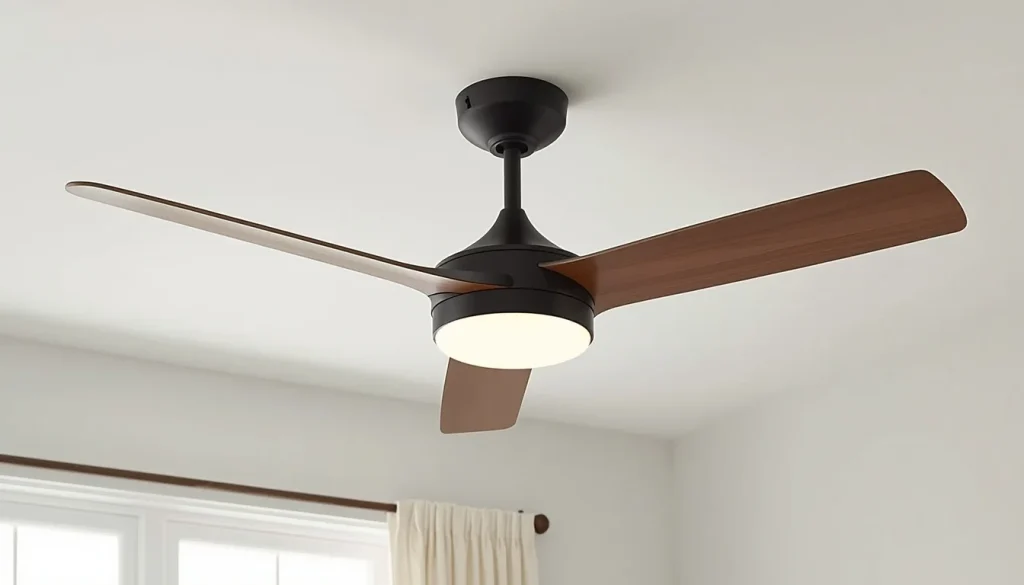
The Minka-Aire Light Wave is worth considering if you want a contemporary bedroom fan with integrated lighting and a track record in independent testing.
The 52-inch model features three shaped blades, a remote control, and a dimmable LED light. Its distinctive design may suit modern bedrooms where the fan is intended to be both a practical fixture and part of the room’s appearance.
The model also appears in Consumer Reports’ 2026 ceiling fan testing coverage. A summary of those tests published by Quartz reports excellent airflow and noise performance at both high and low speeds.
However, the available test summary does not provide a directly comparable decibel figure for this model. It is therefore more accurate to say the fan performed well in the reported testing than to assign it a noise level that has not been verified.
The Light Wave uses an AC motor, demonstrating that DC technology is not an absolute requirement for a quiet bedroom fan. Overall design and measured performance matter too.
What makes it worth considering
- Independent test results support its low- and high-speed noise performance.
- Integrated lighting and remote control simplify bedroom use.
- The modern three-blade design suits contemporary interiors.
- Several finishes and other sizes are available in the product collection.
Potential drawbacks
It may cost more than a basic ceiling fan, and its published product specifications do not provide a directly comparable independent bedroom noise rating. Availability and warranty coverage should also be checked before purchasing in Canada.
Best for: Buyers in the USA who want a premium-looking fan with integrated lighting and encouraging independent noise-test results.
Check the official Minka-Aire Light Wave product information for specifications and available configurations.
3. Westinghouse Comet Indoor 52-inch: Best Value-Focused Choice
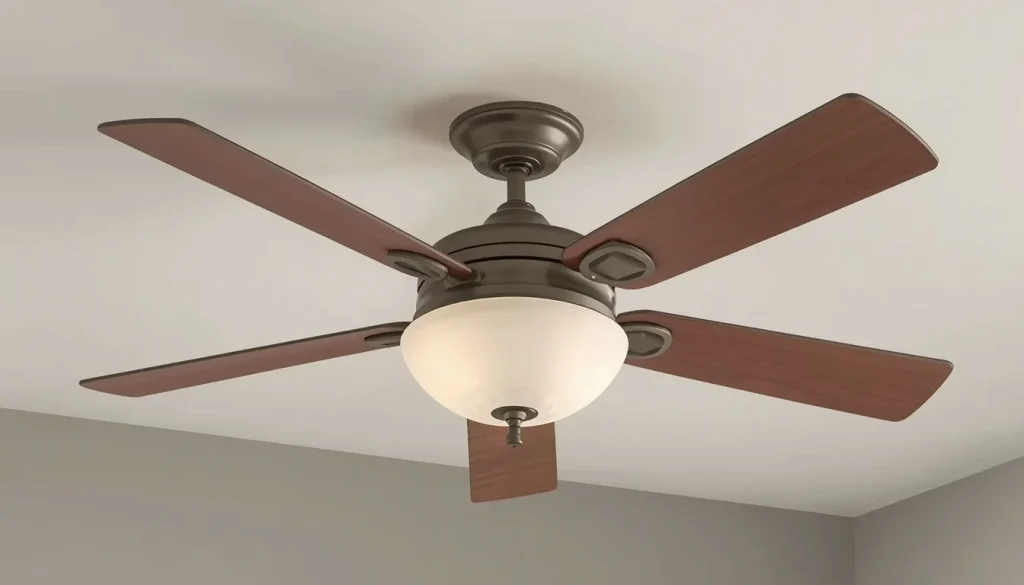
The Westinghouse Comet Indoor 52-inch is worth examining if you prefer a traditional ceiling fan with integrated lighting rather than paying for premium designer styling.
It uses five blades and is available in several finishes. Depending on the exact variant, it includes an integrated LED light or a light fixture with replaceable bulbs. Always check the model number because specifications and included features can differ between versions.
The Comet also appears in Consumer Reports’ ceiling fan tests. The published summary of those results reports excellent high-speed and low-speed noise performance, with airflow also receiving a strong rating. That makes it a useful comparison candidate for buyers who want quiet operation without automatically choosing a premium designer model.
The manufacturer’s official Comet product page lists 3,589 CFM of maximum-speed airflow and 63 watts of fan energy use at high speed for the specified model. These are model-specific figures, not universal values for every Comet variant.
What makes it worth considering
- Encouraging independent noise-test results at low and high speeds.
- A familiar five-blade design that suits many traditional bedrooms.
- Integrated lighting on the listed model.
- Published airflow and power specifications for comparison.
Potential drawbacks
This model does not have a directly comparable published decibel rating in the sources reviewed. It is also designed for the North American market, so international buyers should not assume it is suitable for installation elsewhere.
Best for: Buyers who want a conventional bedroom fan and prefer independent performance evidence over marketing language alone.
Compare the model details with the Consumer Reports ceiling fan testing summary before making a final decision.
4. Honeywell Carnegie 52-inch: Best for Quiet Low-Speed Operation
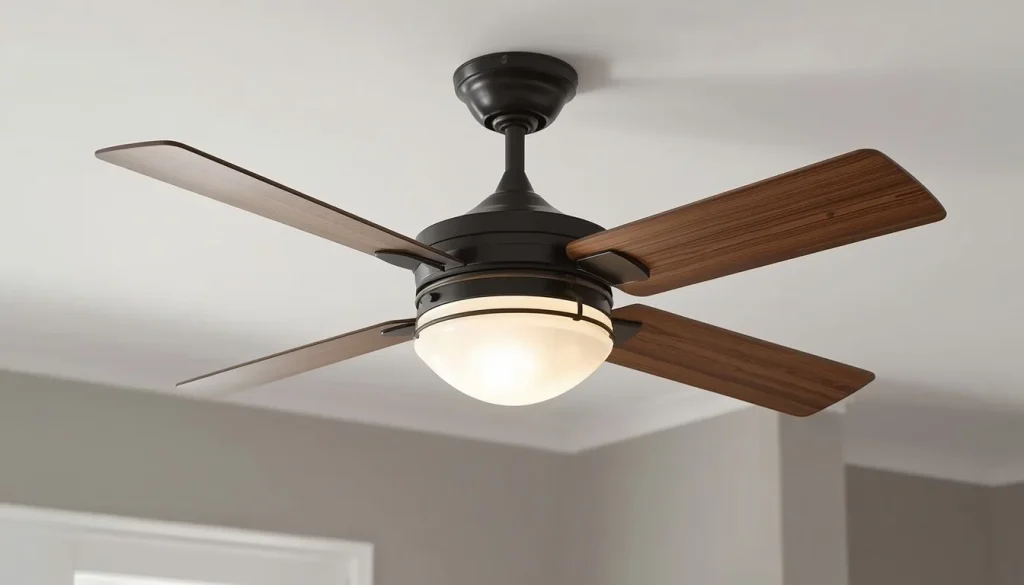
For a bedroom fan, high-speed performance matters less if you usually run the motor on low throughout the night. The Honeywell Carnegie 52-inch is worth considering for precisely that reason.
In Consumer Reports’ testing, the Carnegie received an excellent rating for low-speed noise, while its high-speed noise result was very good. The published test summary notes that the motor became more noticeable at high speed, although it did not reach the point of being considered annoying by the testers.
This distinction matters because the best fan for sleeping is not necessarily the one that produces the strongest breeze. A model that runs smoothly on a gentle setting may be more comfortable than one that needs to run faster to move enough air around the room.
The Carnegie has a traditional industrial-inspired appearance and comes with lighting. Features and control arrangements can vary by model, so verify whether the exact version includes a remote or uses pull chains.
What makes it worth considering
- Strong reported low-speed noise performance.
- Airflow suitable for people who need more than a decorative fan.
- Integrated lighting on the tested model.
- A more traditional visual style than some contemporary three-blade fans.
Potential drawbacks
Its high-speed noise performance was not rated as highly as its low-speed performance. Buyers who regularly operate a fan at high speed should take that distinction into account.
Best for: People who tend to keep their bedroom fan on a low setting while sleeping.
See the Consumer Reports ceiling fan testing overview and confirm the specifications of the exact Carnegie model available locally.
5. Fanco Eco Silent Pro DC 52-inch: Best for Low-Power Overnight Use in Australia
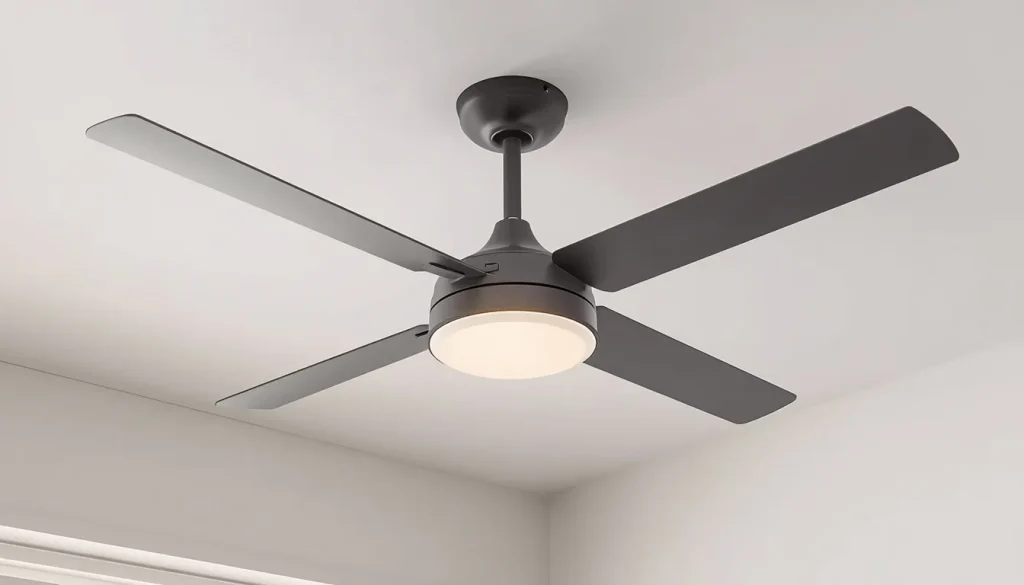
Running a ceiling fan for several hours every night makes energy consumption worth considering alongside noise.
The Fanco Eco Silent Pro DC is designed for buyers who want adjustable airflow, integrated lighting on the relevant variant, and low power consumption at the lower speed settings.
The listed 52-inch model has six speeds and a DC motor. Its published performance data gives a power consumption of 1.3 watts at speed one, increasing as the fan speed rises. The same listing reports airflow of 3,908 cubic metres per hour at the lowest setting.
These figures are useful because they show that the lowest setting still moves air while using relatively little electricity. However, low power consumption does not prove that a fan is exceptionally quiet. I did not find a comparable independent noise rating for this specific model in the reviewed sources.
The remote, timer, and reversible operation also make it a practical model to compare if you want to adjust airflow from bed.
What makes it worth considering
- Six speed settings for more precise airflow control.
- Very low listed power consumption at the lowest speed.
- Published performance information for comparing airflow and energy use.
- A practical option for overnight operation.
Potential drawbacks
A directly comparable independent noise measurement was not available in the sources reviewed. The purchase decision should therefore be based on the verified specifications, warranty, installation suitability, and any independent test information you can obtain.
Best for: Australian buyers who prioritize low electricity use and flexible airflow control while still checking noise performance before purchasing.
See the Fanco Eco Silent Pro product specifications for the listed performance figures and included features.
6. Claro Whisper Low Profile V2 DC 44-inch: Best for Low Ceilings in Australia
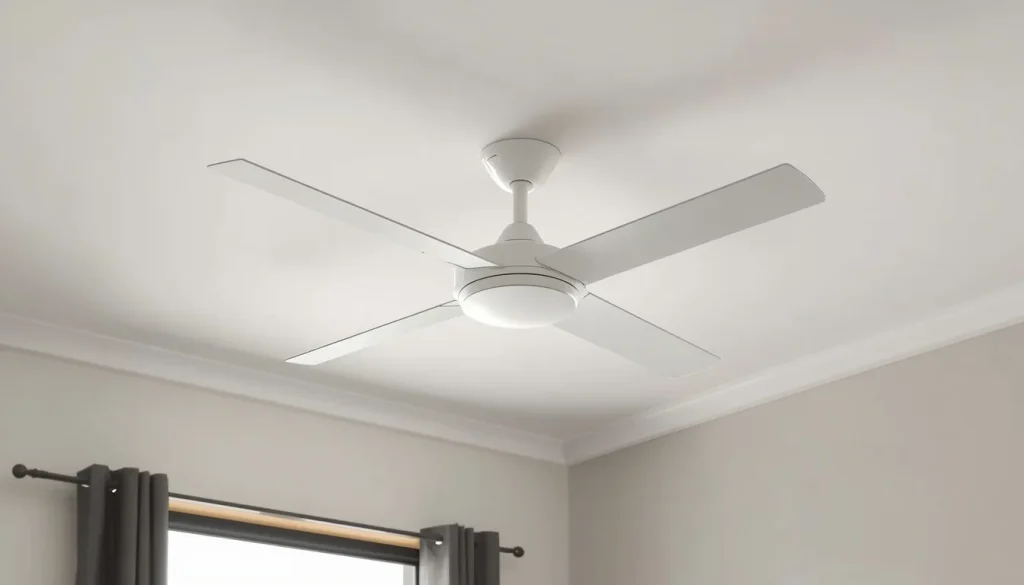
A noisy fan is not the only thing that can make sleeping uncomfortable. A fan that hangs too low or feels visually overwhelming in a compact bedroom can also be a poor fit.
The Claro Whisper Low Profile V2 DC 44-inch is designed for rooms where installation height is a priority. Its listed ceiling-to-blade distance is approximately 160 mm, with a greater total drop when the light is included.
The Australian product listing describes a DC motor, six speeds, remote control, reversible operation, and an included light. Published figures show power consumption starting at 0.8 watts on the lowest setting, with airflow of 2,067 cubic metres per hour at that speed.
These figures suggest that the model provides a gentle airflow option with very low power consumption. However, a comparable independent bedroom noise measurement was not found in the reviewed sources, so it should not be described as a proven decibel leader.
Check the installation details carefully: the listed version is intended for flat ceilings only.
What makes it worth considering
- Low-profile mounting for rooms with limited ceiling height.
- Six speed settings for adjusting airflow at night.
- Remote control and a timer for convenient operation.
- Low listed power consumption on speed one.
Potential drawbacks
The available product information does not establish an independent noise rating, and the flat-ceiling limitation may rule it out for some rooms.
Best for: Australian homeowners who need a compact, low-profile ceiling fan and want low-speed airflow options.
Review the Claro Whisper Low Profile V2 DC product specifications before deciding whether it suits your ceiling.
7. Fantasia Mayfair Combi 42-inch: Best Low-Profile Option for the UK
UK buyers may prefer a ceiling fan sold and supported locally rather than importing a product designed for another electrical market.
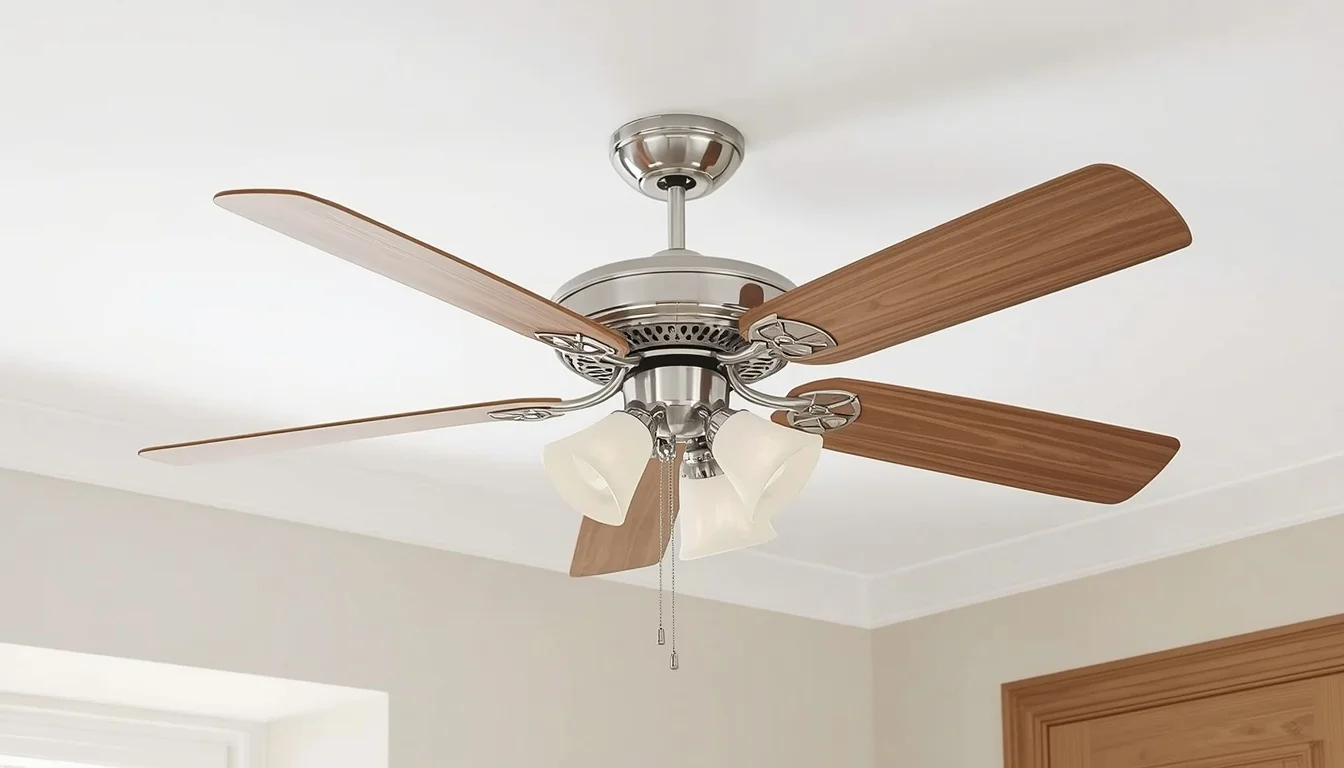
The Fantasia Mayfair Combi 42-inch is a traditional fan with a relatively shallow mounting profile. The manufacturer describes it as quiet in operation and states that the drop from the ceiling to the blades is approximately 165 mm.
It offers three forward speeds and reverse operation, together with a three-light fitting. The listed model uses pull cords for the fan and light, while remote control is available as an upgrade.
These are useful practical features, especially if your bedroom has limited ceiling height or you need a fan and light in one fixture. Nevertheless, the manufacturer’s description of quiet operation should not be confused with an independently verified noise measurement.
If you are a light sleeper, ask the retailer or manufacturer for a test result that identifies the noise level, operating speed, and measurement conditions. A demonstration in a quiet room may also help you assess whether the sound is comfortable for you.
What makes it worth considering
- A shallow mounting profile for low ceilings.
- Integrated lighting.
- Forward and reverse operation.
- A UK-market product with local manufacturer support.
Potential drawbacks
It offers fewer speed settings than many DC models, and a directly comparable independent noise figure was not found in the sources reviewed.
Best for: UK buyers looking for a locally supported, low-profile ceiling fan with lighting.
Check the official Fantasia Mayfair Combi product page for current specifications and available finishes.
What Makes a Ceiling Fan Quiet?
Understanding the source of fan noise can help you choose a suitable model—and may even save you from replacing a fan that only needs a simple adjustment.
DC Motor vs. AC Motor: Which Is Quieter?
DC ceiling fans are often worth considering for bedrooms because many offer more speed settings and low-speed operation with relatively low power consumption.
A broader range of speeds lets you fine-tune the airflow rather than choosing between a few widely spaced settings. Some DC models also perform particularly well at low speeds.
However, DC does not automatically mean silent. A poorly installed DC fan can vibrate or produce mechanical noise, while a well-designed AC fan can operate comfortably in a bedroom.
The complete design, blade balance, motor quality, mounting system, and operating speed all matter.
For a detailed comparison of costs, efficiency, and motor characteristics, read our guide to DC vs. AC Ceiling Fans: Which Is Better for Your Home?.
Blade Design Matters More Than Blade Count Alone
Some people assume that a three-blade ceiling fan will always be quieter than a five-blade model. That is not a reliable rule.
Airflow and noise depend on several factors, including blade shape, pitch, motor performance, and rotational speed. A well-designed fan with five blades can outperform a poorly matched three-blade fan in both airflow and perceived noise.
When comparing models, look for independent noise measurements and useful airflow figures instead of judging the fan by appearance alone.
Our guides to 3-Blade vs. 5-Blade Ceiling Fans, Ceiling Fan Blade Size, and Ceiling Fan Blade Pitch explain how these design choices influence fan performance.
Motor Noise vs. Airflow Noise
Not all fan noise comes from the motor.
Motor noise may sound like humming, buzzing, or a low mechanical vibration. It can become more noticeable when the room is quiet.
Airflow noise is the sound created as air moves around the blades. It generally becomes more noticeable as speed increases.
Mechanical noise may include clicking, rattling, or repetitive tapping caused by loose components, blade imbalance, or mounting problems.
Knowing which type of sound you hear will help you choose a replacement or troubleshoot an existing fan more effectively.
What Noise Level Is Best for Sleeping?
Noise ratings can help you compare ceiling fans, but the numbers must be interpreted carefully.
Decibels, written as dB, measure sound level. The dBA scale applies a weighting designed to reflect how human hearing responds to different frequencies.
When comparing two fans, make sure you know whether the manufacturers use dB or dBA and whether their measurements were taken under similar conditions.
Is Under 35 dB Quiet Enough for a Bedroom?
CHOICE notes that noise levels below 35 dB on its medium-speed test should allow people to sleep soundly. Its assessment also considers the airflow available at the lowest speed.
This provides a useful reference point, but it is not a universal guarantee. The measurement distance, background noise, room acoustics, and testing conditions can all affect how a number should be interpreted.
For example, a fan advertised at 30 dB on its lowest setting cannot automatically be considered quieter than a fan measured at 32 dB on medium. The speeds and conditions differ.
Before trusting a noise claim, check:
- Whether the figure comes from an independent test or the manufacturer.
- Which operating speed was tested.
- Whether the measurement uses dB or dBA.
- Whether the test distance and method are stated.
- Whether motor noise and airflow noise are included.
A product described as “whisper-quiet” without a measurement may still be suitable, but the description alone is not proof.
How to Choose the Quietest Ceiling Fan for Your Bedroom
The best model is one that suits your room, provides enough airflow at a comfortable speed, and avoids unnecessary sound.
1. Choose the Right Fan Size
A fan that is too small may struggle to circulate air adequately. A fan that is too large may be difficult to fit comfortably in a compact room.
As a starting point, ENERGY STAR’s ceiling fan sizing guidance recommends the following blade spans:
| Bedroom Area | Suggested Blade Span |
|---|---|
| Up to 75 sq. ft. (about 7 m²) | 29–36 inches |
| 76–144 sq. ft. (about 7–13.4 m²) | 36–42 inches |
| 145–225 sq. ft. (about 13.5–20.9 m²) | Around 44 inches |
| 226–400 sq. ft. (about 21–37.2 m²) | 50–54 inches |
These are starting points, not universal installation rules. Ceiling height, room shape, furniture, airflow needs, and manufacturer recommendations may affect the final choice.
For more detailed guidance, use our What Size Ceiling Fan Do I Need? Room Size Chart and Calculator or read our complete guide to choosing the right ceiling fan.
2. Prioritize Comfortable Low-Speed Airflow
Maximum CFM is useful, but it does not tell you everything about bedroom comfort.
CFM stands for cubic feet per minute and describes the volume of air a fan moves in a minute. The amount of airflow you need depends on your room size, ceiling height, climate, and personal preference.
For sleeping, look for a fan that can move enough air on a low setting without creating an unpleasant breeze or excessive airflow noise.
A high-CFM fan is not necessarily the best bedroom choice if its lowest setting still feels too strong. Conversely, a very quiet fan that barely circulates air may leave you uncomfortable.
Our Ceiling Fan CFM Explained guide covers airflow terminology, while How Much CFM Do I Need for a Ceiling Fan? helps you estimate the airflow appropriate for your room.
3. Check Ceiling Height and Mounting Type
A fan should fit vertically as well as horizontally.
Low ceilings may require a hugger or flush-mount model, while taller ceilings may need an appropriate downrod to position the fan correctly.
ENERGY STAR’s installation guidance recommends keeping the blades at least 7 feet above the floor and 18 inches away from walls under its US-oriented guidance. Local requirements and the manufacturer’s instructions take precedence in other markets.
The fan must also be mounted securely to a support designed for a ceiling fan. An unsuitable mounting box or loose installation can cause vibration and rattling.
Read the ENERGY STAR ceiling fan installation guidance and use a qualified electrician in accordance with local requirements.
4. Look for a Remote and Sleep Timer
Convenient controls can make a genuine difference when you are trying to fall asleep.
A remote lets you reduce the fan speed without getting out of bed. A timer allows you to schedule the fan to turn off after you fall asleep, while smart controls may offer schedules and app-based adjustments.
These features do not make the motor inherently quieter, but they make it easier to operate a fan at a comfortable speed throughout the night.
5. Consider Energy Consumption
If your ceiling fan runs for eight hours each night, its power consumption deserves attention.
You can estimate electricity costs using this formula:
Electricity cost = (Watts × Hours used ÷ 1,000) × Electricity rate per kWh
For example, a fan drawing 20 watts and running for eight hours uses 0.16 kWh per night. Over 30 nights, that is approximately 4.8 kWh.
Multiply the energy used by your local electricity rate to estimate the monthly cost.
The calculation is only as accurate as the power figure you use. A fan’s consumption changes with speed, so using its maximum wattage when you normally run it on low may overestimate the cost.
In the USA and Canada, ENERGY STAR’s certified ceiling fan database is a useful way to compare eligible models for energy efficiency. Certification indicates energy performance, however, not necessarily superior bedroom noise performance.
How to Stop a Ceiling Fan From Making Noise at Night
If your current ceiling fan has started making noise, replacing it may not be necessary. The first step is to identify the type of sound and its likely cause.
Always switch off the fan before inspecting it. For any inspection involving wiring or electrical components, disconnect the appropriate circuit and consult a qualified electrician when needed.
How to Fix a Humming or Buzzing Ceiling Fan
A humming sound may originate from the motor, a control system, loose components, or electrical problems.
Start by checking the following:
- Confirm that the fan is being operated with the manufacturer-approved speed control.
- Check whether the sound occurs at every speed or only at one setting.
- Look for visible signs of loose external fittings while the power is off.
- Consult the manufacturer’s troubleshooting instructions if the sound continues.
Never use an ordinary lighting dimmer to control fan speed unless the manufacturer explicitly approves that specific control for the fan. An incompatible control can cause humming or operating problems.
A persistent electrical buzz should not be ignored. If the fan overheats, smells burnt, trips a breaker, or produces a new or worsening electrical noise, stop using it and contact a qualified electrician.
How to Fix Clicking or Ticking Sounds
A regular clicking sound may come from a loose screw, a light cover, a pull chain striking the housing, or another component moving as the fan rotates.
With the fan switched off, inspect accessible external parts according to the owner’s manual. Make sure light covers and other fittings are secure, and remove any loose object that could be hitting the fan.
Do not reach toward the blades while the fan is running or attempt to repair internal electrical parts yourself.
If the clicking continues after you have ruled out obvious external causes, contact the manufacturer or a qualified technician.
How to Fix a Wobbling or Rattling Ceiling Fan
Some movement may be visible in a ceiling fan, but pronounced wobbling can indicate an installation or balancing problem.
Possible causes include:
- Loose blade screws or mounting hardware.
- Uneven blade alignment.
- Dirt accumulating unevenly on the blades.
- A damaged blade or blade holder.
- An unsuitable or insecure mounting point.
After disconnecting power, clean the blades and check accessible fasteners according to the manufacturer’s instructions. If the fan remains unbalanced, use an approved balancing kit when appropriate.
ENERGY STAR’s installation and usage tips include guidance for addressing a wobbly ceiling fan.
If the mounting point moves, the fan makes a sudden loud noise, or you suspect damage to the support structure, stop using the fan until it has been inspected.
Why Does a Ceiling Fan Make More Noise at Low Speed?
A low setting does not guarantee silence. Depending on the design, a fan may produce noticeable electrical hum, vibration, or repeated clicking at a particular speed.
If the noise occurs only at one setting, note which speed produces it. Check the manual and contact the manufacturer for model-specific advice.
Do not assume that lubricating the motor, changing electrical wiring, or fitting a different wall controller is the correct solution. Many modern motors are not intended for user servicing.
Which Quiet Ceiling Fan Is Best for Your Country?
The best purchase depends partly on where you live. Product availability, electrical compatibility, installation rules, and warranty support are not the same across all four markets.
USA
Start by comparing the Minka-Aire Light Wave, Westinghouse Comet, and Honeywell Carnegie models discussed above. They have relevant independent test information, although their results should not be treated as a single standardized ranking against Australian or UK models.
Check the exact model number, mounting requirements, control compatibility, and warranty before purchasing.
Canada
US-market models may be available through Canadian retailers, but stock and warranty coverage can vary. Verify that the specific model is suitable for Canadian installation and has appropriate local support.
The ENERGY STAR product finder is a helpful starting point for comparing eligible models sold in the USA and Canada.
UK
Look for a fan marketed for the UK, with appropriate electrical compatibility, installation instructions, and warranty support. The Fantasia Mayfair Combi is one low-profile model worth comparing, but you should ask for independent noise information if quietness is your main priority.
Australia
The Aeratron AE3+ is particularly relevant because CHOICE publishes a bedroom performance assessment. The Fanco Eco Silent Pro and Claro Whisper Low Profile V2 are additional candidates for buyers who value low-speed power consumption and adjustable airflow.
Check the precise variant and installation requirements before purchasing. Do not assume that a fan designed for one country’s electrical system is suitable for another simply because the product looks identical.
Frequently Asked Questions About Quietest Ceiling Fan for Bedroom
What Is the Quietest Ceiling Fan for a Bedroom?
The answer depends on the testing method, the speed being used, and the amount of airflow you need. The Aeratron AE3+ has particularly relevant published bedroom assessment information from CHOICE, while several North American models have promising low- and high-speed noise results in Consumer Reports testing.
There is no single universally established winner across all four countries based on directly comparable tests.
Are DC Ceiling Fans Quieter Than AC Fans?
Many DC fans offer more speed settings and efficient low-speed operation, making them attractive for bedrooms. However, not every DC fan is quieter than every AC fan. Motor design, blade balance, installation, and operating speed also affect noise.
What Is a Good Noise Level for Sleeping?
CHOICE uses below 35 dB on medium speed as a useful reference in its bedroom fan guidance. However, there is no universal number that guarantees comfortable sleep for everyone. Compare measurements taken under similar conditions and consider both airflow and the type of noise produced.
Can a Ceiling Fan Be Completely Silent?
A running fan moves air, and that movement can create some sound even when the motor itself is quiet. A well-designed fan should minimize distracting motor noise, vibration, and rattling, but completely silent operation should not be assumed.
Why Does My Ceiling Fan Hum at Night?
Common causes include motor characteristics, an incompatible control, loose components, or an electrical problem. If the hum has appeared suddenly, is getting louder, or occurs alongside overheating or a burning smell, stop using the fan and have it checked.
Are Three-Blade Fans Quieter Than Five-Blade Fans?
Not necessarily. Blade count alone does not determine noise. Blade shape, pitch, motor quality, rotational speed, and installation all influence performance. Compare tested noise and airflow results rather than choosing a fan solely by its number of blades.
Can a Wall Dimmer Cause Ceiling Fan Humming?
Yes, an incompatible lighting dimmer or speed controller can cause operating problems. Use only the control type approved for the specific fan, and consult a qualified electrician if the fan continues to hum.
Is a Quiet Ceiling Fan Worth the Extra Cost?
It can be worthwhile if fan noise regularly interrupts your sleep. However, a higher price does not automatically mean quieter operation. Look for credible test results, comfortable low-speed airflow, appropriate sizing, and useful warranty support before paying more.
Final Verdict: Which Quiet Ceiling Fan Should You Choose?
Choosing the quietest ceiling fan for a bedroom is about finding the right balance between sound, airflow, energy consumption, and room suitability.
For Australian buyers who want published bedroom performance information, the Aeratron AE3+ deserves close consideration. In the USA, the Minka-Aire Light Wave, Westinghouse Comet, and Honeywell Carnegie are worth comparing because of their reported independent noise-test results.
If you are shopping in Australia for a fan with very low listed power consumption, the Fanco Eco Silent Pro DC is another candidate. For low ceilings, compare the Claro Whisper Low Profile V2 in Australia or the Fantasia Mayfair Combi in the UK, while keeping in mind that their reviewed product information does not establish a comparable independent noise rating.
Before making your final decision, check the noise evidence, make sure the fan supplies sufficient airflow on low, and confirm that it suits your ceiling height and local installation requirements.
Most importantly, remember that a noisy fan does not always need replacing. If your current fan hums, clicks, or rattles, identifying and correcting the underlying problem may be the simplest route to a quieter bedroom.
The best bedroom ceiling fan is ultimately the one that delivers comfortable airflow without distracting you when you need to sleep.

“The right fan can make a bigger difference than you think.”
Hi, I’m Michael Turner, an author and home appliance researcher at BestFanSolve.com.
My interest in fans started with a simple question: How do you know which fan is actually right for your needs? With so many types, features, brands, and technical specifications available, choosing a fan can quickly become confusing. I created BestFanSolve.com to make that process easier.
Through this website, I share practical fan reviews, buying guides, comparisons, troubleshooting tips, maintenance advice, and solutions to common fan problems. I focus on turning complicated product information into clear, useful guidance that everyday readers can actually understand and use.
Whether you’re searching for a quiet bedroom fan, a powerful fan for a large room, an energy-efficient option, or simply trying to figure out why your current fan isn’t working properly, my goal is to help you find the information you need before making a decision.
I believe good recommendations should be based on research, real-world considerations, honest pros and cons, and the specific needs of the user—not simply marketing claims.
Through BestFanSolve.com, I’m committed to helping readers find the right fan, solve common fan problems, and make smarter purchasing decisions with confidence.
— Michael Turner
Author & Home Appliance Researcher
BestFanSolve.com