

Choosing the right ceiling fan blade size can make a noticeable difference in how comfortable your room feels. A fan that is too small may struggle to circulate air throughout the space, while an oversized fan may not fit comfortably in a compact bedroom or office.
The tricky part is knowing what the numbers on a ceiling fan actually mean. Does a 52-inch ceiling fan have 52-inch blades? How do you measure an existing fan? And what size should you choose for a bedroom, living room, or open-plan space?
This ceiling fan blade size guide answers those questions with a practical room-size chart, easy measuring instructions, and tips for choosing the right fan for your home. Whether you measure in inches and square feet or centimetres and square metres, you will learn how to compare fan sizes more confidently.
What Is Ceiling Fan Blade Size?
Ceiling fan blade size usually refers to the blade span, also called the fan’s diameter or sweep. It is the distance across the circle formed by the rotating blades, measured from one blade tip to the opposite blade tip.
For example, a 52-inch ceiling fan has a blade span of approximately 52 inches (132 cm). It does not mean that each individual blade is 52 inches long.
Understanding this difference is important because manufacturers use blade span to describe fan size and provide room-sizing recommendations.
Blade Length vs. Blade Span
Blade length and blade span are related, but they describe different measurements.
- Blade length: The distance from the base of an individual blade to its outer tip.
- Blade span: The total diameter of the rotating blade circle, measured across opposite blade tips.
- Blade sweep: Another common term for the diameter covered by the rotating blades.
- Fan housing: The central motor assembly, which is not included in the blade-span measurement.
When comparing ceiling fans, look for the manufacturer’s stated blade span rather than relying on the length of a single blade.
For a more complete explanation of room measurements, see our ceiling fan size for room guide.
Does the Number of Blades Affect Fan Size?
Not directly. A three-blade fan and a five-blade fan can have the same blade span.
For example, both models might measure 52 inches across. However, their blade shapes, pitch, motor performance, and airflow characteristics may differ.
A fan with more blades is not automatically more powerful or quieter. If you are comparing different designs, our guide to 3-blade vs. 5-blade ceiling fans explains the differences in greater detail.
Ceiling Fan Blade Size Chart by Room Size
The easiest way to estimate the right ceiling fan blade size is to measure your room’s floor area and compare it with a sizing chart.
The following table uses the general room-sizing recommendations published by ENERGY STAR’s ceiling fan guide. The measurements in centimetres and square metres are approximate conversions.
| Room area (square feet) | Approximate area (m²) | Suggested blade span |
|---|---|---|
| Up to 75 sq ft | Up to 7 m² | 29–36 inches (74–91 cm) |
| 76–144 sq ft | 7.1–13.4 m² | 36–42 inches (91–107 cm) |
| 145–225 sq ft | 13.5–20.9 m² | Around 44 inches (112 cm) |
| 226–400 sq ft | 21–37.2 m² | 50–54 inches (127–137 cm) |
| Over 400 sq ft | Over 37.2 m² | Consider 56 inches (142 cm) or larger, or multiple fans |
These sizes are starting points, not strict rules. Recommendations can differ between manufacturers, and some newer fan designs are available in sizes outside these ranges.
For example, an Australian buying guide from Bunnings recommends considering fans up to approximately 120 cm for rooms around 4 × 4 metres or smaller, with larger fans or multiple fans for bigger spaces. This illustrates why it is worth checking the room-sizing guidance for the specific fan sold in your market.
Room shape, ceiling height, blade clearance, and published airflow ratings should also influence your final choice.
What Size Ceiling Fan Do You Need for a Small Room?
For a room up to 75 square feet (around 7 m²), a fan with a 29–36-inch blade span is a useful starting point.
This size may suit a compact bedroom, small home office, or utility room. However, the fan still needs adequate clearance from walls, furniture, and nearby fixtures.
You can also explore our recommendations for the best ceiling fans for small rooms if you need help choosing a suitable design.
What Size Ceiling Fan Is Best for a Large Room?
For rooms between approximately 226 and 400 square feet (21–37 m²), a 50–54-inch fan is a reasonable starting point.
For larger areas, you may need a bigger fan or more than one fan. A long living room, for example, may need a different arrangement from a square room with the same floor area.
Our guide to the best ceiling fan for a large room covers additional considerations when choosing a fan for a spacious area.
How to Measure Ceiling Fan Blade Size Correctly
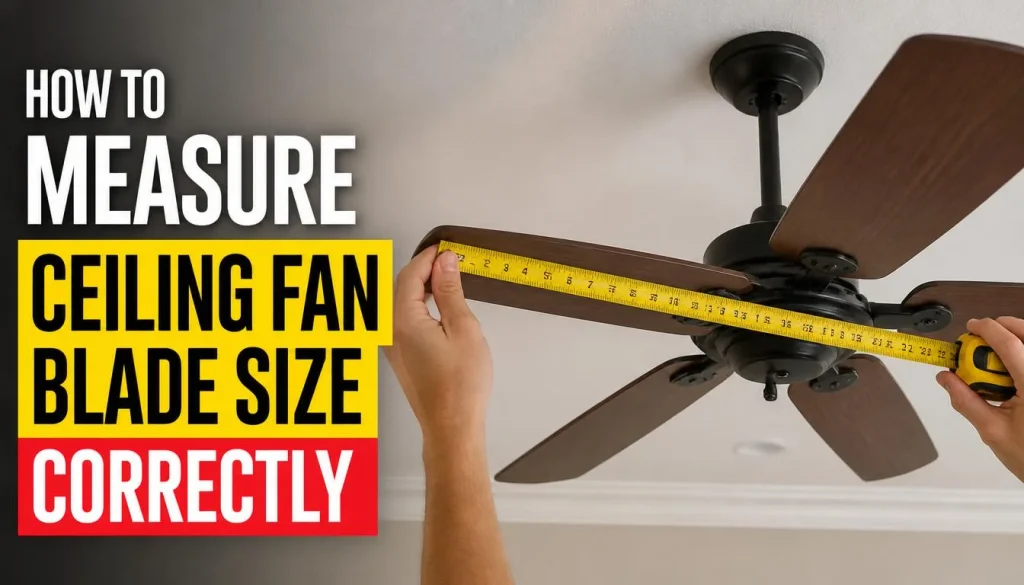
Measuring a ceiling fan is straightforward once you know where to place the tape measure.
Before measuring an installed fan, switch it off and wait until the blades have stopped completely. If you need to climb a ladder, use suitable equipment and avoid measuring from an unstable position.
The Hunter Fan measuring guide also explains how to measure blade span and account for ceiling height.
How to Measure a Fan With an Even Number of Blades
If your fan has an even number of blades, follow these steps:
- Turn off the fan and wait for the blades to stop.
- Locate two blade tips that face in opposite directions across the centre of the fan.
- Measure the straight-line distance from one blade tip to the opposite blade tip.
- Record the measurement in inches or centimetres.
For example, if the distance between opposite blade tips is 52 inches, the fan has a 52-inch blade span.
Do not measure from the tip of one blade to the motor housing. That gives you a different measurement and will underestimate the overall fan size.
How to Measure a Fan With an Odd Number of Blades
Fans with three or five blades generally do not have an opposite blade directly across the centre.
In this situation, you can measure the distance from the centre of the fan to the tip of one blade. This measurement is the approximate radius.
Multiply it by two to calculate the blade span.
Formula:
Blade span = Radius × 2
For example:
- Distance from the fan’s centre to a blade tip: 26 inches
- Calculation: 26 × 2 = 52 inches
- Result: The fan has an approximate 52-inch blade span.
Keep the tape measure aligned with the blade’s radial direction and use the rotational centre rather than the edge of the motor housing.
How to Measure a Detached Ceiling Fan Blade
If you have removed a blade for inspection or replacement, measure from the blade’s mounting end to its outer tip.
This gives you the approximate length of that individual blade, not the complete fan span.
You should not simply double the detached blade’s length to determine the original span. Some blades attach to a holder or bracket, and the distance between the mounting point and the rotational centre affects the final measurement.
If you need the original fan diameter, check the model number, manufacturer’s specifications, or installation manual whenever possible.
How to Convert Inches to Centimetres and Square Feet to Square Metres
If you are comparing ceiling fans from different countries, these simple conversions can help.
- 1 inch = 2.54 centimetres.
- 36 inches = approximately 91 cm.
- 42 inches = approximately 107 cm.
- 44 inches = approximately 112 cm.
- 52 inches = approximately 132 cm.
- 1 square foot = approximately 0.0929 square metres.
For example, a room measuring 12 × 12 feet has an area of 144 square feet, or approximately 13.4 m².
A room measuring 3.6 × 3.6 metres has an area of 12.96 m².
Both measurements describe a room of roughly the same size, so you can compare them with the relevant room-sizing recommendations.
How to Calculate the Right Ceiling Fan Size for Your Room

You do not need a complicated calculator to estimate the right blade span. A tape measure and a basic calculator are usually enough.
Step 1: Measure the Room’s Length and Width
Measure from wall to wall in both directions.
For a rectangular room, record the length and width using the same unit. You can use feet, metres, or another consistent unit.
For example, a bedroom might measure:
- Length: 12 feet
- Width: 12 feet
Step 2: Calculate the Floor Area
Use this formula:
Room area = Length × Width
For the example above:
12 × 12 = 144 square feet.
Compare the result with the sizing chart to find an appropriate starting range.
For a metric example, a room measuring 3.6 × 3.6 metres has an area of 12.96 m².
You can follow the same method in either measurement system.
Step 3: Measure an L-Shaped or Irregular Room
An L-shaped room cannot always be measured accurately using a single length and width.
Instead, divide the floor plan into smaller rectangles that do not overlap. Calculate the area of each rectangle and add the results.
For example:
- Section A: 10 × 12 feet = 120 square feet.
- Section B: 6 × 8 feet = 48 square feet.
- Total floor area: 120 + 48 = 168 square feet.
A fan around the 44-inch range may be a useful starting point based on the general chart. However, because this room has an irregular shape, one centrally located fan may not distribute air evenly across every section.
Consider where people sit, work, or sleep before deciding whether one fan or multiple fans would be more suitable.
Step 4: Consider the Ceiling Height
Floor area helps estimate the blade span, but ceiling height affects how the fan can be installed.
A compact room with a low ceiling may need a flush-mount fan to preserve headroom. A room with a high or vaulted ceiling may require a compatible downrod to position the blades at a suitable height.
Do not assume that a fan with the right diameter will automatically fit your ceiling.
Step 5: Check the Manufacturer’s Recommendations
Before making a final decision, check the manufacturer’s recommended room size and installation requirements.
This is especially important if your room falls between two sizing categories or has unusually high ceilings, a narrow layout, or limited clearance.
For additional installation guidance, see ENERGY STAR’s ceiling fan installation and usage tips.
Does Ceiling Height Affect the Blade Size You Need?
Yes, but ceiling height and blade span solve different problems.
Room area helps determine the approximate fan size. Ceiling height determines how the fan can be mounted safely and how far the blades will sit above the occupied part of the room.
Ceiling Fans for Low Ceilings
Rooms with low ceilings may require a flush-mount or low-profile ceiling fan.
These models sit closer to the ceiling than many traditional fans mounted on downrods. However, the complete installed height matters, especially when a fan includes a light kit.
A smaller blade span does not automatically make a fan suitable for a low ceiling. You must check both the fan’s dimensions and its installation requirements.
Ceiling Fans for Standard-Height Ceilings
For a typical residential ceiling, several mounting options may be suitable, depending on the fan’s design.
A standard mount may provide the correct blade height without an additional extension. Some installations may require a different downrod to meet the manufacturer’s recommendations.
Measure the finished floor-to-ceiling height and consult the fan’s installation manual before choosing the mounting arrangement.
Ceiling Fans for High or Vaulted Ceilings
A high ceiling can leave the blades too far above the occupied area if the fan is installed without a suitable extension.
A compatible downrod may help lower the fan to a more useful height. For a sloped or vaulted ceiling, you may also need a mounting system specifically approved for the ceiling angle.
Check the permitted ceiling angle, required hardware, and structural support before installation.
How Much Clearance Should a Ceiling Fan Have?
Clearance is a critical part of choosing a fan. Even if the blade span suits your room, the fan must fit safely around nearby walls and objects.
ENERGY STAR’s general guidance recommends positioning ceiling fan blades at least 7 feet above the floor and keeping the fan at least 18 inches from the walls. Some manufacturers recommend greater wall clearance, so these figures should not be treated as universal rules.
Check the installation instructions for your exact model and allow adequate space around:
- Walls and doorways.
- Pendant lights and other ceiling fixtures.
- Tall wardrobes, shelving, and cabinets.
- Beams and sloped surfaces.
If you are replacing a smaller fan with a larger one, measure the proposed installation location again. The previous fan’s mounting position may not provide sufficient clearance for the new blade span.
How to Choose Replacement Ceiling Fan Blades
Replacing damaged or worn blades may seem simple, but finding compatible blades involves more than matching their length.
Different fan models can use different mounting arrangements, blade holders, screw positions, and blade profiles. A blade that looks similar may still be unsuitable for your fan.
Check the Fan Model and Manufacturer
Start by identifying the fan’s brand and model number.
Look for the product label, installation manual, or original documentation. Check whether the manufacturer offers replacement blades specifically designed for that model.
If you cannot identify the fan, contact the manufacturer or a qualified professional before attempting to fit replacement blades.
Match the Mounting Holes and Blade Holders
Compare the replacement blade’s mounting pattern with the original blade.
Check the hole spacing, blade holder design, attachment hardware, and any model-specific requirements.
Matching the overall length is not enough. The replacement must be designed to attach securely and operate correctly with the fan’s motor and blade assembly.
Why You Should Not Mix Random Replacement Blades
Ceiling fan blades are designed to work as part of a balanced rotating assembly.
Using blades with different weights, shapes, or dimensions can cause wobbling, vibration, noise, and additional stress on the fan.
Do not mix unrelated blade sets or modify blade holders to force a fit. Follow the manufacturer’s replacement instructions and stop using the fan if it develops unusual movement or vibration.
If compatible replacement parts are no longer available, replacing the entire fan may be the safer option.
For any work involving wiring, mounting hardware, or structural support, consult a qualified electrician or installer where appropriate.
What Affects Airflow Besides Blade Size?
Blade span is important, but it does not tell you everything about a fan’s performance.
Two ceiling fans with the same diameter can produce different amounts of airflow. Their blade design, pitch, motor, rotational speed, and installation conditions all influence performance.
Blade Pitch and Design
Blade pitch refers to the angle of a blade relative to the plane in which it rotates.
Blade shape and pitch affect how the fan moves air. However, a steeper blade pitch alone does not guarantee better performance. The motor must also be designed to handle the aerodynamic load.
When comparing models, look at the manufacturer’s specifications rather than judging performance from blade appearance alone.
What Does CFM Mean?
CFM stands for cubic feet per minute. It measures the volume of air moved by a fan under specified operating conditions.
A larger blade span can help a fan circulate air across a wider area, but the diameter alone does not determine its CFM rating.
When comparing two fans, consider their published airflow ratings, available speed settings, and energy efficiency.
Our guide to how much CFM you need for a ceiling fan explains how to compare airflow requirements with your room size.
Do DC and AC Motors Affect Blade Size?
The type of motor is another consideration when comparing ceiling fans, but DC and AC motor types do not determine the correct blade span by themselves.
A fan still needs to be appropriately sized for the room and installed according to its specifications.
If energy consumption, speed control, or motor performance is a concern, read our comparison of DC vs. AC ceiling fans.
How to Choose the Right Blade Size for Different Rooms
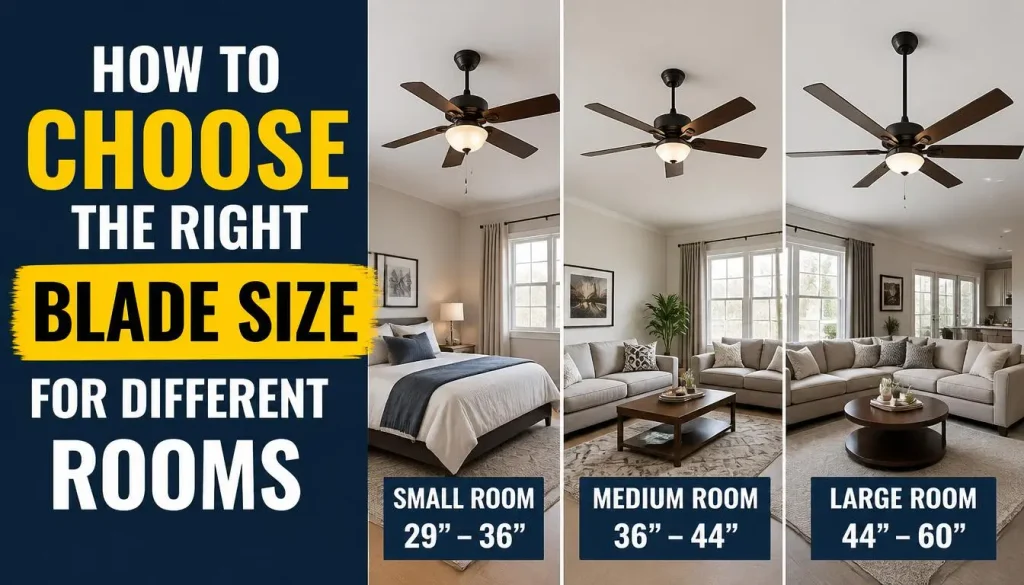
The ideal size depends on the room’s measurements and how you plan to use it.
Bedrooms
A bedroom needs a fan that provides comfortable airflow without feeling overpowering when you are resting.
A room around 100–144 square feet may be a starting point for comparing fans in the 36–42-inch range, depending on the manufacturer’s recommendations.
Beyond diameter, consider low-speed performance, motor noise, and the fan’s installation height.
For more practical advice, see our guide to the best ceiling fan for a bedroom.
Living Rooms
Living rooms often have furniture, lighting fixtures, and several seating areas that influence where a fan should be installed.
For a room around 300 square feet, a 50–54-inch blade span is a reasonable starting point under the general sizing chart.
However, a long living room may need a different arrangement from a square room with the same floor area.
Kitchens and Dining Rooms
Measure the entire area that needs airflow and consider the location of cabinets, tall appliances, and pendant lights.
If the kitchen and dining area form one open space, you may need to account for both sections rather than selecting a fan based on the dining table area alone.
Also check the manufacturer’s suitability guidance for humid or exposed environments.
Home Offices
A home office may need less forceful airflow than a large family room.
For compact offices, a smaller fan can be suitable if it meets the room-size recommendations and has enough clearance.
Adjustable speeds are useful when you spend long periods at a desk and want to avoid strong airflow across papers or equipment.
Covered Patios and Outdoor Areas
Outdoor spaces require particular attention to the fan’s environmental rating.
A fan designed for indoor use should not automatically be assumed suitable for a covered patio or exposed outdoor installation.
Check whether the manufacturer specifies a damp rating for protected humid environments or a wet rating for locations exposed to rain. Choose a fan designed for the exact installation environment.
Common Ceiling Fan Blade Size Mistakes to Avoid
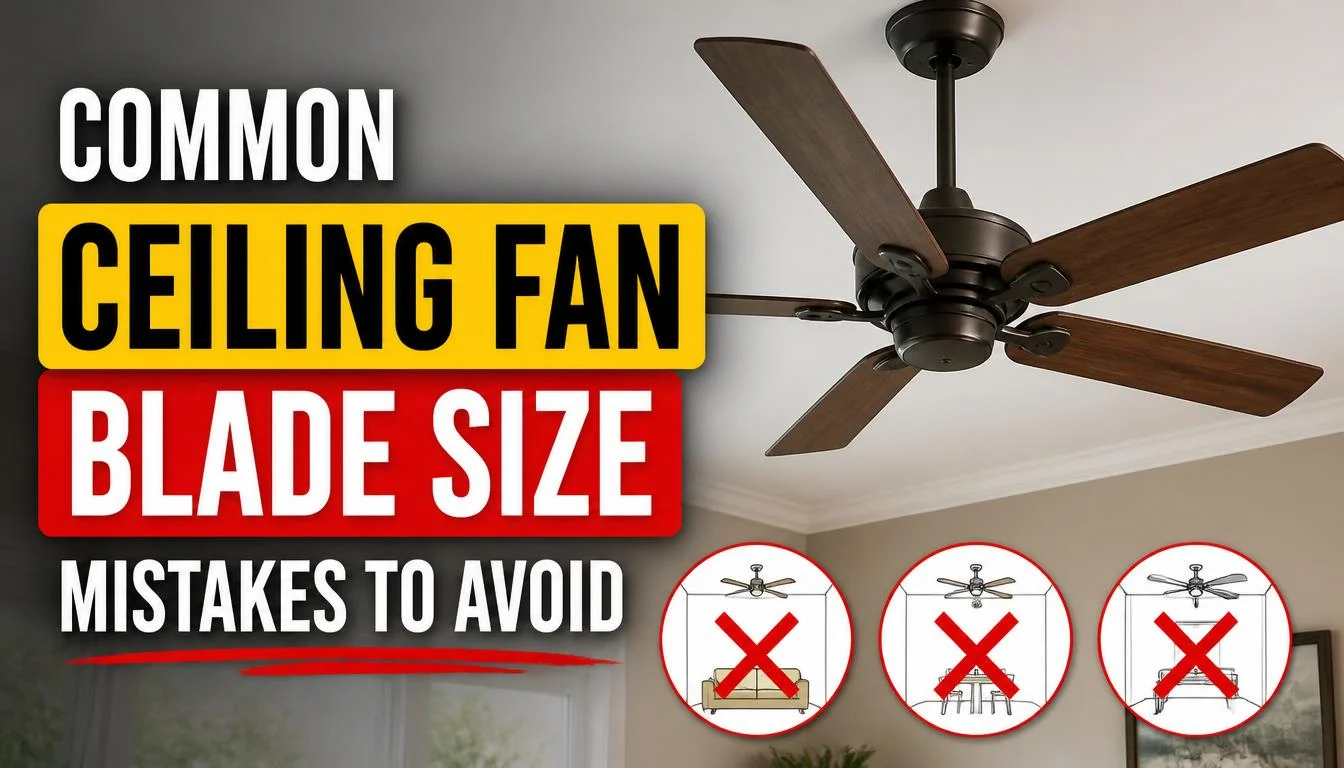
A few simple checks can prevent many sizing mistakes.
1. Confusing blade length with blade span.
A 52-inch fan does not have individual 52-inch blades. Check the manufacturer’s stated diameter.
2. Choosing a fan without measuring the room.
Estimate the floor area and compare it with a relevant sizing chart before buying.
3. Ignoring wall and fixture clearance.
Check the distance between the proposed blade tips and nearby walls, doors, lights, and other objects.
4. Assuming a larger fan is always better.
A larger fan may be suitable for a spacious room, but the correct choice depends on room layout, airflow needs, and comfort.
5. Choosing blades based only on appearance.
Blade shape and design matter, but compatibility, airflow, and motor performance matter too.
6. Replacing blades without checking compatibility.
Confirm the fan model, mounting pattern, and manufacturer’s requirements before installing replacement blades.
7. Forgetting regional measurements and installation guidance.
When comparing advice from different countries, convert the measurements carefully and consult the product instructions and applicable local requirements.
Frequently Asked Questions About Ceiling Fan Blade Size Guide
What Is the Standard Ceiling Fan Blade Size?
There is no single standard size for every room. Common residential fan sizes include 42, 44, 48, and 52 inches, while smaller and larger models are also available.
The right blade span depends on room area, layout, ceiling height, and the manufacturer’s recommendations.
How Do I Know What Size Ceiling Fan Blades I Need?
Measure the room’s length and width, calculate its floor area, and compare the result with a ceiling fan sizing chart.
If you are measuring an existing fan, measure its blade span from one blade tip to the opposite tip. If you need replacement blades, also check the fan model and mounting compatibility.
Is a 52-Inch Ceiling Fan Too Big for a Bedroom?
Not necessarily. A 52-inch fan may be suitable for a larger bedroom, depending on the room’s dimensions, ceiling height, and installation clearance.
It may be unnecessarily large for a compact room. Compare the room’s floor area with the manufacturer’s recommendations before making a decision.
Does Ceiling Fan Size Include the Motor Housing?
No. The stated ceiling fan size generally refers to the blade span across the rotating blade tips, not the width of the motor housing or the length of an individual blade.
Can I Put Longer Blades on My Existing Ceiling Fan?
Only if the manufacturer confirms that the replacement blades are compatible with your particular fan model.
Longer blades can change the balance and load of the rotating assembly. They can also create clearance problems. Do not assume that a fan can safely accommodate longer blades simply because they fit its mounting holes.
What Happens if My Ceiling Fan Is Too Big for the Room?
An oversized fan may look out of proportion, create stronger airflow than you prefer, or fail to provide adequate clearance.
However, a larger blade span is not automatically a problem. Check the room dimensions, mounting position, published performance, and manufacturer’s guidance before deciding whether the fan is unsuitable.
What Is the Best Ceiling Fan Blade Size for a Small Room?
For rooms up to approximately 75 square feet (7 m²), a 29–36-inch blade span is a useful starting point.
Always confirm the manufacturer’s sizing recommendations and make sure the fan can be installed safely.
How Much Space Should Be Between Ceiling Fan Blades and the Wall?
ENERGY STAR’s general guidance recommends at least 18 inches between the fan and the walls, while some manufacturers recommend greater clearance.
Check the installation manual for the exact model and allow enough space for doors, lights, furniture, and other nearby objects. Follow applicable local installation requirements.
Final Thoughts: Choose the Right Ceiling Fan Blade Size
Choosing the right ceiling fan blade size becomes much easier when you understand blade span, measure your room correctly, and consider the installation conditions.
Start by calculating the room’s floor area and using a sizing chart to identify a suitable range. Then check the ceiling height, wall clearance, published airflow ratings, and manufacturer recommendations before making your final decision.
If you are replacing an existing fan, confirm the model and replacement-blade compatibility rather than choosing by length alone.
Most importantly, do not focus on blade size in isolation. A fan that fits your room, circulates air comfortably, and can be installed safely is a better choice than one selected simply because it has the largest blades.

“The right fan can make a bigger difference than you think.”
Hi, I’m Michael Turner, an author and home appliance researcher at BestFanSolve.com.
My interest in fans started with a simple question: How do you know which fan is actually right for your needs? With so many types, features, brands, and technical specifications available, choosing a fan can quickly become confusing. I created BestFanSolve.com to make that process easier.
Through this website, I share practical fan reviews, buying guides, comparisons, troubleshooting tips, maintenance advice, and solutions to common fan problems. I focus on turning complicated product information into clear, useful guidance that everyday readers can actually understand and use.
Whether you’re searching for a quiet bedroom fan, a powerful fan for a large room, an energy-efficient option, or simply trying to figure out why your current fan isn’t working properly, my goal is to help you find the information you need before making a decision.
I believe good recommendations should be based on research, real-world considerations, honest pros and cons, and the specific needs of the user—not simply marketing claims.
Through BestFanSolve.com, I’m committed to helping readers find the right fan, solve common fan problems, and make smarter purchasing decisions with confidence.
— Michael Turner
Author & Home Appliance Researcher
BestFanSolve.com